





© ROOT-NATION.com - Use of content is permitted with a backlink.
OLED monitors have long moved beyond the purely gaming segment. Today, they are also used for professional work and as all-purpose displays. At the same time, their growing popularity has brought a wider range of OLED panel technologies to the market. As a result, choosing the right model has become more complicated than it may seem at first glance. Let’s take a closer look at how modern OLED panels differ, whether burn-in is still something to worry about in 2026, and for whom OLED offers a genuine advantage rather than just a marketing one.
TABLE OF CONTENTS:
What Types of OLED Panels Are There?
Despite sharing the “OLED” name, these displays are based on different technologies, which ultimately determine how accurately they reproduce colors, how bright they can get, how sharp small text appears, and how long the monitor is likely to last.
QD-OLED: Maximum Color and Brightness
QD-OLED combines blue OLED pixels with a quantum-dot layer that generates additional red and green light. The result is a very wide color gamut, high color saturation, and vivid HDR highlights that simply cannot look as impressive on other panel technologies.
This is why QD-OLED has become particularly common in flagship gaming monitors. It is well suited to modern AAA games, HDR content, as well as photo and video work where color accuracy is critical.
Over the past few years, the technology has gone through several generations. Early panels lagged somewhat behind competing technologies in peak brightness and text clarity, while newer versions offer higher brightness, improved subpixel layouts, and more effective algorithms for mitigating uneven pixel aging.

The ROG Strix OLED XG27AQDMES gaming monitor uses a third-generation QD-OLED panel. It offers better longevity than previous generations and significantly reduces flicker, even when the frame rate fluctuates. Another advantage is the Neo Proximity Sensor, which works together with the ROG OLED Care Pro software to switch the display to a dark state as soon as the user steps away. This provides an additional layer of protection against burn-in.
WOLED: Time-Tested Versatility
WOLED works somewhat differently: white OLED pixels are combined with color filters to produce the image. It is one of the oldest and most mature OLED technologies, with a strong track record in both TVs and monitors.
Modern WOLED panels deliver excellent contrast, true deep blacks, and fast response times. At the same time, recent generations have become brighter and better at rendering fine text, making them quite comfortable for everyday work as well.
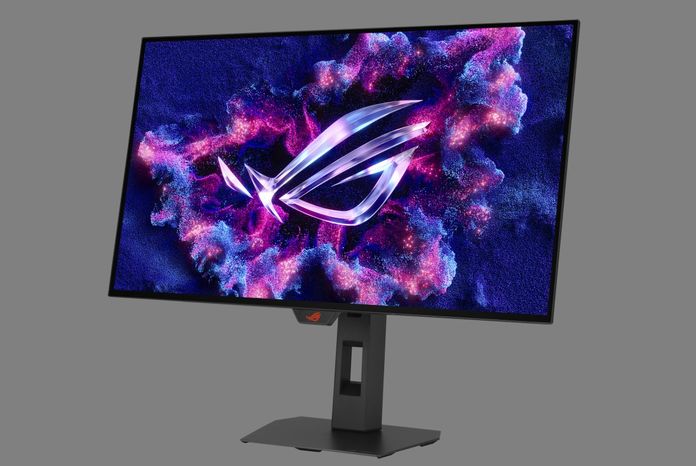
The ROG Strix OLED XG27AQDMG Gen2 (XG27AQDMGR) features a new TrueBlack Glossy™ panel with an anti-glare layer, designed to preserve deep blacks under different lighting conditions. Compared with previous glossy WOLED panels, it reduces reflections by 38%, making the monitor more comfortable to use even in a brightly lit room. For many users, WOLED remains the more versatile choice, offering a good balance for gaming, video content, and everyday work.
Tandem OLED: The Next Step
One of the newest directions in OLED technology is Tandem OLED, which uses multiple light-emitting layers instead of a single one. This design offers several advantages: higher brightness, lower stress on each individual layer, and, as a result, potentially longer panel lifespan. That is why Tandem OLED is considered one of the most promising OLED technologies for professional use.

The ROG Swift OLED PG27AQWP-G Edition 20 stands somewhat apart. It is an exclusive model created to celebrate ROG’s 20th anniversary. Through the semi-transparent black chassis, you can see the internal design, including details made from genuine 24-karat gold. It is a monitor that genuinely aims to be the centerpiece of a high-end setup.
OLED Generations: Why They Matter Too
When evaluating an OLED monitor, it is worth looking not only at the panel type but also at its generation. Early generations of OLED monitors were designed primarily for gaming. Over time, manufacturers have increased HDR brightness, improved compensation algorithms for uneven pixel aging, enhanced text clarity, and optimized power consumption.

Monitors based on the latest OLED generations are noticeably better suited to long hours of everyday use than their predecessors. This is particularly valuable for designers, programmers, and other professionals who spend most of their working day in front of a screen.
Is Burn-In Still a Concern in 2026?
Burn-in has long been the main argument against OLED. However, modern panels are significantly more resistant than the models of a few years ago.
First, the panels themselves have become more resistant to uneven aging. Second, cooling is playing an increasingly important role. Modern monitors may use more effective heat-spreading plates, graphene or graphite elements, and, in some cases, full-fledged heatsinks. The lower the panel’s operating temperature, the longer its expected lifespan.

The third component is software-based protection. ASUS OLED Care, for example, combines several mechanisms: automatic pixel shifting (Pixel Shift), pixel cleaning (Pixel Cleaning), brightness control for static elements, Windows taskbar detection, and dimming of logos and other stationary interface elements. This prevents static content from remaining at maximum brightness in the same area for extended periods – one of the main causes of uneven pixel aging.
Does this mean burn-in has disappeared as a phenomenon? No. You cannot override the underlying physics, and OLED still has its limitations. However, with normal day-to-day use and the built-in protection features enabled, burn-in is no longer the major deal-breaker it was considered to be several years ago.
When OLED Really Shines
Esports and fast-paced online games. OLED’s near-instant response time keeps the image sharp even during rapid camera movements. The difference is particularly noticeable in Counter-Strike 2, VALORANT, Apex Legends, and other competitive titles. The ROG Strix OLED XG27AQDNG is designed specifically for this type of player, offering a 360 Hz refresh rate and a 0.03 ms (GTG) response time for exceptionally smooth motion.

AAA games with HDR. In story-driven games, OLED highlights its biggest strengths: perfect blacks and virtually infinite contrast. Cyberpunk 2077, Alan Wake 2, and Pragmata can look noticeably more impressive on an OLED display. The ROG Swift OLED PG27AQWP-W uses a new Tandem OLED panel that delivers 15% higher peak brightness, 25% greater color volume, and 60% longer lifespan compared with the previous generation of WOLED panels.

Video editing and color grading. High contrast, accurate reproduction of dark scenes, and a wide color gamut make OLED a useful tool for HDR video, photography, and digital graphics. The ASUS ProArt Display OLED PA27USD, with 4K resolution, a built-in colorimeter, and color accuracy of ΔE < 1, is essentially a ready-to-use workstation for professionals who work with visual content every day.

Watching movies and TV shows. OLED can bring a more cinematic viewing experience to the home. The absence of backlight bleed and the high contrast are especially noticeable in a dark room, particularly on a large display. The 34-inch ROG Strix OLED XG34WCDMS, with RGB QD-OLED technology and a BlackShield coating, is designed specifically for this kind of immersive viewing experience.

An all-purpose workstation. If a single monitor needs to handle work, gaming, and multimedia, OLED delivers excellent image quality across virtually every scenario. That is why it is increasingly chosen by users who want one display without major compromises. A dual-mode feature, such as the one on the ROG Strix OLED XG32UCWMG, is particularly useful here, allowing users to switch between 4K for work and Full HD for competitive gaming.

Conclusion
In 2026, QD-OLED, WOLED, and Tandem OLED represent three different approaches, each with its own strengths. However, all three deliver a level of contrast, response time, and overall image quality that most LCD panels still struggle to match. Just as importantly, modern cooling systems and software such as ASUS OLED Care have significantly reduced the risk of burn-in.
Whether you are looking for a monitor for gaming, professional color work, or simply an all-purpose display, OLED is now one of the most compelling options on the market. This is especially true for models based on the latest generations of the technology.
Read also: ASUS ROG Strix OLED XG27AQWMG Review: 2K Tandem WOLED, TrueBlack Glossy, and 280 Hz

