





© ROOT-NATION.com - Use of content is permitted with a backlink.
On August 1, the Ukrainian book market was shaken by terrible news: a Russian attack destroyed the largest logistics hub of the RNK-Ranok publishing corporation in Kharkiv. The warehouse stored books and other products from the KnyhoLand bookstore chain, Ranok, Fabula, READBERRY, Korali Books, Shche Odnu Storinku, Varvar Publishing, and a number of other publishers that are also part of the RNK-Ranok group. A total of 8 million books were lost. The Root-Nation editorial team spoke with Ranok media manager Viktoriia Lysenko about the first days after the tragedy, the response from readers and partners, the estimated losses, the timeline for recovery, and the company’s plans for the future.
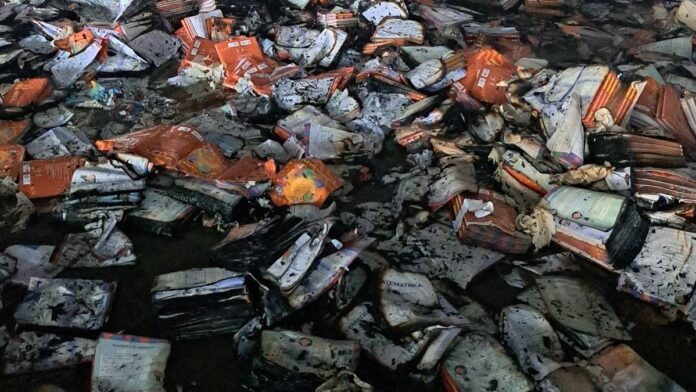

TABLE OF CONTENTS:
The First Days After the Strike
Root Nation: The strike on the warehouse came as a shock to the entire book industry and the wider book community. What did the team do in the first days after the strike, and which processes did you prioritize getting back up and running?
Viktoriia Lysenko: The first days after the strike were extremely difficult for the team. There were a lot of emotions, but there was practically no time to process them. We had to act. First of all, we needed to understand the actual scale of what had happened: what had been destroyed, what could be salvaged, and which books we could quickly put back into circulation. At the same time, we were thinking about our people and the safety of the team. The most important thing is that everyone was alive.
From the very first hours after the strike, RNK-Ranok founder Viktor Kruhlov spoke with media representatives and answered questions about the scale of the destruction, the area affected by the fire, and the overall situation. The following day, we established a crisis-management headquarters. We brought together people responsible for different areas and literally checked in every day, sometimes several times a day: what was happening, what needed to be done right away, where the biggest risks were, and what we could do to mitigate them.
The fire continued to burn. It was finally extinguished only on the seventh day, but we could not afford to wait. The Automated Logistics Center (ALC) was a major hub through which books from not only Ranok but also many other publishers passed. So the shutdown of the warehouse meant that a huge part of the supply chain would come to a halt.
We essentially had to rebuild the entire process from scratch: find storage for books arriving from printing houses, figure out how to receive and process orders on the official website and the KnyhoLand website, and work out how to ship books to customers, bookstores, and schools. At the same time, we were documenting the damage and losses.

The issue of textbooks was particularly urgent. Some print runs that were supposed to be delivered to schools within the next few weeks had been destroyed. And the start of the school year could not simply be postponed. So we immediately began looking for what could be reprinted and where, where to source the paper, how to restructure production schedules, and how to compensate for the losses as quickly as possible.
At the same time, we began discussing the situation and possible ways to provide assistance and support with our partners, other publishers, and international colleagues. We wrote to foreign authors and publishers, asked readers to pre-order books by their favorite authors, and set up donation envelopes. Even a publishing house as large as Ranok cannot deal with the consequences of an attack of this scale on its own. We truly appreciate how quickly we felt the support of the book community.
Supporting the team was another important priority. For our people, this was not simply a loss of property – they watched the results of many years of their work go up in flames. What helped us enormously was that all layouts, databases, and operational data were stored in the cloud. The physical books were destroyed and so was the warehouse, but our knowledge, experience, and intellectual capital remained intact.

Root Nation: How is logistics and the storage of the surviving print runs organized now? Did you consider relocating your warehouse operations to safer regions?
Viktoriia Lysenko: Since 2022, and well before the attack, we had already begun operating under a distributed model. Some of our books were stored in backup warehouses in other cities. Company data was duplicated and stored in the cloud and across several servers. Ranok publications are printed at 14 printing houses located in different regions of Ukraine. So, while we lost 70% of our inventory, we did not lose the company. We were able to resume some shipments from our backup warehouses. The delivery of textbooks to school libraries from these warehouses never stopped, not even for an hour.
As for sales, all of our online stores are operating, although with a limited range of products. Orders are being shipped from our backup warehouses, and the business continues to operate. Order processing and delivery times have increased, but we hope our readers will understand.
This attack showed that there is no longer any completely safe place in Ukraine. We cannot keep our entire stock of books, paper, or finished products in a single location. Instead of one large facility, we will build a network of smaller warehouses. At the same time, we need a centralized fulfillment facility so that a distributed system does not result in slower deliveries. This approach is more expensive and more difficult to manage, but after August 1, we can no longer evaluate logistics solely in terms of cost efficiency. We need to assess whether the company will be able to keep operating after one of its facilities is hit.

Relocation does not solve the key challenges faced by a large publishing house. A government program can help move a business, find suitable premises, or relocate equipment. But it cannot relocate the entire book-publishing ecosystem. Ranok is one of Ukraine’s largest publishing houses, and it is not just an office or a warehouse. It includes editorial teams, authors, printing companies, logistics, tens of thousands of square meters of storage space, and millions of books in circulation.
The country’s largest printing facilities have historically been based in Kharkiv. Around 70% of all Ukrainian books are printed here. You simply cannot relocate these printing facilities overnight. The Automated Logistics Center was a huge warehouse built to European standards. It used advanced technologies for the rapid sorting, tracking, storage, and processing of large volumes of books, as well as dedicated terminals for loading trucks. This was not some small piece of industrial equipment – it was a huge-scale facility, essentially a factory in its own right.
Even if we relocated completely, paper would still have to be transported from Europe, while large print runs would still need to be produced at Ukrainian printing facilities, many of which are located in Kharkiv. Textbooks also need to be delivered quickly across the country. Splitting production between facilities in different cities would significantly increase both production costs and lead times. In addition, relocation does not solve the issues related to financing, war-risk insurance, or paper supplies.

That is why our solution is not to move the entire warehouse operation from one large facility to another, but to build a distributed system. This means several smaller warehouses in different regions, diversified logistics routes, and avoiding the concentration of a critical portion of our inventory in a single location. This model is more expensive and more difficult to manage, but during wartime, it is the more responsible approach. The war has taught us that resilience means being able to lose one element after an attack while keeping the entire system operational.
On the Consequences of the Attack and Recovery
Root Nation: Recovery will require enormous resources. Are there any joint initiatives with charitable foundations planned to accelerate Ranok’s reconstruction? Or perhaps there are grant programs available?
Viktoriia Lysenko: Yes, we are exploring every possible avenue for recovery, and we certainly do not expect to be able to accomplish this on our own. The scale of the losses is such that it requires pooling resources – ours, those of our partners, charitable organizations, and international institutions. Following the attack, the Ranok-Ukraine Charitable Foundation launched a fundraising campaign to help mitigate the consequences of the attack and restore the lost print runs. We are also reaching out to Ukrainian and international foundations, publishing associations, and partner organizations. We have already compiled a list of around 50 international institutions with which we are either already communicating or planning to establish contact.
Some of these opportunities will be aimed not simply at compensating for the lost books, but at rebuilding the infrastructure itself – logistics, warehouse facilities, equipment, energy systems, and backup systems. And here it is important to distinguish between two separate tasks. The first is to deal with the consequences of the attack and restore operations now. The second is to build a system that will be more resilient to the challenges ahead. It is the second one that we need.

So we are considering grants for equipment recovery, war-damage compensation programs, partner financing, prepayments, and charitable fundraising campaigns. But the scale of the problem needs to be understood: existing grant instruments may help cover the purchase of some equipment, but they cannot compensate for the loss of nearly UAH 1 billion worth of book inventory.
Textbooks are a separate issue. They were printed for the government at minimal margins, so what is needed here is a systemic government solution: a special preferential fund, financing for reprints, or another mechanism for sharing wartime risks. A publishing house cannot bear the entire burden of reprinting state-ordered textbooks on its own.

We would like to take this opportunity to thank everyone who has reached out and offered support. For us, it was not just financial assistance. It was a signal that we are not alone and that the Ukrainian book industry is standing together. That is why we are open to joint projects with charitable foundations, international donors, publishers, and businesses. If there is an opportunity to do more than simply address today’s problem and instead help rebuild Ukraine’s book infrastructure, we are ready to talk to anyone who wants to contribute. Because restoring Ranok is not just about one business. It is about ensuring that Ukrainian books can continue to be printed, stored, and reach their readers.
Root Nation: Have you calculated the total losses yet?
Viktoriia Lysenko: So far, we have only made preliminary estimates. Around 8 million books were destroyed – approximately 70% of our entire inventory, covering around 28,000 titles. The cost of the destroyed books was nearly UAH 1 billion at cost price. This is comparable to the annual turnover of the entire corporation. As for the books, this includes titles published by brands that are part of the RNK-Ranok corporate group, as well as by publishers that worked with the Knyholend bookstore chain, which has 250 suppliers. Books from publishers outside the corporation accounted for approximately one-tenth of the total. The remaining 6.2–6.6 million books were commercial titles published by the corporation’s brands: Ranok, Readberry, Fabula, Korali Books, Osnovy, Zhorzh, Shche Odnu Storinku, Varvar Publishing, Kenguru, Svoie, and 4mamas.
Of the total number of books destroyed, 620,000 were school textbooks published by Ranok for grades 4, 6, 7, 8, and 9. We are calculating the cost of the destroyed Automated Logistics Center and its equipment separately. By the most conservative estimate, the loss is at least $5.5 million, which was the amount invested when the facility was built. If we were to build it today, the cost would be higher.

The final losses will be higher, as they will also include the cost of reprinting, purchasing paper, establishing new logistics, renting facilities, lost sales, and legally documenting the consequences of the attack. Based on our current estimate, full recovery could take three to five years.
On supporting readers and authors
Root Nation: How have overseas partners or authors with whom the publishing houses belonging to the ‘Ranok’ corporation collaborate reacted to this tragedy?
Viktoria Lysenko: We have received a huge number of messages from authors, rights holders, literary agents and publishing partners. Many have gone beyond mere words of support: partners are willing to discuss deferrals of payments and royalties, provide information assistance and organise joint campaigns. Foreign authors have shown their support by posting updates about the attack on our ALC, particularly those whose books are published by VARVAR Publishing – Robert Rath (author of *The Uncountable and the Harbinger* (Warhammer)) and Charles Soule (Star Wars).
A particularly telling example is Polish writer Joanna W. Gajzler, author of Nekrovet. She donated all royalties from the Ukrainian edition of her book to Zhorzh, whose print runs were also destroyed in our logistics center.
Another Polish author, Jakub Ćwiek, offered to transfer the rights to one of his books free of charge. These gestures from authors clearly demonstrate how interconnected the book ecosystem is and how a single Russian attack caused losses for numerous Ukrainian publishers at once.

Root Nation: How did the reading community respond? Did you see a noticeable increase in e-book sales or pre-orders?
Viktoriia Lysenko: After we called on readers to buy print books, pre-order new releases, and purchase e-books, the response was incredible. As early as August 2–3, we saw sales at the Knyholend bookstore chain increase two- to threefold. People were deliberately buying Ranok books, spreading information about what had happened, making donations, and placing pre-orders. In many bookstores, our print editions sold out very quickly.
For us, this was a tremendous source of support. Because behind every book purchased at that time, we saw not simply a sale, but a desire to help us weather the crisis and keep working. Pre-orders are particularly important right now. They allow us to receive funds before a print run is released and use them for paper, printing, and the restoration of a specific book. In other words, readers are effectively investing in bringing that book back to the shelves.

There is also interest in digital formats. However, it would be premature to cite figures that are not yet representative. We need a little more time to understand where we saw an emotional response to the event and where new, long-term reading habits are beginning to take shape. But we saw the most important thing immediately: people did not turn away from Ukrainian books. On the contrary, at the moment when we were facing our greatest difficulties, they showed us that books matter to them.
Root Nation: Do you plan to expand the range of e-books or audiobooks as an alternative to physical copies?
Viktoriia Lysenko: We will definitely be expanding our digital publishing efforts. Some books whose print runs we cannot restore in the near future because of the losses will be made available to readers in digital formats. This will allow people not to wait for months if they need a particular book now.
For educational literature, digital versions and supplementary materials can also help address situations where a print run is temporarily delayed. However, we do not see digital formats as a replacement for print. We will develop audiobooks selectively, depending on rights, demand, and production costs. A good audiobook is a separate product, and simply reading the text aloud is not enough.
Right now, we do not need to choose between print and digital books. Our goal is to make Ukrainian books available in different formats. But print books are not going anywhere, especially when it comes to children’s reading and education. In these areas, their role goes far beyond simply providing a way to read a text.
Restoring Print Runs and Supplying Schools
Root Nation: The destruction of such a large number of copies affects the market. Have you compiled a list of the most important or most in-demand titles that need to be reprinted first?
Viktoriia Lysenko: Yes, we have prioritized the publications. The absolute and non-negotiable priority is textbooks. Seven Ukrainian printing houses have already agreed to urgently reprint 620,000 copies. Next comes Category A: the most in-demand educational, children’s, and fiction titles, books with active pre-orders, as well as titles for which we have important commitments to readers, authors, and partners. Publications in Categories B and C are being assessed separately.
We physically will not be able to quickly restore all of the approximately 28,000 destroyed titles. Under our preliminary plan, we will reprint roughly one-third of them over the next two years, focusing first on the titles readers need most. Some of the backlist will remain available in digital formats.
The exact list of commercial titles is constantly being updated based on demand, pre-orders, rights availability, paper supplies, and available printing capacity. So we will not name individual books or authors until we can confirm an actual printing date.

Root Nation: A batch of textbooks that was supposed to be delivered to schools the following day was destroyed in the warehouse. How will this loss affect the supply of educational and children’s literature to schools and readers?
Viktoriia Lysenko: This is the most painful issue because these are textbooks for grades 4 and 9 under the new curricula. They cannot simply be replaced with older editions. Some of these print runs had already been affected during a previous Russian attack on the Konvi Print publishing facility. We reprinted them, and now they have been destroyed in the warehouse. In other words, some textbooks now have to be printed for essentially the third time.

Some of the print runs had already been delivered to regional warehouses before the attack, so shipments to schools did not stop. According to our initial assessment, approximately 75% of schools were expected to receive their printed textbooks on time, while 20–25% faced a risk of delays. Now, seven printing houses have taken on the urgent reprinting of 620,000 copies. Our goal is to make up for the losses as much as possible during September.
All the necessary digital versions are available, so even if a printed copy is delayed, the educational process can still begin. However, having a digital file does not relieve us of our responsibility to deliver actual textbooks to children. The restoration of some children’s and educational titles may take longer because school textbooks are being given priority access to printing capacity. However, we are not abandoning these titles and will gradually bring them back into circulation.
Root Nation: Did you have to postpone any planned new releases in order to free up resources to restore the lost print runs?
Viktoriia Lysenko: Yes, we had to revise our publishing plans. But that does not mean we have put new releases on hold. We have simply reprioritized them. Right now, the main priority is to restore what was lost, especially educational literature that children need at the very beginning of the school year. Some of the resources we had planned to allocate to new projects had to be redirected toward reprinting destroyed editions, logistics, and rebuilding our inventory.
We have indeed postponed some new releases. In some cases, we have adjusted print runs; in others, we have revised production schedules. But we cannot stop publishing new books altogether. The publishing house has to keep operating, otherwise we will gradually lose not only what was destroyed but also our future.
New books are not only part of our mission – they also generate the working capital that helps finance the recovery. So we will try to preserve the release schedules for titles that are nearly ready, highly anticipated, or already have pre-orders, while postponing less urgent projects if necessary.

At this point, our approach is straightforward: we are restoring what is critically necessary without putting further development on hold. Books that are already waiting to reach their readers should be published. However, under the changed circumstances, we need to be considerably more flexible and more deliberate in how we allocate each available resource. Each editorial team/publisher will provide specific updates on release dates for upcoming titles once printing schedules have been confirmed.
“You can burn millions of books. But you cannot burn knowledge.”
Root Nation: What gives your team the strength to keep working and publishing books despite Russia’s ongoing aggression?
Viktoriia Lysenko: First and foremost, it is people. Our team came together the very next day after the strike and started thinking not about what we had lost, but about what we would do next. Our readers, who continue to buy books, place pre-orders, and support us. Printing companies that find ways to quickly print what we need at the moment. Authors, partners, and colleagues from Ukraine and other countries who call and ask not only, “How are you?” but also, “What can we do?”
That gives the team a great deal of strength.
We understand very well why Russia targets books, schools, publishing houses, and warehouses. It is not a coincidence. When a book is destroyed, the aim is not to destroy paper. The aim is to deprive Ukrainians of knowledge, memory, language, and the ability to tell their own story. If we stop publishing books, the aggressor will achieve exactly the result it seeks. That is why, for us, continuing to publish books is neither an act of heroism nor a catchy slogan. It is our work. And it is our responsibility to children, readers, authors, and the entire team.
A warehouse can be destroyed. Millions of books can be burned. But knowledge cannot be burned. And the desire to read, learn, and create something of one’s own cannot be destroyed.
And we will rebuild Ranok. Because after every night comes morning.
Read also: All book and comic reviews on RN

