






© ROOT-NATION.com - Use of content is permitted with a backlink.
Mysterious and invisible dark matter, which, according to estimates by space researchers, accounts for about 85% of the total mass of the universe, does not interact with light at all. Scientists infer its presence solely based on how it affects visible celestial objects. However, a group of researchers from China now claims to have recorded the most direct evidence of dark matter’s existence in history.
According to a paper published in the scientific journal *Physical Review Letters*, astrophysicists representing the Chinese Academy of Sciences detected a distinct gamma-ray burst while analyzing data collected by the Fermi Gamma-ray Space Telescope (FGST) over 15.5 years of operation. The authors of the study claim that this burst serves as clear confirmation of the prevailing hypothesis, according to which dark matter is composed of weakly interacting massive particles (WIMPs). Such a gamma-ray signal is precisely the effect that should occur during the collision and mutual annihilation of these particles.
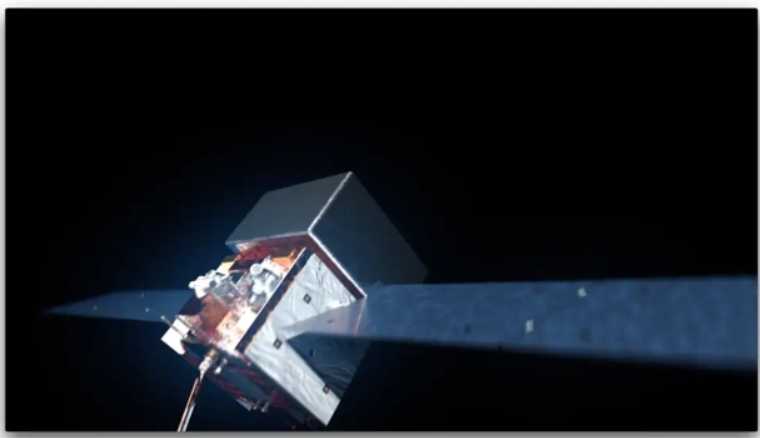
The detection of such a distinct gamma-ray line could provide decisive evidence that would unequivocally confirm the existence of dark matter particles and reveal their properties in the context of subatomic physics.
Gamma rays are among the most powerful forms of radiation in space and are of key interest in the search for dark matter, especially for proponents of the WIMP concept. WIMPs interact extremely weakly with electromagnetic and nuclear forces, making it impossible to detect them using light or by observing their interactions with ordinary matter. At the same time, collisions between WIMPs are thought to produce a specific type of gamma radiation, which serves as their signature.

The appearance of a powerful source of gamma rays of unknown origin naturally leads some scientists to consider the involvement of dark matter. At the very least, this recent study is far from the first of its kind. Last year, another group of experts argued that the gamma-ray emission at the center of our galaxy is caused precisely by dark matter. Just one month later, another researcher claimed that WIMPs were responsible for another atypical gamma-ray signal, also detected in the FGST data.
Despite this, it is extremely difficult to definitively prove the nature of such gamma-ray evidence. In the history of astronomy, there have been instances where potential dark matter signals were later found to be ordinary equipment malfunctions. Furthermore, only a few galaxy clusters were observed during the study, so it is possible that this particular cluster was simply an anomaly.

However, the authors emphasize in their paper that their calculations of the signal-to-noise ratio cast doubt on the assumption of an instrumental error. In any case, given the exceptional clarity and distinctiveness of this burst, studying its physical origin is extremely valuable to science, the researchers add.
It is also important to note that this research group is not the only one detecting such hard-to-explain gamma-ray signals. The FGST telescope continues to operate and will double its data set by 2040. Furthermore, international space agencies plan to launch new gamma-ray telescopes into orbit over the next four years, so it is entirely possible that gamma-ray radiation will be the first bridge connecting humanity to dark matter.
Read also: Through Nuclear Fire: Trinitite – A Material That Should Not Exist