





© ROOT-NATION.com - Use of content is permitted with a backlink.
TABLE OF CONTENTS:
ESP32 vs Arduino 2025: The platform war that will change everything
Hello, electronics fans!
Make yourself comfortable, because today we will analyze one of the hottest confrontations in the world of microcontrollers – the moment when a young, ambitious predator tries to dethrone an old king. And it’s not just that…. it’s much more dramatic!
Act one: The coup of the century that no one expected
Picture this: October 2025. Qualcomm – the same guys who make the chips in your smartphone – walks into a pub where Arduino is having a cocktail with its army of 33 million users and declares: “Game over. You’re mine!”
Yes, you read that right: Qualcomm bought Arduino.
And here is the first fruit of this union – the Arduino UNO Q for a ridiculous $44. Do you know what UNO Q can do? It runs on Linux and has hardware acceleration for AI. That is, you give it a command to recognize an object, and it deploys a neural network as if it were a regular blink.ino sketch
But there’s a nuance.
Act two: Parallel reality (or how I went crazy over prices)
Look, I’ve been tinkering with electronics for 10 years now, and it still hurts to admit it:
ESP32 costs $5-10 and does much more than Arduino UNO R4 for $20-25.
It’s like going to a restaurant, ordering plain rice, and being served rice, sushi, and crème brûlée. And this is not a mistake!
Let’s break it down:
- ESP32 DEVKIT V1 is like buying a hipster food truck for the price of a hot dog.
- Arduino UNO is like paying for a brand.
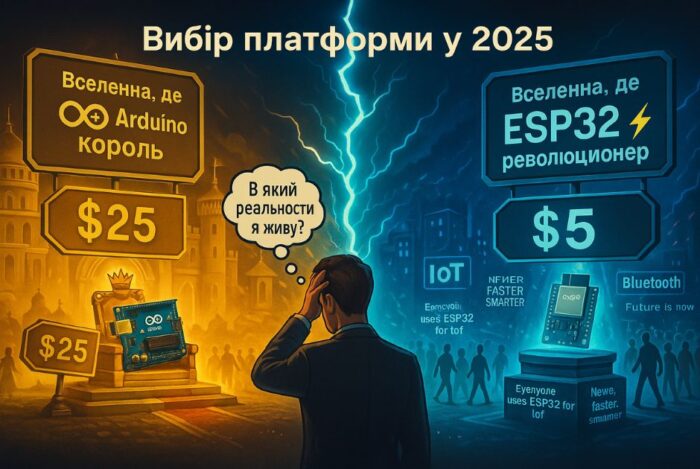
Why is that? People often pay for a story, not a product. Arduino is the king of the community, and ESP32 is a revolutionary with everything to come.
Act three: The choice is clear
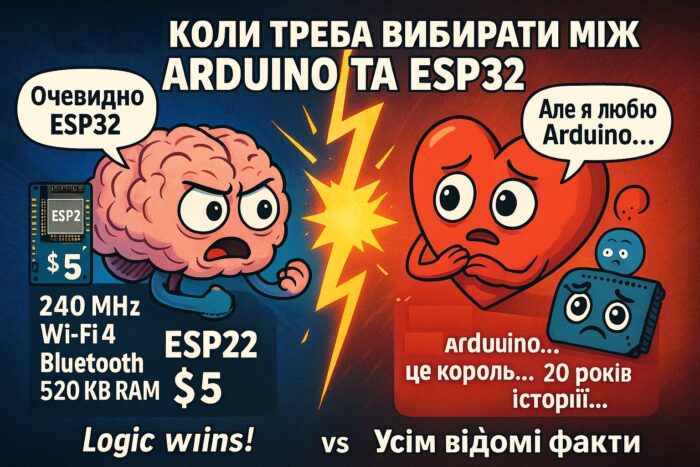
And now for the most interesting part – the technical specifications. Without further ado, the numbers speak for themselves:
Processor:
- Arduino Uno: 1 core, 16 MHz (like an old Volkswagen Polo).
- ESP32: 2 cores, 240 MHz (like a BMW M4 from a mafia garage).
RAM:
- Arduino: 2 KB (yes, only TWO KILOBYTES).
- ESP32: 520 KB.
That is, if the Arduino Uno is a 4-page notebook, then the ESP32 is a whole encyclopedia. The difference? 260 times! It’s like comparing the memory of a 2025 smartphone to a 1995 Nokia 3310 that your dad used to send SMS.
Flash memory:
- Arduino: 32 KB.
- ESP32: 4 MB.
Again: 125 times more. ESP32 can store an entire library, while Arduino can only store a few photos of a swan.
Act four: The wireless revolution
Here Arduino just stayed in the shadows.
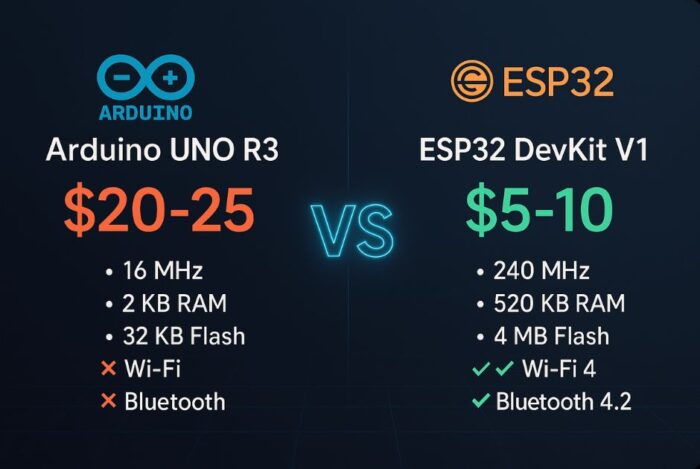
The ESP32 has built-in Wi-Fi 4 and Bluetooth BLE 4.2. Arduino UNO? It hasn’t even heard of the Internet. It’s like a wise man in a cave – wise, but cut off from the world. Want Wi-Fi on your Arduino? Buy a separate shield for $15-20.
It’s like ordering a pizza and then paying extra to have cheese on it.
Here’s a sign to illustrate:
| Parameter | Arduino UNO R4 | ESP32 | ESP32-C6 | The winner |
|---|---|---|---|---|
| Speed | 48 MHz | 240 MHz | 160 MHz | ESP32 (5 times faster!) |
| Wi-Fi | ❌ Requires a shield | ✅ Wi-Fi 4 | ✅ Wi-Fi 6 (!) | ESP32-C6 |
| Bluetooth | ❌ | ✅ BLE 4.2 | ✅ BLE 5.3 | ESP32-C6 |
| AI acceleration | ❌ | ❌ (but available in ESP32-S3!) | ❌ | ESP32-S3 |
| Price | $20-25 | $5-10 | $10-15 | ESP32 |
| GPIO pins | 14 | 34 | 30 | ESP32-S3 (45) |
Look at this table – it’s like a sniper’s shot. Even against the ESP32-C6 (which is newer and more expensive), the Arduino looks like an old friend you found on social media and realized was stuck in the 2010s.
Act Five: What is this all about in real life?
Now the main question is: when to choose what?
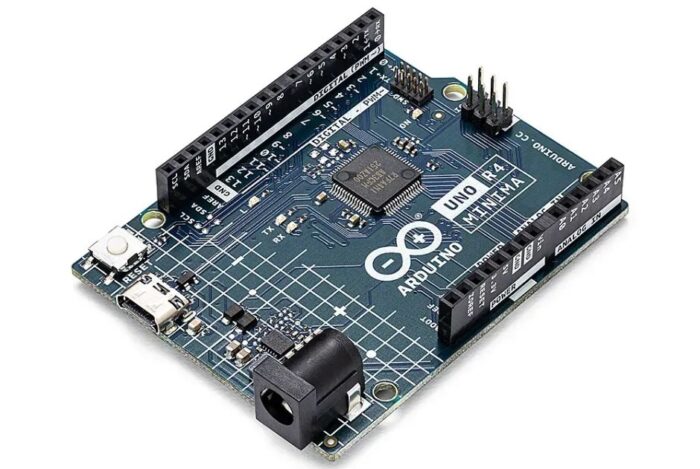
Arduino is your choice if:
- ✅ You are an absolute beginner (even your grandmother can figure out Arduino).
- ✅ You need 5V logic (most old sensors are just like that).
- ✅ You like the ecosystem with a thousand shills.
- ✅ You are studying at school (Arduino is already taught as a driving lesson).
- ✅ You need stability (20 years on the market is no joke).
Arduino is NOT your choice if:
- ❌ You need Wi-Fi/Bluetooth.
- ❌ You have a limited budget.
- ❌ You want to build an IoT project.
- ❌ You need AI processing.
- ❌ You want to connect a camera.

ESP32 is your king if:
- ✅ It is an IoT project (this is its element).
- ✅ Smart home (Alexa, Google Home – it’s their friend).
- ✅ Limited budget (4 ESP32s for the price of one Arduino).
- ✅ AI on the device (ESP32-S3 is your option).
- ✅ Projects with a camera (ESP32-CAM works wonders).
- ✅ Matter/Thread for the smart home (it’s ready for the future).
ESP32 is not for you if:
- ❌ You like to procrastinate and are afraid of complications.
- ❌ You need 5V logic (ESP32 works on 3.3V).
- ❌ You collect old Arduino shields.
Act six: Projects that will change your life
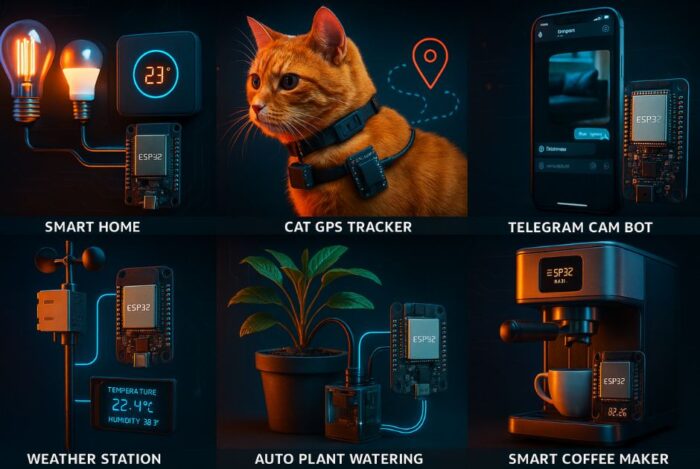
Theory is great, but life starts with practice. Here’s what people are doing with these boards in 2025:
They’re doing miracles with ESP32:
- Smart home with Google – control lights, relays, temperature with a single voice command.
- GPS tracker for your cat – so that your furry touring companion doesn’t get lost.
- Voice robot – control with gestures or voice (like in science fiction movies).
- IoT weather station – weather directly to your phone.
- Telegram bot with a camera – a security system that writes to you on Telegram.
- Automatic watering of plants – your flowers live better than you.
- Smart coffee maker – coffee brews itself while you sleep.
- Smart fish feeder – fish are fed on schedule.
- Crypto wallet – OLED display and real-time exchange rates.
- Automatic greenhouse – climate control, like on a space station.
The Arduino is a classic:
- LED effects (animation, like on a Christmas tree).
- Linear robots (robotics for children).
- Sensor projects (sensors, sensors, and more sensors).
- MIDI controllers (for musicians).
- 3D printers (controllers for RepRap).
- Drones (if you have a specialist).
- CNC machines (for those who love wood and metal).
Do you see the difference? Arduino means “do your homework”, ESP32 means “change the world”.
Act Seven: Numbers that tell the truth
Let’s take a look at the statistics:
Arduino:
- 33+ million users (more than the population of some countries).
- Market in 2025: $815 million.
- Forecast for 2032: $2.5 billion (10% growth per year).
- 50%+ of projects use Arduino UNO.
- North America buys 38% of Arduino, Europe – 26%.
IoT ecosystem:
- 2023: 16 billion IoT devices.
- Forecast for 2025: 40 billion (IoT is growing like a weed).
This means that people need Internet-enabled devices. And this is the ESP32 zone.
Act eight: New products in 2025 that change the game
Wondering what to buy right now? Here are the latest ESP32 models:
- ESP32-S3 (2020, but still top of the line) – AI acceleration, 45 GPIO, camera support. For face recognition and voice assistants. Price: $8-12.
- ESP32-C3 (2020) – cheap, secure, RISC-V processor. For budget IoT and sensors. Price: $4-6.
- ESP32-C6 (2021) – Wi-Fi 6 and Thread/Zigbee. The future of smart home with Matter. Price: $10-15.
- ESP32-C5 (2023) – the first ESP32 with 5GHz Wi-Fi 6. For high-speed IoT. Price: $12-18.
- ESP32-H2 (2022) – without Wi-Fi, but with Thread/Zigbee. For mesh networks and low consumption. Price: $6-10.
- ESP32-P4 (2024) – 400 MHz, dual-core, H.264, MIPI. For AI and video. Price: $15-25.
Espressif (the manufacturer of ESP32) simply churns out new products like a conveyor belt. And Arduino and Qualcomm are preparing their response…
Act nine: What happens next?
Arduino UNO Q from Qualcomm is a dark horse that everyone is watching:
- Linux + MCU in one package.
- Access to Qualcomm Snapdragon chips.
- Focus on AI and robotics.
- Maintaining an open-source approach.
It’s like your old friend Arduino went to Harvard for an internship and came back smarter.
ESP32 is not sleeping either. Espressif is cooking:
- More models with Wi-Fi 6 and Matter.
- ESP32-C5 with dual-band Wi-Fi (2.4 + 5 GHz).
- Edge AI (AI processing on the device).
- Even lower power consumption (battery will last for months).
On the horizon:
- Merger of Arduino and ESP32 ecosystems.
- Greater compatibility between platforms.
- Matter/Thread will become a smart home standard.
- Edge AI will be as familiar as the power button.
Act ten: An honest conversation about choices
Golden Rule 2025:
- IoT, Wi-Fi, AI, camera → ESP32. Full stop.
- Areyou a beginner and need simplicity? → Arduino. Easier, more tutorials, the community will hug you like a family member.
- Need stability for years? → Arduino. 20 years of history is an ironclad guarantee.
- Professional, industrial automation? → Arduino Pro or ESP32 (depending on the task).
- Do you want everything at once? → Both! Arduino IDE works for both, the code is almost the same.
Epilogue: The big picture
What has changed in the last 12 months?
Qualcomm bought Arduino and said: “Old King, let’s conquer the world together!” Arduino replies: “Okay, but I like my shields and my community.” Qualcomm: “No problem, here are the chips, just like in the iPhone.”
ESP32 sits in ambush, smiles, and says: “I’m already king here.”
The result: more innovation, more choice, more opportunities for your projects.
If you’re a beginner, start with Arduino – it’s the cradle of electronics. An LED, a button, a sensor… and then you’ll want Wi-Fi. Welcome to the world of ESP32!
If you’re already “in the know,” run to the ESP32. It’s waiting with Wi-Fi, Bluetooth, and an army of features.
And anyway, thank you Arduino for teaching millions of people about soldering, resistors, and that magical moment when an LED lights up for the first time
Conclusion:
- ESP32 is the king of IoT, speed, and price.
- Arduino is the father of electronics, the teacher of millions, the heart of the community.
- Qualcomm + Arduino = a new era begins.
- The world of electronics is being rewritten.
The choice is yours. All doors are open!

, and what to choose for your project. Qualcomm has bought Arduino.)