





© ROOT-NATION.com - Use of content is permitted with a backlink.
Let’s be honest. You’ve probably never really thought about a screwdriver. It just sits in your drawer – maybe a little rusty, maybe with a chipped handle. But the story of this simple piece of metal is surprisingly dramatic. It involves medieval castles, ambitious millionaires, industrial espionage, and even life-saving technologies.
TABLE OF CONTENTS:
One Tool, 500 Years, 4 Revolutions: A History You’ve Never Heard
Today, we’re looking back over half a millennium. From the time when the screwdriver was literally a weapon, to the point where it has become smarter than some people you know. Ready? Let’s go back to the year 1480.
Episode 1: Knight, Musket, and the “Twisting Tool”
Imagine Germany at the end of the 15th century. Wolfegg Castle. You’re a knight. You need to remove your helmet after a tournament – because, well, nature calls – but you can’t. Your squire has lost the “tool.”
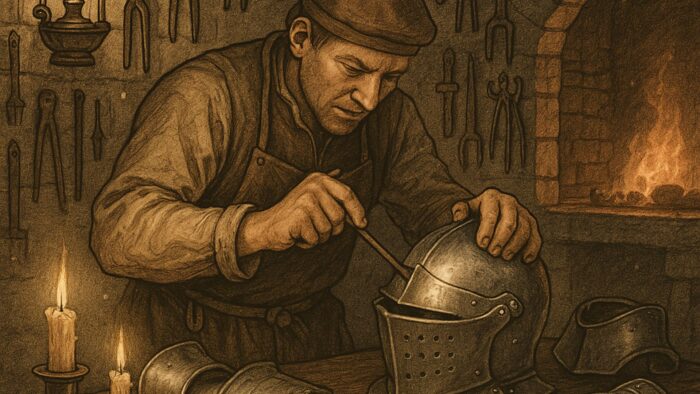
It was in the medieval household records of Wolfegg Castle (1475–1490) that historians found the first depiction of a screwdriver. At the time, it resembled a torture device more than a tool and was called not a “screwdriver” but a “turnscrew.”
What was it used for?
- To tighten screws on the most expensive suits of armor.
- To disassemble matchlock muskets.
Early screwdrivers were essentially elite military tools, and screws were handmade. In 1537, Nuremberg even passed a law specifying that a musket screw must have exactly five turns. Germans and standards – some things never change.
Episode 2: 400 Years of Struggle and the “Flat Slot”
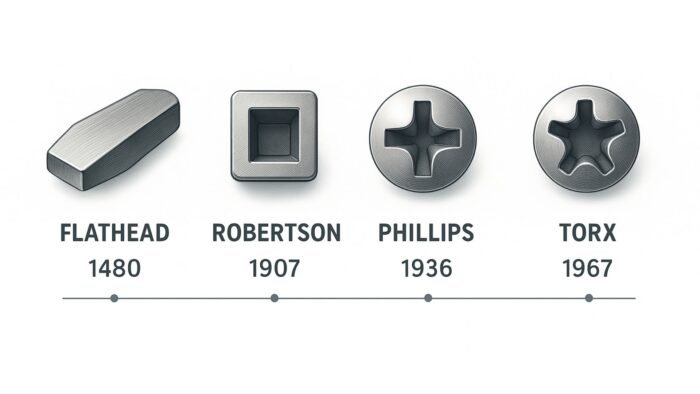
For the next four centuries, humanity lived with a single type of screwdriver – the flathead.
You know the feeling: you turn, the screwdriver slips, scratches the metal, and jabs your finger. Blood, cursing, ruined parts. Why? Because the flat slot was designed in an era when precision was measured “by eye.”
In the 18th century, things improved somewhat – Henry Maudslay invented accurate lathes. But the problem persisted: the screwdriver still tended to slip out of the screw.
Episode 3: How Ego Killed the Perfect Screwdriver (The Robertson Case)
The early 20th century. The automotive boom. Assembly lines. In 1907, Canadian inventor Peter Robertson made a breakthrough: he created the square-socket screw.
It was nearly perfect. The screwdriver fit the square like a glove. Screws could be tightened with one hand, even with your eyes closed. Fisher Body immediately adopted them for Ford Model T bodies. The time savings were enormous.
Then Henry Ford, the capitalist shark, approached Robertson: “I want exclusive rights to this invention in the U.S.”
Robertson replied: “No. I’ll manufacture them myself.”
Ford: “Fine, then goodbye.”

Ford turned down the best screw in history for business reasons. The square socket remained a niche product – though Canadians still swear by it. The world was ready for a different hero.
Episode 4: Henry Phillips and “The Bug That Became a Feature”
The 1930s. Henry Phillips enters the scene. He bought the patent for the crosshead (Phillips) screwdriver.
It had one characteristic engineers initially saw as a flaw: if too much force was applied, the screwdriver would cam out of the screw. This is known as the cam-out effect.
For automakers like General Motors, it turned out to be a lifesaver. Assembly line workers’ machines had no sense of restraint and often stripped screws by over-tightening. The Phillips screwdriver automatically slipped out when the screw was fully seated.
It wasn’t a mistake – it was foolproofing. This is how the PH standard, now found in almost every household, was born.
Episode 5: The Age of Electricity and the Final Boss
In the second half of the 20th century, the Torx (star-shaped) drive appeared – an option designed for robots that could already control torque precisely. But for ordinary users, a new problem emerged.
The classic steel screwdriver your grandfather used can be dangerous in 2025. If you stick it into a socket or an electrical panel, the metal will conduct 220 volts straight through you and into the ground.

Evolution needed to take the final step: from mechanics to electronics, from simple turning to diagnostics.
The Peak of Evolution: ANENG B05
We’ve come a long way – from bone handles and forged iron to advanced polymers. Today, we have the ANENG B05 voltage tester screwdriver. It’s the great-grandchild of that first screwdriver from the German castle, but now with “higher education.”
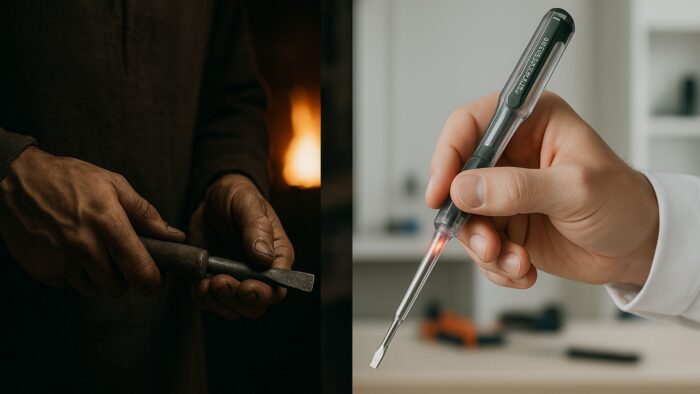
Why would a medieval armorer give their soul for this tool?
- It reveals the invisible. Touch a contact, and it lights up if there’s danger (live wire). No more guessing or poking with your finger.
- It locates breaks. Remember the frustration of a damaged extension cord? This screwdriver pinpoints the break without cutting the wire.
- Ergonomics matter. The handle is made of ABS plastic – the same material used in car interiors – rather than slippery wood or heavy iron.
- And it’s still a screwdriver: a sturdy chrome-vanadium shaft with a Phillips crosshead (hello, Mr. Phillips!).
Finale
Over 500 years, the screwdriver has evolved from an elite tool for knights into a smart gadget that costs next to nothing but can save lives. The choice is yours: remain in the era of “flathead frustration” or step into the 21st century.

