





© ROOT-NATION.com - Use of content is permitted with a backlink.
TABLE OF CONTENTS:
How $13 million turned into an empty promise: Kickstarter failures that will make you think twice
The year is 2014. Summer. 62,642 people. $13,285,226. One refrigerator.
You paid $185 for the “revolutionary refrigerator of the future” in July 2014. They promised delivery in February 2015.
Now it’s October 2025 – more than 10 years later.
You still don’t have a refrigerator. The company went bankrupt. And your money? Gone. Compensation? $20.
This isn’t fiction. This is a real story of 20,000 people.
But listen, I’ll be honest: Kickstarter is awesome. Thanks to crowdfunding, thousands of incredible products have appeared that would never have seen the light of day otherwise. Pebble Watch, Oculus Rift, Exploding Kittens – the list goes on.
But there is also a dark side. And today I’m going to talk about it.
Why? Because the statistics are scary: 9% of successfully funded Kickstarter projects never deliver a product. This is every eleventh project.
These are the five biggest failures in the history of crowdfunding. Millions of dollars, fraud lawsuits, people without products.
But the most important thing is why it happened and how to avoid repeating their mistakes.
Quick facts
Kickstarter:
- Raised: $7.5+ billion
- 36% of projects reach their goal
- 9% of successfully funded projects do not deliver → 22,500 failures
Critical:
You are NOT buying a product. You are an investor, not a customer. The Kickstarter rules state: “Creators owe backers their best honest effort.” (i.e., they promise to “try hard”, not guarantee the result). Failure = no product, no money, no protection.
Drama 1: Coolest Cooler – How $13 million turned into a national scandal
The promise that made everyone go crazy
July 2014. Ryan Grapper launches Coolest Cooler, a “21st century refrigerator”.
Cooling – Blender – Bluetooth – LED – USB – Bottle opener – $185
Result:
Goal: $50,000 → Raised: $13,285,226 (265x!) – 62,642 backers – Most funded campaign of 2014
Time, Forbes, Good Morning America – the media went crazy.
The problem? Grapper underestimated EVERYTHING.
Three fatal mistakes
#1 Scale: Planned 500 units → got 62,000. This means mass production in China, certification, customs, logistics nightmare.
#2 Price: $185 did not cover the cost of production given the scale. Certification, production, delivery of 62k units – the math didn’t add up.
#3 Trump tariffs: 2018-19: US-China trade war. Tariffs of 10% → 25%. The last nail in the coffin.
Amazon scandal
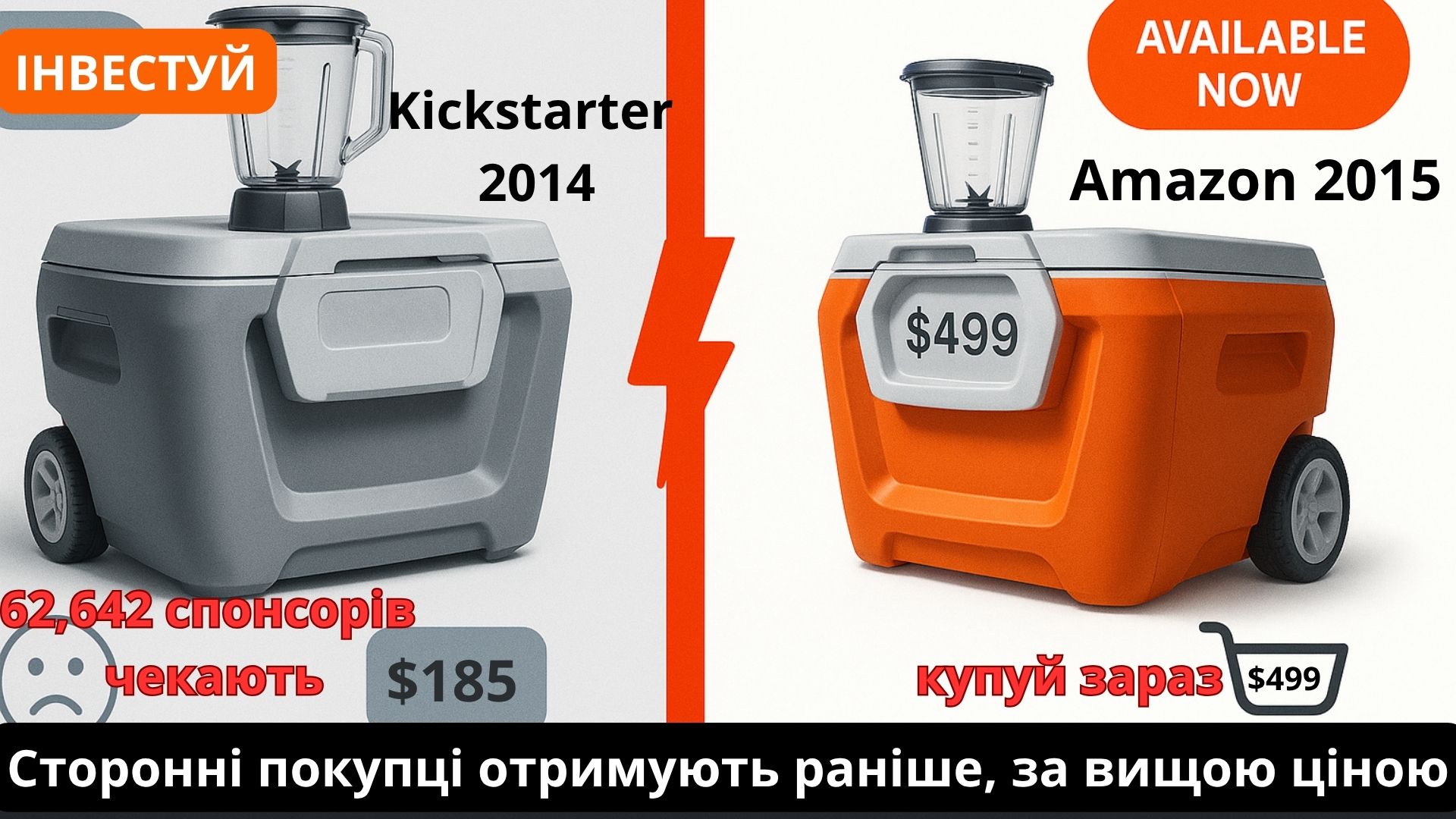
2015: Thousands of sponsors are waiting. And suddenly – Coolest on Amazon for $399-499. Strangers get them before those who funded them. The reaction: Fury.
“Pay another $97”
March 2016: Grapper asks backers to pay an additional $97 for “expedited shipping.” You already paid $185 in 2014, waited 2 years, saw a refrigerator on Amazon… and now you have to pay more?
A scandal. Investigation by the prosecutor’s office. Threats of lawsuits.
The end
December 2019: Coolest LLC closes.
✅ Delivered: ~42,000 – ❌ Not received: ~20,000 – Losses: ~$4,000,000 – “Compensation”: $20
Official reason: tariffs. Real reason: poor management and underestimation of costs.
Drama 2: Zano Drone – $3.5 million and 600 semi-functional toys
The promise of magic
November 2014: Torquing Group (UK) – Zano, an autonomous micro-drone.
Palm size – Auto-tracking – HD – Smartphone control – £139 (~$210)
DJI with the following features: $1000+. On paper, it’s incredible.
Cost: £2,335,119 (~$3.5 million) – 12,075 sponsors – CES 2015: “Best of CES” – Popular Science: “Top 100”
The problem? Everything is a lie.
Investigating the truth
November 2015: Torquing goes bankrupt. 600 drones out of 15,000 have been delivered. The scandal is so big that Kickstarter hired investigative journalist Mark Harris. The result: a 13,000-word article that left no stone unturned in their lies.
What the investigator found:
The promotional video is a fake. It was shot by DJI Inspire (~$3,000), not Zano. Auto-tracking did not work. Face recognition was not developed. The footage is scrolled backwards.

The team had no experience. They had never made drones. They did not understand the complexity. Overestimated their skills by 1000%.
Money spent on: MacBook Pro for everyone, BMW for the investor’s son, luxury office, marketing without a product.
Math: Harris did the math – even without the fraud, Zano would have been £1.4 million in debt. £139 is not a good price for a product like this.
The worst part:
600 drones delivered were online-only. Torquing went bankrupt → servers shut down → all drones turned into bricks. The people who RECEIVED the product have non-working junk.
Drama 3: Lily Drone – $34 million and a fraud lawsuit
“Just throw it and it will fly”
May 2015: Lily Robotics – a breathtaking video. A man runs through the mountains and throws a drone into the air. It stabilizes and automatically follows.

Throw-and-go – Auto-tracking – Waterproof – $499 for pre-order
60,000 pre-orders – $34 million + $15 million from venture capitalists → Total: ~$50 million
Delivery: February 2016 → “Later in 2016” → “2017” → Never.
January 2017: A double blow
January 12: Lily closes, promises to refund.
January 13: SF prosecutors file a lawsuit: False advertising and Unfair practices.
The investigation revealed:
The video was not shot with a Lily. DJI Inspire + GoPro (~$3,000). Lily did not have a prototype.
The CEO knew: “I am worried that a lens geek could study our images and detect the unique GoPro lens footprint. I think we should be extremely careful if we decide to lie publicly.”
Translation: “I’m worried that a lens geek could study our images and detect the unique GoPro lens footprint. I think we should be extremely careful if we decide to lie publicly.”
Violation of the FTC Mail Order Rule. Lily was collecting pre-orders, which are legally a sale. Delaying delivery without offering a refund is illegal.
$50 million disappeared. Bank loan against customers’ money. Loss of contact with customers. Not a single drone has been produced.
Prosecutors demand a $300 million fine. Lily has no funds. People received partial refunds or nothing.
Drama 4: Skarp Laser Razor – When physics says no
2015: Skarp Technologies – a razor with a laser instead of a blade. ⚡ No cuts – ♻️ Reusable – In the shower – $159
Kickstarter: $4,012,279 – 20,000+ backers – Media: “The future of shaving!”

The problem: Physics. The prototype barely worked: slowly, only on dark hair, and only at the perfect angle. Kickstarter suspended the campaign – no working prototype.
They moved to Indiegogo (where the rules are less strict). They raised another $442k. Total: ~$4.5 million.
Why it didn’t work: To make the laser cut effectively:
- High power → dangerous for the skin
- Low power → does not work
2025: Delivery – Never – Last update: 2018 – Sponsors lost $4.5 million – No refunds
Drama 5: iBackPack – When “smart” = “scam”
2015: Doug Monahan – iBackPack 2.0. A backpack with everything: USB – WiFi – Bluetooth – GPS – ️ Bulletproof lining – Wireless charging – $90-200
Indiegogo: $718,000

Red flags:
- ❌ Diagrams are too professional for a startup
- ❌ Videos without demonstration of functionality
- ❌ The founder has had previous failed campaigns
- ❌ Bulletproof material for $90 is physically impossible
They disappeared: 2016 – videos deleted – 2017 – site went down – 2018 – founder not responding – Delivered: 0
2018: FTC lawsuit. Doug is guilty, he is banned from crowdfunding. The money disappeared. Sponsors are left with nothing.
Chapter 6: Patterns of disaster
Six signs of failure
Pattern #1: Too good = Not true
7 functions for $185? Autonomous drone for $210? Bulletproof backpack for $90? DJI, Apple, GoPro can’t do it – why can a startup from a garage?
Pattern #2: No prototype
Only CGI graphics? Promises of “coming soon” features make up 80% of the description? Never shown a continuous video? That’s a red flag.
Pattern #3: Underestimating production
Prototype ≠ mass production. Certification + quality control + logistics + customs = costs that startups ignore.
Pattern #4: Overfunding
$50k = 500 units is manageable. $13 million = 60k units = a nightmare. More money ≠ easier.
Pattern #5: Marketing > Development
Professional videos, viral campaigns, media – but weak technical specifications, unrealistic promises, unqualified team.
Pattern #6: Silence
Infrequent updates + vague explanations + ignoring questions = project death.
How not to become a victim – Checklist
Kickstarter ≠ Store
You are an investor, not a customer. “Best effort” ≠ guarantee. Failure = zero protection.
Check out the team
Previous projects? Relevant experience? Do they talk openly about difficulties? No successful projects = red flag.
A working prototype is required
Only renders = no. “In development” = no. Continuous video of the device = yes.
Check the math
Is the price an order of magnitude lower than the competition? An autonomous drone for $200 when DJI is $1000+? The math doesn’t add up.
Check the team on Google
LinkedIn profiles? Previous projects? Company registration? Domain age? If the team is a ghost on the Internet, it’s probably a scam.
Wait and see
Don’t rush to be an early bird → wait for reviews → in retail (if available). You lose the discount, but without any risk.
Quick checklist
- ✅ Do you have a working prototype?
- Does the team have experience?
- Is the price realistic?
- Is it easy to find information about the company online?
- Are there regular and meaningful updates?
- Does the team respond adequately to comments?
- Are the promises realistic?
- ✅ Is the delivery date realistic?
3+ “no” → think again about supporting the project.
Two sides of the coin!
Good news: 91% of successfully funded projects see it through. Pebble, Oculus (which Facebook bought for $2 billion), Exploding Kittens, Fidget Cube – thousands of successful products.
The bad news: 9% fail. 22,500 failed projects. Millions of lost dollars.
Crowdfunding is a tool. And like any tool, it can be used for both creation and destruction.
Your task: Be smart, cautious, and realistic.
And now you!
What was your experience with Kickstarter? Was it a success or a failure? Did you lose money? Tell us about your best and worst experiences.
Write in the comments! Tag a friend who plans to support a dubious project

