





© ROOT-NATION.com - Use of content is permitted with a backlink.
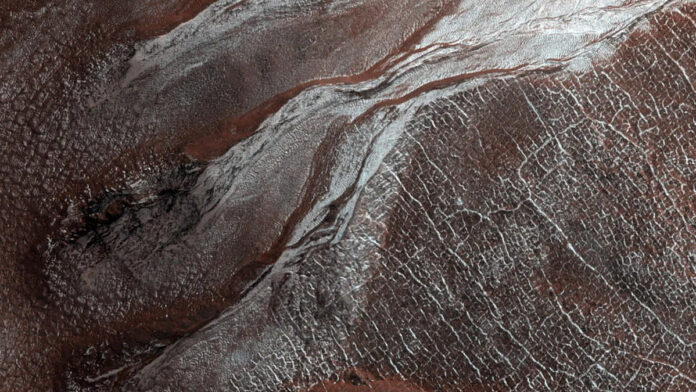
In the years following the discovery of gullies on Mars, scientists had hoped that these features might be evidence that liquid water once existed on our neighboring planet. However, in 2014, NASA cast doubt on this hypothesis. It turned out that the gullies are much younger than previously thought, and their formation may have been linked not to water, but to the seasonal freezing of carbon dioxide – that is, dry ice.
After that, the mystery only deepened: exactly how could frozen CO₂ have created such gullies? A new study by a French team of astrophysicists examines this question in detail based on observational data accumulated over decades by the Mars Express and Mars Reconnaissance Orbiter spacecraft. The researchers focused on the Sisyphi Cave region near Mars’s south pole, where the surface is crisscrossed by an entire network of gullies.

The analysis yielded two main findings. First, the involvement of liquid water in the formation of these structures appears extremely unlikely. Second, and much more unexpectedly, the gullies also do not appear to be explained by CO₂ geysers, which were previously considered one of the main alternative mechanisms. “Instead, the data point toward fluidization processes or avalanches caused by CO₂ ice, which may occur during the late stages of seasonal ice sublimation,” the team noted in their paper.
When NASA’s Global Surveyor first transmitted images of numerous gullies on the surface of Mars, it sparked enormous interest. After all, on Earth, gullies are usually formed by flowing water, so their presence on Mars seemed like potential evidence that liquid water had once existed there. And water, in turn, was considered one of the most important possible indicators of the existence of extraterrestrial life. This led to a large number of scientific papers dedicated to explaining the Martian gullies through the presence of liquid water.
However, not all astronomers agreed with this interpretation. In particular, in 2002, Australian geologist Nick Hoffman suggested that the gullies might have been formed by frozen carbon dioxide. His hypothesis was met with considerable skepticism among his colleagues; however, as subsequent studies have shown, the scientist may have been correct.
Once the dry ice explanation was no longer viewed as merely a fringe theory, researchers proposed a whole range of other possible mechanisms. These included CO₂ geysers, underground aquifers, and snow cover formed from ice and dust.

In their new study, the scientists first checked whether the most recent data actually allowed them to definitively rule out water. During the Martian spring, when the gullies form, the researchers detected no spectral signals that could be linked to water. The team then compared the timing of gully formation with the timing of CO₂ geyser activity. The result was unfavorable for this theory: there is a clear temporal mismatch between these phenomena. The dark spots caused by geyser activity appeared significantly earlier than the gullies.
The researchers do not rule out the possibility that a certain connection may still exist between the geysers and the gullies. However, the temporal characteristics of these processes, as well as physical constraints, make such a correlation quite weak. One possible alternative scenario mentioned in the study involves sublimation caused by CO₂ ice. Under this mechanism, turbulent carbon dioxide bubbles act as a kind of lubricant: they allow dry ice and dust to rise above the surface, creating an effect similar to how a hockey puck hovers above the table thanks to a thin air cushion.

Afterward, the mixture of Martian ice and regolith begins to move down the slope. In the process, it cuts through the surface and forms a gully. The result is a landform very similar to an Earthly gully, although the mechanism behind its formation is fundamentally different.
The authors also emphasize that gullies at lower elevations may form according to a different scenario. Furthermore, at this stage, it is still too early to completely rule out the geyser hypothesis. At the same time, Martian gullies are far from the only evidence scientists are relying on in their search for signs of water on the Red Planet.
Read also: Blue Origin will build a laser communications network on Mars under a NASA contract