





© ROOT-NATION.com - Use of content is permitted with a backlink.
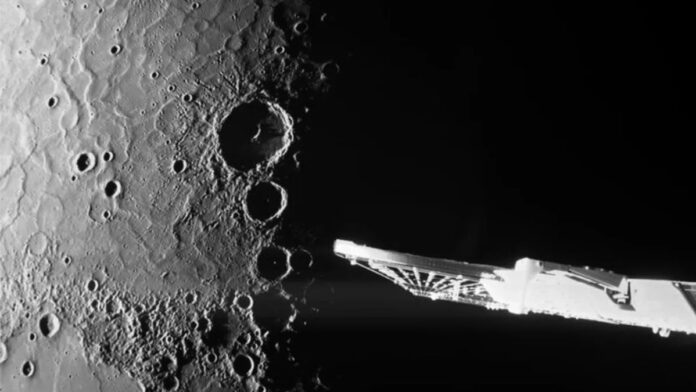
The spacecraft carrying European and Japanese scientific probes is completing its eight-year journey and will arrive at Mercury on September 3, where it faces a series of challenging maneuvers to study the scorching planet. The BepiColombo mission was launched from Earth in 2018 on a complex trajectory to investigate the smallest and least-studied planet in the Solar System by placing two spacecraft into orbit around it. Before that, however, the spacecraft must begin a prolonged approach phase that ESA has described as the most challenging operational phase in its history.

ESA mission manager Santa Martinez noted at a pre-arrival press conference that this is a highly ambitious mission, while Mercury itself is a challenging target because of the extreme environment near the Sun. Mercury’s relatively low mass – it is only slightly larger than the Moon – gives it a weak gravitational pull compared with the Sun, making it much more difficult for the spacecraft to approach without risking being burned up or lost in deep space. To slow down and speed up, as well as adjust its trajectory, the spacecraft has traveled more than 10 billion km and performed nine gravity-assist flybys. The two interconnected probes will then separate from the transfer module.
Ignacio Tanco, ESA’s head of operations for the exploration of the inner Solar System, explained that the process can be compared to commissioning a new spacecraft, except that it is taking place near another planet. Starting in April, ESA’s Mercury Planetary Orbiter will begin studying the planet closest to the Sun with unprecedented precision from an altitude of 480 km above the surface, while Japan’s Mercury Magnetospheric Orbiter will investigate the space environment and magnetic field from an elliptical orbit extending up to 11,000 km from the planet. On September 3, Mercury will be approximately 63 million km from the Sun and 200 million km from Earth.
Tanco noted that at such a distance, real-time operations are impossible because of the 30-minute delay between sending commands from Earth and receiving confirmation that they have been executed. As a result, the spacecraft must perform the necessary checks and carry out the separation procedure autonomously. Tanco acknowledged that this is a highly risky process.

If all goes well, spring-loaded mechanisms will gently eject the probes from the fly-by module at a speed of several centimetres per second without the use of explosives. Many components, including the thermal control system, the propulsion system and the orientation systems, are being tested under these conditions for the first time. Tanko added that it would be easier to list the components that cannot fail, as there are very few of them, but the team is prepared for any surprises. The mission has already encountered problems, notably engine malfunctions in 2024, which resulted in a flyby at a closer distance than planned and disrupted the overall schedule. The next challenging phase will take place in December, when the two probes will separate to enter their own orbits.
Mercury remains the least explored of the four terrestrial planets in the inner Solar System, which also include Venus, Earth, and Mars. The first spacecraft to capture detailed images of its surface was NASA’s Mariner 10 in 1974. Later, in 2011, the MESSENGER spacecraft entered orbit around the planet. However, a number of questions concerning Mercury’s magnetic field, iron core, and the formation of hollows on its surface remain unresolved.
Martinez concluded that BepiColombo, equipped with 16 scientific instruments and developed at a cost of €1.7 billion ($2.5 billion), will provide humanity and the scientific community with unique data on Mercury and open a new chapter in our understanding of the Solar System.
Read also: After months of silence: NASA has lost one of its most successful spacecraft in Mars orbit
Source: straitstimes