





© ROOT-NATION.com - Use of content is permitted with a backlink.
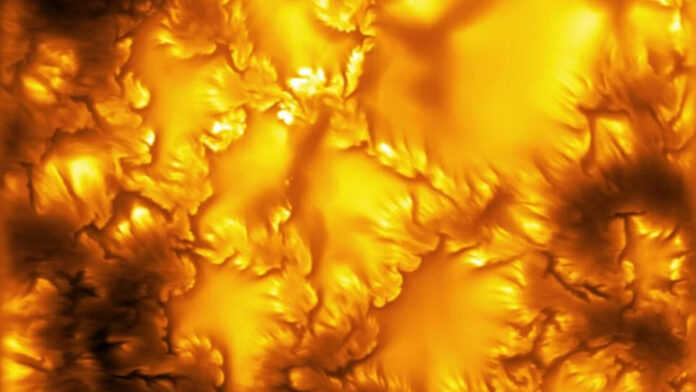
In a research paper published yesterday in the journal *Nature*, scientists have presented images of the Sun’s visible surface – the photosphere – with the highest level of detail ever achieved. These images are not only stunningly beautiful – they contain extremely important information about the fundamental physical processes of our central star, including the first experimental confirmation of a long-standing hypothesis that could only be revealed thanks to the high spatial resolution of the Inouye Solar Telescope.
Read also: AERONAUT – everything that flies above the ground: aviation, UAVs and drones, rockets, and space

The study’s first author and astronomer at the National Solar Observatory, David Kuridze, emphasized in an interview with Gizmodo that it is critically important for science to understand the events unfolding on the Sun at the microscopic level. He noted that this is of fundamental importance for understanding the star itself, its magnetic properties, and global dynamic processes, which is why scientists must study precisely these small-scale, microscopic fields.
The Inouye Solar Telescope, built by the National Science Foundation and located near the summit of the shield volcano Haleakala on the island of Maui, is the most powerful facility of its kind in the world. Thanks to its unique 4-meter-diameter mirror, it captures seven times more sunlight than any other instrument, enabling it to produce incredibly sharp and detailed images of the photosphere.

David Kuridze was part of an international team of scientists who initially sought to find the best way to fully unlock the potential of the Inouye Solar Telescope. Developing and testing various methods to improve image quality ultimately led to these stunning images of the Sun’s surface.
Co-author of the study, leading researcher at the National Solar Observatory and acting program scientist for the Inouye Solar Telescope instruments, Friedrich Vöger, told Gizmodo that when he and his colleagues first saw these images, they immediately recognized the Kelvin–Helmholtz structures and felt an instant sense of elation.
A Kelvin–Helmholtz instability occurs when two fluids or gases move along a common boundary at different speeds, creating a flow shear, through which minor disturbances transform into wave-like or spiral vortices. The existence of this phenomenon in the solar photosphere had long been predicted by theory, but until now, researchers had been unable to directly observe its telltale signs. Friedrich Vöger added that the opportunity to observe these patterns and ultimately prove beyond a doubt their connection to the Kelvin–Helmholtz instability brought the team deep satisfaction and incredible excitement.

Answers to the Major Mysteries of Solar Physics According to scientists, this discovery could bring us closer to solving several scientific mysteries, including the problem of solar corona heating. According to the Princeton Plasma Physics Laboratory, while the sun’s surface temperature is about 5,500 °C, its outer atmosphere – the corona – heats up to nearly 2,000,000 °C, which is approximately 200 times hotter.
This is paradoxical, since temperatures would be expected to decrease with distance from the hot surface. Experts have hypothesized that the Kelvin–Helmholtz instability contributes to the heating of the corona, and the new comprehensive data will allow them to study this process in greater detail.
The results may also explain why the solar magnetic cycle is so short. The Sun’s magnetic poles reverse approximately every 11 years, which is an extremely rapid rate by cosmic standards. To maintain such a high rate, the Sun’s magnetic fields must dissipate and reorganize with tremendous efficiency; however, existing models have been unable to fully explain this mechanism. The Kelvin–Helmholtz instability may not be the sole component of this system, as it dissipates magnetic fields extremely efficiently.

With highly detailed data from the Inouye Solar Telescope at their disposal, the researchers plan to use computer programs to automatically search for and analyze the twisted traces of the Kelvin–Helmholtz instability. This will help them determine the prevalence of this phenomenon in the photosphere, the amount of energy it can transport into the solar corona, and the extent of its influence on the propagation of magnetic fields in the lower layers of the Sun’s atmosphere.
David Kuridze concluded that this discovery opens up entirely new avenues for solving the most important challenges and mysteries currently facing solar physics.
Read also: “Artificial Sun”: China Completes Testing of the World’s Largest Thermonuclear Magnet