





© ROOT-NATION.com - Use of content is permitted with a backlink.

SEO is dead. How many times have you heard this? Search Engine Optimization has been around since Altavista (remember Altavista?) stormed the internet back in the mid-90s. Everyone wanted their website at the top of search results for specific keywords. Free traffic from search engines. Beautiful, simple, lucrative. Does it still work? Kind of. But fewer and fewer people are typing queries into Google anymore. They’re asking ChatGPT. They’re prompting Gemini. And those large language models don’t work like search engines at all. So is RAO (retrieval augmentation) going to replace SEO?

TABLE OF CONTENTS:
What Even Is Retrieval Augmentation?
When you ask an LLM something like “Where can I get the best burger in New York after 11 pm on weekends?”, unlike Google, it doesn’t show indexed results. It goes out and searches various internet sources to find current information. That’s retrieval augmentation.
The full process (Retrieval Augmented Generation, or RAG) works like this: First, the LLM figures out if your question needs internet research. If it does, it structures an approach for which sources to use and how. Gemini has the most sources right now because Google integrated everything into it (shocking). Then it executes the structured retrieval, filters and analyzes the data, and combines that with your original prompt to generate an answer. RAG was initially developed to fill knowledge gaps and give LLMs current information, including real-time data. Makes sense. These things need to know what’s happening now, not just what happened in their training data.
As a business, you want to appear in as many prompt results as possible. Ideally portrayed positively, matching what your prospects actually need. When someone’s hunting for late-night burgers, you want your shop recommended. Just like in the old days, when you would pay someone to optimize your website for local SEO, now you’re going to pay an agency
That’s what Retrieval Augmentation Optimization is for.
RAO Is Not Just SEO For Robots
You might think RAO is just SEO, but for AI. That’s only half true.
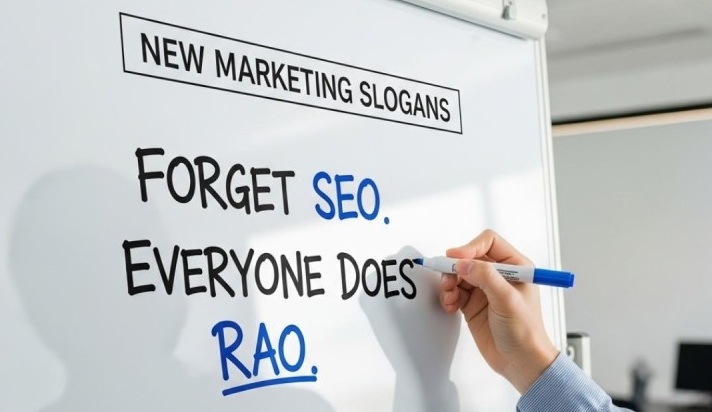
With SEO, you optimize for specific keywords to rank high so your website gets fed traffic from search engines through clicks. Pretty straightforward, at least in theory. RAO is totally different. LLMs don’t do a single search and grab the top three results. Don’t believe me? Ask ChatGPT or Gemini how they’d research your specific business. They’ll happily explain their process, name their sources, list the various keywords they’d use.
One key difference: they use multiple trusted sources. Backlinks barely matter here. Rankings rarely matter. Most keywords are long-tail. It’s not sufficient to rank high on any search engine anymore.
Your business needs to be referenced. Across various sources, not just one. Your information needs to be complete, consistent, and current everywhere. Nothing kills RAO faster than conflicting or outdated information.
If you’re a restaurant and your menu isn’t consistent across search engines, maps, and delivery platforms, the LLM might just drop you from results. The same applies to opening hours, payment methods, and all of it. The prompt “Which burger shop in my area is open after 11pm, accepts Visa and is dog friendly?” will trigger a variety of long-tail keyword searches and metadata queries across multiple data sources. If you don’t have the necessary information published and current, you’re filtered out. Simple as that.
RAO in the Real World
In SEO, we identified search intents and derived keywords. In RAO, we need to do much more. We need to identify customer demand and ensure all required information exists on multiple websites referencing our business. Get your business referenced (no backlink needed) on various websites that rank for a variety of keywords, including long-tail. At least 10 to 15 different sites. News sites, communities, whatever’s relevant.
Google Maps and business directories need to be current with all necessary information. Opening hours, payment methods, menus, products, services. You need 100% coverage on Google Maps. That’s a good baseline for what information to present everywhere.
X, Instagram, and Reddit are king now. If your business is a no-name on these platforms, you’re toast. Many of the LLMs were trained on Reddit and X data. If users recommend your business in subreddits, you’ll likely end up in the RAG chain.
Use the LLMs themselves to tell you their approach. Think about what you sell, to whom, and in what situations. Then ensure you’re covered in those prompts.
Local information matters more than ever. Your region, your location, everything. If anything about your business looks weird or dodgy, the LLM’s security filters will drop it.
The Metrics That Matter Now
There aren’t real RAO analytics tools yet (users adopted faster than vendors could build, go figure). The current best practice is to keep a list of demand scenarios for your customer personas, along with corresponding prompts. Check regularly to see if your business shows up.
That being said, website traffic has almost become meaningless as a metric. People rely on LLMs. In the SEO days, social networks and backlinks were a source of trust for your website. Now they’re a source of information to verify accuracy and timeliness around your business. You should post frequently and participate on Reddit, X, Instagram, and TikTok. That’s how LLMs know your business exists, is open, and still provides services. Text descriptions on video platforms like YouTube, Instagram, and TikTok are increasingly relevant. LLMs rely on these. If you extend your hours or run a special weekend deal, you announce on TikTok, the summary needs to be in the text description. Otherwise, the LLMs won’t catch it.
Public MCP Will Kill Websites
Your website is already irrelevant (sorry). Most businesses can’t even execute basic UX/UI principles anyway. Websites and web apps are dead. They’ll stick around for a few more years, but their dominance is fading fast. The Model Context Protocol already allows LLMs to execute actions. You need to prepare for a world where your online shop, food ordering system, or appointment calendar supports MCP. Soon, LLMs will do the ordering, booking, and payment on behalf of users. And this isn’t some distant future but something that’s happening in the months to come.
RAO is the first step to prepare your business for MCP conversions. People don’t search websites to buy stuff anymore. The only part currently left is the “buy” action, and MCP will replace that very soon. Much of this is in research right now. Standards for public MCP are being developed. As with everything in AI, the future is likely tomorrow morning, not a few years away. Somewhere between corporate RAG pipelines and the best uncensored AI text generator experiments, you can already see the pattern. Large web platforms like Booking.com will become less relevant. Your approach to making sales through your own website doesn’t really matter anymore.
What Happens Next
Here’s a very bold statement: Google’s search engine will be replaced by Gemini. But is it really bold? We’re already seeing early stages with Gemini on top of every Google search, which just proves websites and SEO, for that matter, are becoming obsolete. LLMs are already on phones, tablets, cars, computers, TVs. They’ll expand further and have no limitations.
You cannot fight this change.
Someone driving a car with Android Automotive won’t use your website to order pizza. They’ll use Gemini through voice commands. Gemini will use MCP to execute orders on your behalf, and Google will likely charge you for it.
This is the present, quickly making its way out of software labs into the real world. Bookstores didn’t die because Amazon was cheaper. They died because Amazon delivered more convenient technology that just worked.
Don’t become what bookstores were in the early 2000s: late adopters who tried to fight the future and failed.
Start your RAO strategy today. Plan for a future where business happens through MCP.
Or don’t. But Cindy from accounting will probably outlast you.

 going to replace SEO?)