





© ROOT-NATION.com - Use of content is permitted with a backlink.
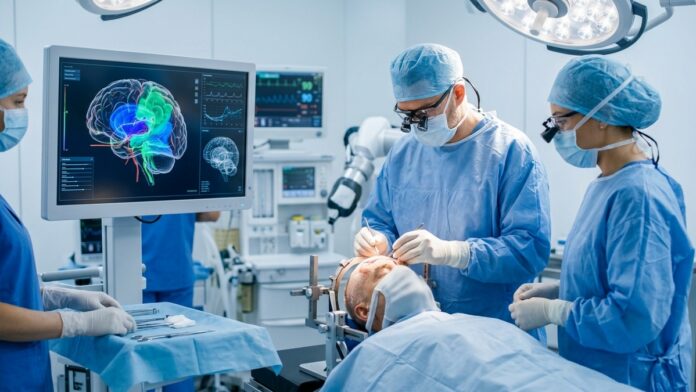
London neurosurgeons performed the world’s first successful brain tumor removal surgery using AI, preserving the vision of a 48-year-old patient. The procedure took place in May at the National Hospital for Neurology and Neurosurgery (NHNN), part of the UCLH university hospital complex, but details had not been disclosed until now, pending the completion of the rehabilitation period for the patient, whose name is Rice Gibberts.
During the procedure, the medical team maintained full control over the operation, while the AI system continuously analyzed the live video feed from the camera and helped identify the location of key anatomical structures, particularly blood vessels and nerve fibers that could not be damaged near the 11-millimeter tumor on Gibbert’s pituitary gland. After regaining consciousness, the patient noted that he immediately recognized all objects in the room clearly, and within 7 days he was able to move around freely on his own, without using glasses or a cane.

He has since resumed his duties as head of customer service and describes his current vision as fully restored. Doctors performed the procedure using advanced AI technology that highlights tiny structures in the brain with color, making it easier for specialists to identify them safely. Previously, this medical facility had used the technology solely for research purposes, so this operation marked its first actual application on a patient.
The pituitary gland is located in close proximity to blood vessels and the optic nerves, meaning that an error of even 1 mm carries the risk of irreversible consequences, including blindness, stroke, or death.
According to Sofia Bano, an associate professor of robotics and AI at UCL and the project’s technical lead, the system was trained on hundreds of surgical videos, acquiring a level of surgical expertise that would take a human years of practice to attain. She added that the algorithm was designed to recognize critical anatomical structures, surgical instruments, and tissue interactions in real time, serving as a guide for the surgeon during precise maneuvers.
After the diagnosis was made in 2024, Gibbert’s symptoms were controlled for a long time without surgery, but later worsened, manifesting as a severe hormonal imbalance and a decline in visual acuity, which meant that without surgery, the man faced the risk of complete blindness.
NHNN began operations in 1859 as the world’s first specialized neurosurgical clinic, so it is only logical that it was within its walls that the world’s first AI-assisted neurosurgical procedure was performed.