



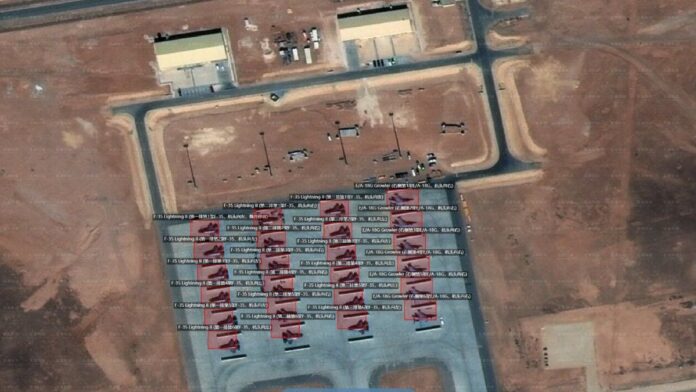

-processed satellite imagery to more accurately target US bases in the Middle East.)
© ROOT-NATION.com - Use of content is permitted with a backlink.
Iranian military units are using satellite imagery processed by AI to improve the accuracy of targeting US bases in the Middle East. This was reported by ABC News on April 5, 2026, citing US Department of Defense intelligence. The technology in question is that of the Chinese company MizarVision, which uses automatic object recognition to detect bases, equipment, and infrastructure in minutes instead of hours.

Such capabilities reduce the cycle of target destruction and increase the risks to US personnel and facilities. Defense officials emphasize that this signals a shift in the balance as adversaries begin to use commercial AI tools to close the gap with U.S. intelligence and precision strike capabilities.
According to the U.S. Defense Intelligence Agency, the Islamic Revolutionary Guard Corps uses these datasets to plan missile and drone attacks. This demonstrates how commercial geospatial analytics is transforming targeting processes in modern conflicts. MizarVision, a company partially owned by the Chinese state, offers high-resolution satellite imagery with AI markings of military installations, infrastructure, and logistics hubs. This data is available on open platforms. The algorithms are able to detect aircraft, fortified shelters, fuel depots, radar systems, and troop concentrations over large areas.

Previously, such capabilities were available only to closed state intelligence agencies, but now they are offered by commercial providers. By accelerating the cycle from information collection to analysis, such AI solutions provide almost instantaneous targeting support. For Iran, this means less dependence on its own intelligence resources and, at the same time, increased accuracy in strike planning.
The MizarVision platform uses machine learning models trained on military signatures. It automatically classifies objects by shape, thermal characteristics, and context, adding geospatial metadata for integration into command and control systems. This approach is in line with the concept of network-centric operations, where the speed of data analysis directly affects the effectiveness of strikes.

Recent reports indicate that Chinese companies are combining AI with satellite, maritime, and aviation data to map the deployment of US forces. Even open commercial imagery becomes operationally valuable when it is aggregated, labeled, and disseminated quickly. In this form, Iran can form a clear picture of targets for missile and drone attacks.
U.S. forces have traditionally used camouflage, fortified shelters, and radiation control to protect their facilities. However, AI analysis reduces the effectiveness of these measures, as algorithms are able to track patterns, predict activity, and find priority targets.

China’s dual-use technology model allows commercial companies to create effects close to military intelligence, even without direct military involvement. Even with detained or open AI data, it can generate information suitable for strike planning. For Iran, this opens up the possibility of selectively attacking air defense radars, command centers, and logistics hubs, increasing pressure on US forces in the region. In addition, fixed facilities are becoming more vulnerable, and the issues of cloaking, signature management, and commercial data control are coming to the fore.
Read also: