





© ROOT-NATION.com - Use of content is permitted with a backlink.
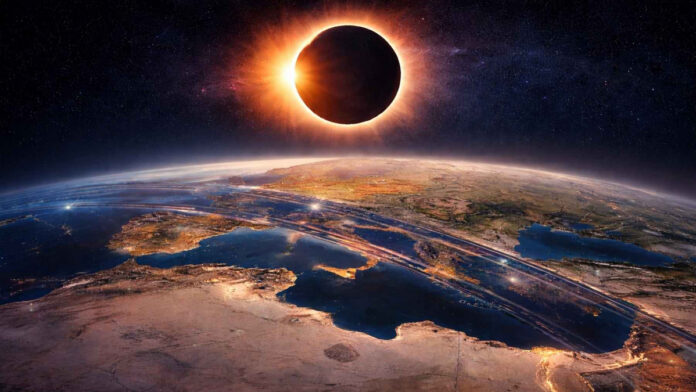
There is exactly one month left until the total solar eclipse of 2026. The total phase of this astronomical event will occur on August 12, 2026. The Moon’s shadow will pass over parts of Greenland, Iceland, and northern Spain, briefly turning daylight into nighttime darkness within a narrow band of totality. This will be the first total solar eclipse visible in Europe since 1999.
The path of totality will pass through Greenland, Iceland, and the northern regions of Spain, with the total phase lasting up to 2 minutes and 18 seconds. Spain is expected to be one of the prime locations for viewing due to favorable weather conditions. Those planning to observe the event in Spain must have a clear view of the western horizon, as the Sun’s disk will be low above the horizon during the peak of the eclipse.

Read also: AERONAUT – everything that flies above the ground: aviation, UAVs and drones, rockets, and space
Key geographic locations, transit times, and parameters of the total phase of the eclipse:
Scorsby Sound (Greenland): the total duration of the event will be 1 minute and 46 seconds; it will begin at 4:35 p.m. Central European Time, and the sun’s angular altitude will be 24 degrees above the western horizon.
Reykjavík (Iceland): The duration will be 1 minute and 1 second; the start time is 5:48 p.m. GMT, and the sun will be at an altitude of 25 degrees above the western horizon.
Snæfellsjökull National Park (Iceland): The total phase will last 2 minutes and 10 seconds, beginning at 5:45 p.m. GMT, with the sun at an altitude of 25 degrees above the western horizon.
Gijón (Spain): The eclipse will last 1 minute and 46 seconds, beginning at 8:26 p.m. Central European Summer Time, when the sun will be 10 degrees above the west-northwest.
La Coruña (Spain): The duration will be 1 minute and 15 seconds, beginning at 8:27 p.m. Central European Summer Time at an altitude of 12 degrees above the west-northwest.
Palencia (Spain): The duration will be 1 minute and 42 seconds, beginning at 8:29 p.m. Central European Summer Time, with the sun rising 9 degrees above the west-northwest horizon.
Burgos (Spain): The event will last 1 minute and 44 seconds, beginning at 8:28 p.m. Central European Summer Time, with the sun at an altitude of 8 degrees above the west-northwest horizon.
Segovia (Spain): The total phase will last 54 seconds and can be observed at 8:31 p.m. Central European Summer Time at an altitude of 8 degrees above the west-northwest horizon.
Sigüenza (Spain): The totality will last 1 minute and 38 seconds; the event will occur at 8:30 p.m. Central European Summer Time, with the Moon at an altitude of 7 degrees above the west-northwest horizon.
Mallorca (Balearic Islands, Spain): The duration will be 1 minute and 36 seconds; the event will begin at 8:31 p.m. Central European Summer Time, when the sun will be 2.7 degrees above the west-northwest horizon.
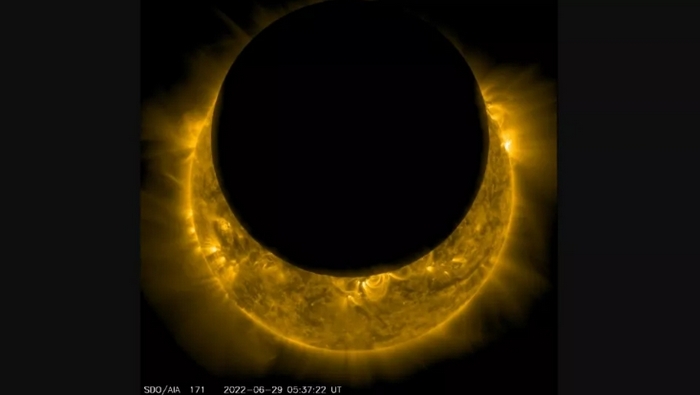
The partial solar eclipse will be visible across most of the European continent. More than 90% of the sun’s disk will be obscured in cities such as London, Paris, and Dublin. Maximum coverage of the sun’s surface in various cities around the world:
New York: the eclipse phase will be 9%.
St. John’s (Newfoundland, Canada): 53% of the sun will be obscured.
Nuuk (Greenland): The area of coverage will reach 79%.
Oslo (Norway): the coverage rate will be 83%.
Berlin (Germany): 84% of the sun’s disk will be covered.
London (United Kingdom): The coverage will reach 91%.
Paris (France): The eclipse will cover 92% of the sun.
Tangier (Morocco): The sun will be 92% obscured.
Dublin (Ireland): The coverage rate is estimated at 94%.
Lisbon (Portugal): The shadow will cover 94% of the sun.
Nice (France): The eclipse coverage will be 95%.
Madrid (Spain): 99.96% of the sun’s disk will be covered.
Barcelona (Spain): The coverage level will be 99.82%.
While residents of a narrow strip across Greenland, Iceland, and Spain prepare to witness the maximum phase of the eclipse low on the horizon, much of the rest of Europe, including major capitals, will have the opportunity to observe a spectacular partial eclipse of the Sun, with coverage exceeding 90%. In Ukraine, this phenomenon will also be visible as a partial solar eclipse, since the country is within the general European visibility zone, where observers will be able to see the Moon’s shadow partially covering the Sun’s surface.
For those who cannot be in the visibility zone or who wish to see the total phase in the highest quality, leading scientific organizations will host free live online broadcasts from telescopes:
- European Space Agency (ESA): will host an international broadcast from the Hawalambre Astrophysical Observatory in Spain on the ESA Web TV platform and on its official ESA YouTube channel
- The Exploratorium (in partnership with NASA): will broadcast a live feed directly from the path of totality in Spain via the official Exploratorium website
- Time and Date: will launch a special interactive stream with minute-by-minute tracking of the moon’s shadow across the planet on the Timeanddate Live Eclipses page
- Royal Greenwich Observatory: will provide a live broadcast of the eclipse from its site in London on the official Royal Museums Greenwich page .
See also: