





© ROOT-NATION.com - Use of content is permitted with a backlink.
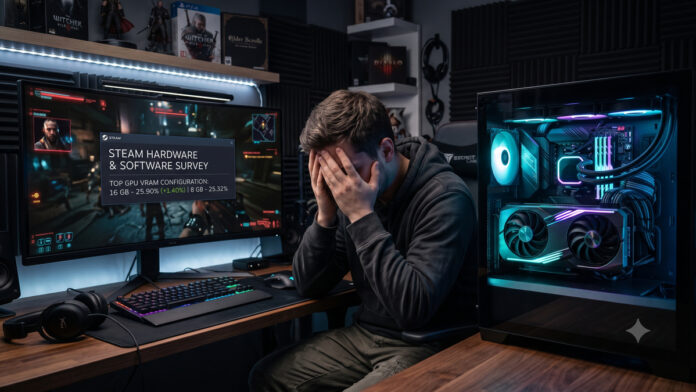
A new survey from Steam shows that graphics cards with 16 GB of video memory are emerging as the most popular choice among gamers. However, current pricing trends suggest that for gamers looking to purchase cards with a significant amount of VRAM, the future looks rather bleak.
Read also: AERONAUT – everything that flies above the ground: aviation, UAVs and drones, rockets, and space
According to observations by TweakTown, Valve’s latest July hardware report shows that 16 GB of VRAM has become the most common configuration, accounting for 25.9% of the market – up 1.4% from last month. This allowed it to displace the 8 GB configuration from the top spot, which dropped to 25.32%. Although the gap is minimal, this fact is highly telling, even when accounting for statistical fluctuations due to the nature of the service’s data collection.

At the same time, the majority of Steam users still use devices with less memory, and configurations with 16 GB or more account for only 36% of systems. Accordingly, nearly two-thirds of gamers are using graphics cards with up to 16 GB of memory, while about 47% make do with 8 GB or less.
However, the surge in demand for 16 GB is striking: as recently as August 2025, according to Notebookcheck data from that time, only 6.8% of users had such graphics cards. By July 2026, this number had nearly quadrupled, increasing by about 20%, which is a very significant figure.
Based on the platform’s statistics, the RTX 5060 Ti 16GB, RX 9060 XT 16GB, and the 9070 series sold very well, not to mention NVIDIA’s more expensive models. The RTX 5070 is also performing exceptionally well, ranking third overall, even though it comes with 12 GB of memory instead of the expected 16 GB. Of course, previous-generation models also account for a significant share of the 16GB models on Steam. In addition, AMD’s performance was influenced by Valve’s correction of an error earlier this year, which had caused the brand’s cards to be displayed incorrectly and grouped into a general, unspecified “Radeon” category.
Buyers’ desire to ensure their PCs remain up-to-date for the future is entirely logical, since 8 GB already seems insufficient in today’s reality. However, the nature of cards with increased VRAM capacity is such that the global memory shortage is hitting them the hardest.

Price increases have already become a reality: a few weeks ago, NVIDIA notified its partners of price hikes for GDDR6 and GDDR7 chips, which it supplies alongside its GPUs. The latest data from Tom’s Hardware also confirms price increases for RTX 5000 series models in South Korea starting this month, driven by rising costs of both VRAM and the chips themselves. According to available data, NVIDIA graphics cards based on the Blackwell architecture could see price increases of up to 30% in this region, after which similar price hikes are likely to affect other markets as well. Price increases are also expected for AMD’s Radeon series, and the “red” camp has already warned that the second half of 2026 will be a tough test for PC gamers’ wallets.
Given that user demand for 16 GB of memory is growing, and prices are steadily climbing – while the component shortage is set to worsen throughout the year and continue into 2027 – the prospects for cost-effective upgrades to high-performance graphics cards remain very bleak.
Read also: A Sacrifice of Power: The RTX 5090 Changed the Color of a Top-of-the-Line Motherboard in Six Months