





© ROOT-NATION.com - Use of content is permitted with a backlink.
Munich-based automaker BMW has unveiled an updated version of the 7 Series sedan. The i7 electric model has been developed from the Neue Klasse platform, including a fundamentally new battery pack. With the launch of the iX3 and the i3 in 3 Series electric sedan format, BMW has already brought two models based on the Neue Klasse platform to market – although the i3 was only given “design premiere” status in March, not a full world debut. The powertrain is well known, as it is in fact a direct derivative of the iX3, the first car built on the new platform. However, BMW’s approach to the formation of technology clusters rather than isolated platforms is particularly evident in the restyling of the i7.

“Utilizing the capabilities of the new technology clusters takes the BMW 7 Series to a whole new level – both visually and technically – in the middle of the model’s life cycle,” BMW says. There is a specific meaning behind these words: the i7, built on the outdated CLAR platform with fifth-generation electric drives, has received a kind of Generation 5.5 upgrade thanks to the battery technology cluster.

The old 101.7 kWh prismatic cell battery has been discontinued as part of this upgrade. The version shown at Auto China retains the Gen5 core, but the body now houses large-format cylindrical cells of the Gen6 battery system of the Neue Klasse platform. As a result, the capacity of the new battery has increased to 112.5 kWh, providing the i7 with a slightly longer range and improved charging speed.

It should be noted that although the Neue Klasse platform – with the iX3 and i3 models – is 800-volt, the battery cells themselves, due to their NMC chemistry, have a similar voltage to previous generations. This makes it possible to configure the 46 mm diameter and 95 mm high cylindrical cells into a 400-volt system for the i7. The cells are identical – the only difference is the way they are organized.

The 112.5 kWh rating for the new i7 battery with cylindrical cells reflects the net capacity, which is the energy actually available to the consumer. The maximum peak charging power has been increased to 250 kW compared to the previous 200 kW. At the same time, BMW traditionally relies not on peak performance but on an optimized charging curve to reduce the overall charging time. According to the manufacturer, the updated i7 charges from 10% to 80% in 29 minutes – five minutes faster than before – but still inferior to modern 800-volt cars.

At the premiere in Beijing, BMW presented three versions of the i7, all with the same battery and four-wheel drive with two electric motors. The electric motors themselves have not changed: the familiar Gen5 units – synchronous machines with external excitation – remain in the front and rear. In fact, BMW only adapted the transmission to the new battery without changing the performance characteristics.
The i7 50 xDrive and i7 60 xDrive are powered by a 190 kW motor at the front and 230 kW at the rear. The system power of the 50 xDrive is 335 kW with 660 Nm of torque, while the 60 xDrive delivers 400 kW and 745 Nm – the figures remain unchanged. The only innovation concerned the names: if earlier the transmission designation was after the technological identifier (i7 xDrive60), now, following the Neue Klasse models, it has been moved to the middle (i7 60 xDrive). Thanks to the new battery, both versions crossed the 700-kilometer mark for the first time in terms of WLTP – 708 and 707 km, respectively.
The flagship version of the i7 M70 xDrive is also equipped with the same battery and 190 kW front motor. However, in the M-version, the rear unit develops 360 kW, raising the total system power to 500 kW and the maximum torque to 1,015 Nm. At the same time, the WLTP range is reduced to 650 kilometers. The M70 accelerates from 0 to 100 km/h in 3.8 seconds (or 3.5 seconds according to the One-Foot-Rollout methodology common in the United States). The 50 and 60 versions are slightly slower – 5.5 and 4.8 seconds, respectively – but they also demonstrate impressive dynamics. Since BMW has not only software unlocked additional power, but also made hardware changes at the battery level, it is only natural that this update is positioned as the most extensive restyling in the history of the BMW Group.
The facelift is intended to play a “pioneering role in the intergenerational, inter-powertrain and inter-segment introduction of technologies across the entire BMW model range.” Along with the electric versions, cars with internal combustion engines have also been updated, and in November 2026, two more plug-in hybrids will join them.
In line with the scope of the update, BMW has significantly redesigned the car’s exterior: the flagship 7 Series, as the brand’s image bearer, is supposed to embody the “new face of BMW in the luxury class.” Max Misoni, a designer who once worked for Polestar and now works for BMW, is responsible for the aesthetics of the Munich premium models. The “monolithic exterior” is designed to create a “distinctive presence and high recognition.”

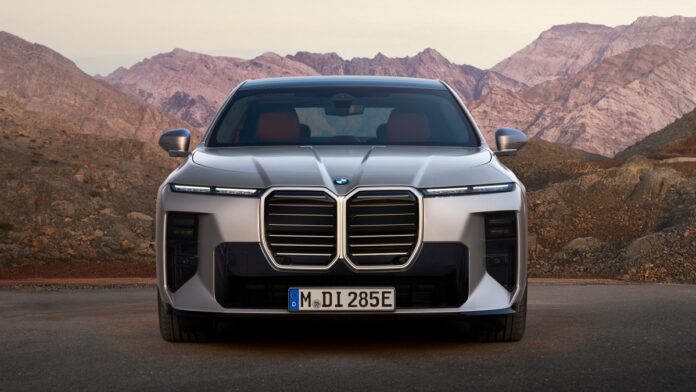
In practice, the changes, despite their restraint on paper, make a noticeable impression. The daytime running lights look similar to the previous ones, but their signature has become more angular. The main headlights, which were previously positioned horizontally below the daytime running lights, are now oriented vertically. Combined with the sharper and clearer outlines of all elements, including the kidney-shaped grille, the front end of the i7 has an even more cohesive and monumental appearance – the word “monolithic” is really apt here. The side profile, as is usually the case with restyling due to the significant cost of changing body panels, remained unchanged – and the i7 is no exception. The rear lights, on the other hand, clearly demonstrate the influence of the Neue Klasse and the current BMW design language.
This philosophy extends into the cabin as well. According to BMW, the interior is characterized by premium materials, minimalist design and a spectacular lighting atmosphere. There are also Neue Klasse technological solutions that have migrated to the flagship of the old CLAR platform: Panoramic iDrive, the sleek, continuous display strip along the bottom of the windshield that debuted in the iX3, is now part of the 7 Series.
In addition, the front passenger is now equipped as standard with the BMW Passenger Screen, which “opens up new possibilities in the field of entertainment and information.” The new steering wheel and the sloping angle of the touchscreen are also inherited from the Neue Klasse.
Production of the updated 7 Series and the three versions of the i7 will begin in July – as before, at BMW’s Dingolfing plant in Germany. The price of the i7 50 xDrive on the German market starts from €121400, the i7 60 xDrive – from €140100. The top-end i7 M70 xDrive will cost at least €182400. The 750e xDrive plug-in hybrid will be available from November at a price of €133900, while the more powerful M760e xDrive will be offered from €159900.
Read also:
- Why the Škoda Karoq 2.0 TDI Is a Practical Choice
- User Experience of the KOVI ADT 300 Motorcycle After 10,000 km of Use