





© ROOT-NATION.com - Use of content is permitted with a backlink.
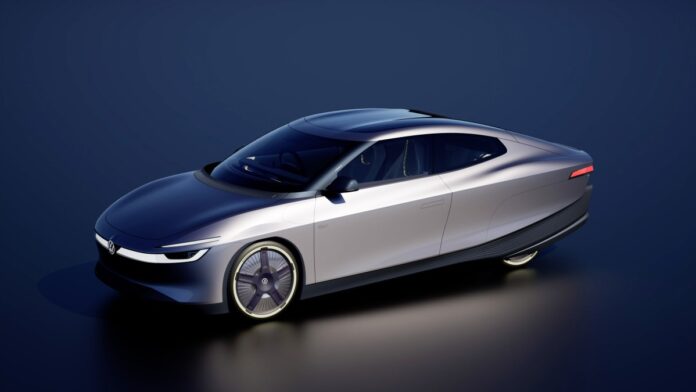
Volkswagen has unveiled the Mission Efficiency concept car, which the company has called the world’s most efficient electric vehicle, and many see it as a revival of the XL1, but in the form of a full-fledged electric vehicle. It is built on the MEB+ platform and uses the same readily available components as the new ID. Polo.

To prove the concept’s real-world efficiency, the development team sent the prototype on a 1,278.36-km marathon. It set off from the main plant in Wolfsburg, passed through Poznań and Olomouc, and then arrived in Vienna. During the entire trip, it stopped to charge only once, recording an average energy consumption of 6.89 kW•h/100 km at the battery cell level, or 7.51 kWh/100 km when accounting for charging losses. At the same time, the instrument panel still showed a range of 164 km remaining. Skeptics, of course, will point out that the trip was completed at an average speed of 67.72 km/h, although the car briefly accelerated to 138 km/h along the way.
Read also: Car Reviews

How did the engineers manage to achieve such results? Thanks to an uncompromising fight against air resistance. The Mission Efficiency has a drag coefficient of just 0.158, which is a claimed world record among passenger cars approved for road use. The original XL1 had a drag coefficient of 0.186, while General Motors’ legendary EV1 had a drag coefficient of about 0.19.

The new concept achieves this thanks to its teardrop-shaped silhouette, small front end, active radiator shutters that close when cooling demand decreases, flush-mounted door handles, and enclosed rear wheels. Airflow control is so meticulous that VW has patented special deflectors on the inner side of the wheel rims.
Read also: Škoda Enyaq 85 (2026) Review: A Family Electric Crossover Focused on Practicality
At speeds above 80 km/h, aerodynamic drag becomes the main enemy of an electric vehicle’s range. Volkswagen claims that this design requires 30% less energy than the standard ID. Polo, so the electric car will cruise at 140 km/h with the same energy consumption as the hatchback does at 100 km/h.

The Mission Efficiency is 4,975 mm long and 1,350 mm tall, and its composite body contains almost no specially developed racing technologies. Instead of building an exotic platform from scratch, the engineers simply mounted the body on the MEB+ architecture. A conventional 99 kW (135 k.s.) electric motor is located between the front pillars, connected to a standard battery with a capacity of 54.9 kWh (usable capacity).
Read also: From Netherlands to Spain: Demanding Real-World Test of BMW iX2 eDrive20
The front suspension uses a standard McPherson design, but the rear axle features a new electromechanical braking system developed in partnership with AUMOVIO. Eliminating heavy hydraulic lines and moving parts in the rear has reduced additional friction and enabled more efficient energy recovery during deceleration.

In collaboration with Continental, Volkswagen has developed a special rubber compound based on the EcoContact 7. The glass roof and trunk lid are equipped with solar panels totaling 370 watts, which power the auxiliary 12-volt system, reducing the load on the main battery and providing up to 30 km of additional range per day in bright sunlight.
Read also: First Impressions of Toyota bZ4X: Brief Test Drive on Road

The minimalist philosophy continues inside. There is no massive screen spanning the entire width of the dashboard, but there is a neat “bring your own device” mount where you can place your smartphone or tablet to control navigation and telemetry. A separate portable Bluetooth speaker in the center console replaces the audio system.

The cabin has a 2+2 configuration. Front passengers have ample headroom and legroom, even for adults; however, the steeply sloping roof means that only people up to 160 cm tall will be comfortable in the rear seats. Since the car’s teardrop-shaped profile tapers smoothly toward the rear, the trunk has a capacity of 481 liters.
Read also: How Škoda Driver Assistance Systems Work: From Sensors to Algorithms

Will Volkswagen actually bring this car to market? Brand Director Thomas Schäfer called it a testament to “technology for the masses, not just for the few.” But even if the Mission Efficiency ever enters mass production, it’s unlikely to cost €25,000, as ordinary drivers might hope. Most likely, the electric car will become a limited-production prestige model priced at over €150,000.
Read also: Audi Starts Production of the New A2 e-tron: First Cars Roll Off the Assembly Line