





© ROOT-NATION.com - Use of content is permitted with a backlink.
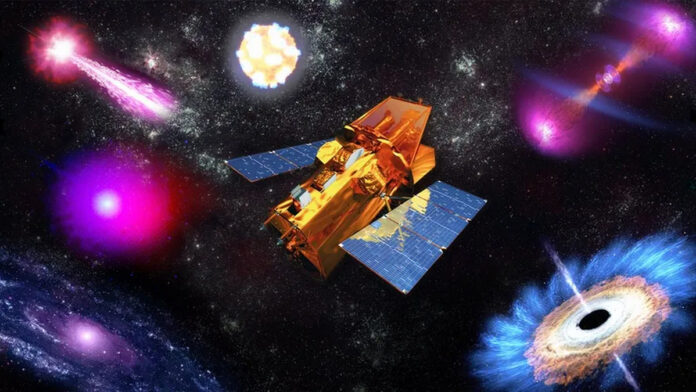
NASA’s Neil Gehrels Swift Observatory is restoring operations of two of its three scientific instruments after a commercial mission to raise the spacecraft’s orbit was significantly scaled back. The mission is now focused exclusively on demonstrating rendezvous technologies for the future servicing of spacecraft directly in orbit.
The Swift team powered up the Ultraviolet/Optical Telescope and the X-Ray Telescope on Wednesday, August 26. Both instruments had been shut down since February, which helped significantly reduce atmospheric drag and extend the spacecraft’s time in orbit in support of plans to raise its orbit.

Operations of the third instrument, the Burst Alert Telescope, were suspended in April to minimize power consumption. This allowed Swift’s solar panels to be positioned in a way that further reduces atmospheric drag. The team expects to return the instrument to full data-collection operations within the next few weeks.
For the past 21 years, Swift has served NASA as a versatile, multifunctional tool for studying the universe. The observatory conducts observations across a broad range of wavelengths, can rapidly point toward transient cosmic bursts, and immediately transmit alerts to other ground- and space-based observatories to enable coordinated follow-up observations.

Earth’s atmosphere creates drag for all spacecraft operating in low Earth orbit, gradually reducing their orbital altitude if they lack their own propulsion systems to compensate for this effect, as is the case with Swift. A recent surge in solar activity significantly increased atmospheric drag on Swift, causing the observatory to lose altitude much faster than previously anticipated.

In September 2025, NASA awarded Katalyst Space a contract to attempt to raise the observatory’s orbit. The company was given one year to design, build, test, and launch its LINK spacecraft, which was intended to rendezvous with, capture, and raise Swift’s orbit.
The LINK spacecraft was launched in July aboard a Pegasus rocket operated by Northrop Grumman. Later that month, however, LINK experienced technical problems with its attitude-control system. On August 19, NASA and Katalyst announced that LINK would no longer attempt to capture and raise Swift. Nevertheless, Katalyst will attempt a rendezvous with Swift and conduct close-proximity maneuvers to test and demonstrate the on-orbit satellite-servicing technologies needed for future space operations.

According to NASA’s calculations, switching to a minimum-drag configuration has extended the time Swift can remain above an altitude of 300 km until October. Below this threshold, operating the telescope becomes extremely difficult, while the spacecraft’s rate of orbital decay increases sharply. With scientific observations now resumed, the team expects Swift to cross this critical altitude threshold within the next one to two months.