





© ROOT-NATION.com - Use of content is permitted with a backlink.
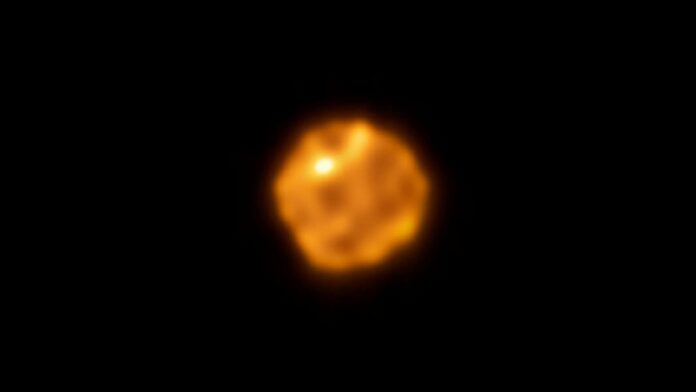
Scientists from the European Southern Observatory (ESO), using the powerful ALMA radio interferometer, have detected an exceptionally stable temperature structure on the surface of the red supergiant Betelgeuse. A bright, hot spot in the northeastern region has maintained its position and intensity for over 7 years. This finding challenges current computer models that describe convective processes inside massive stars.

The results of the study, led by Bill Dent, are described in detail in an arXiv preprint and have been accepted for publication in the journal *Astronomy & Astrophysics*; they are based on a comparison of images from 2015 and 2023. In 2023, astronomers used ALMA’s longest-baseline configuration, which allowed them to achieve an angular resolution of about 7 milliarcseconds. As a result, the disk of a star located 600 light-years from Earth – with a radius approximately 800 times that of the Sun – could be resolved into distinct, sharp fragments rather than appearing as a blurred spot.

In the millimeter range, ALMA observes not the optical photosphere but the lower atmosphere, where the outflow of stellar material is formed. The average temperature of this layer is about 2,300 K (or approximately 2,027 °C). However, observations revealed hotter regions in the northeast and southwest, with the northeastern region being 800 K hotter than the surrounding gas.

The standard model describes the outer envelope of a supergiant as turbulent convection consisting of a small number of giant upwellings that rise, cool, change shape, and sink. However, a comparison with data from 2015 showed that the spot remained in place, while the configuration of the surrounding molecular gas (SiO and CO) had changed significantly, and the radiation showed no signs of rotation that could have dragged the spot along.
The researchers also recorded fluctuations in Betelgeuse’s apparent radius of up to 6%, characterizing it as a swollen star with an uneven atmosphere. The authors of the study suggest that the anomaly may be related to stable polar convection, tidal forces, magnetic effects, or the influence of a putative companion star.

Future ALMA observations should reveal whether this feature is a permanent structure, which would require a complete reevaluation of our understanding of stellar physics prior to a star’s transformation into a supernova.
Read also: $4 billion milestone: NASA successfully launches the Nancy Grace Roman Space Telescope