





© ROOT-NATION.com - Use of content is permitted with a backlink.
At the IFA 2026 trade show, Xiaomi Auto announced its entry into the European market, specifically the German market. The Chinese tech giant plans to take this step in 2027. The company’s pragmatic approach has drawn particular attention. Xiaomi has signed memorandums of understanding with Germany’s eight largest automotive dealer groups.
Xiaomi has signed agreements with Emil Frey, Autohaus Dinnebier, LUEG Mobility, and Penske-Jacobs – a powerful strategic move. German drivers hold domestic car brands in high regard and expect access to trusted service centers when something breaks down. So, by partnering with experienced dealers, the tech giant is building greater trust.

This confidence is based on a pace of development that borders on the fantastic. When Lei Jun announced Xiaomi’s automotive project, many were skeptical of the idea. After all, there have been instances where consumer electronics manufacturers entered the automotive market only to back out. But Xiaomi released its first production vehicle in March 2024 and, in just 2.5 years, sold over 700,000 vehicles in mainland China. The SU7 sedan surpassed the 500,000-unit delivery mark in 28 months, winning one prestigious quality award after another.
Read also: Car Reviews
Xiaomi has set its sights on the premium segment. The SU7 is 4,997 mm long, 1,963 mm wide, and 1,440 mm tall, with a wheelbase of 3,000 mm. It could challenge the Porsche Taycan – with which it shares a certain visual resemblance – and the BMW i5 luxury electric vehicle. In the base version with a single electric motor and rear-wheel drive, the car weighs 1,980 kg, while the dual-motor Max version weighs 2,205 kg. Even the three-motor SU7 Ultra, with carbon-fiber fenders and over 1,500 к. с. of power, weighs 2,360 kg. Xiaomi has succeeded in creating a luxury electric sedan that is spacious enough for passengers and weighs as much as – or less than – its renowned German competitors.

Price is a separate issue. In China, Xiaomi was taking orders for the base SU7 for approximately €28,000, while the speed-oriented Ultra costs around €105,000. Obviously, European buyers won’t see those prices. When factoring in shipping, local taxes, and the EU’s protective tariff barriers, the price of standard models at dealerships will likely range from €50,000 to €65,000, while the cost of the Ultra could exceed €140,000. But considering that the Porsche Taycan starts at €100,000 even before the buyer browses the list of optional extras, and BMW is asking around €70,000 for the base i5, Xiaomi’s pricing looks quite competitive.
Read also: From Netherlands to Spain: Demanding Real-World Test of BMW iX2 eDrive20
Xiaomi realized early on that Europeans are interested in chassis performance, which is why the company actively tests its vehicles on the Nürburgring Nordschleife. In April 2025, a production SU7 Ultra equipped with the Track Package completed the 20.8-km circuit in 7:04.957, setting a record among premium electric vehicles.

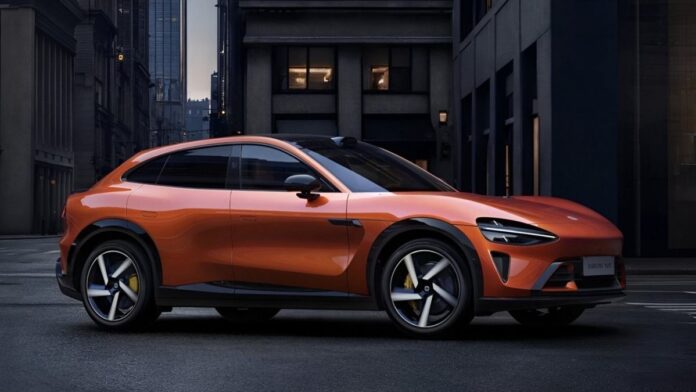
But Xiaomi’s advance isn’t limited to sedans. The YU7 tall SUV received 240,000 orders within 18 hours of its unveiling in China. Its dimensions are 4,999 × 1,996 × 1,600 mm, and its wheelbase is 3,000 mm. The all-wheel-drive version of the YU7 weighs about 2,405 kg.
Read also: VIOFO A329S 3CH Review: 5 Reasons to Install This Flagship Dash Cam in Your Vehicle
To prove that the SUV is no ordinary family car, Xiaomi sent the YU7 GT to the Nordschleife with the Track Package. It clocked a lap time of 10:29.483 – and was even driven by an autonomous system. Such a demonstration of capabilities is bound to make an impression.

The most mature area of development for Xiaomi in its short automotive history has been the recent shift toward electric vehicles with extended range. The SkyNomad lineup, unveiled just a few months ago, utilizes the Kunlun HyperRange architecture. In city centers, pure electric propulsion remains an absolute priority, but significant parts of Southern and Eastern Europe lag behind in the development of fast-charging networks. The combination of an electric chassis with an onboard generator is an example of market adaptation.

The road ahead will certainly not be easy – the political situation surrounding Chinese imports remains unstable, and it will be difficult to convince Audi or Mercedes fans to spend money on a brand previously associated with electric scooters for children. It will also be interesting to see whether Xiaomi will develop a full lineup of right-hand-drive cars specifically for the British market.
Read also: Xiaomi has unveiled new power banks: The 20,000mAh models feature enhanced protection