





© ROOT-NATION.com - Use of content is permitted with a backlink.
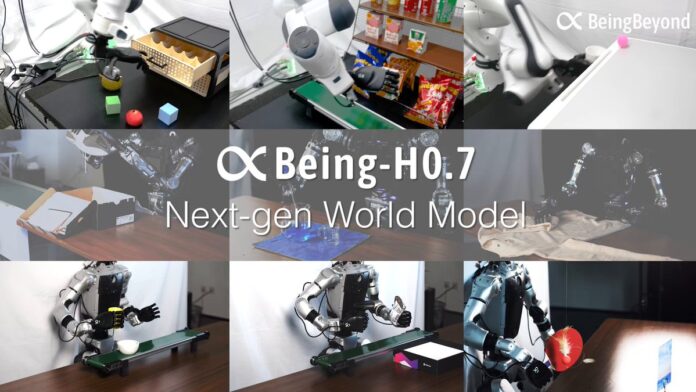
BeingBeyond has unveiled the world’s most powerful model, marking the beginning of the “brain era” for the embodied intelligence industry. This technological achievement allows robots to learn to understand actions as naturally as they learn language. Compressing 200,000 hours of human behavior video into a single chip for edge computing means the first commercially viable model of the world capable of local deployment.
BeingBeyond, as a pioneer in the use of human action video data, provided the perfect answer to the industry’s challenges at this pivotal moment. As robots move from demos to real-world operations, they often struggle to make sense of their environment and tasks, and continuous decision-making in changing circumstances is even more difficult. More and more experts agree that the methods of teaching robots to act need to be radically rethought.

The Being-H0.7 model is an intelligent system trained on enormous amounts of human behavioral data that can migrate between different robots and perform complex operations in the real world. Unlike generative video solutions that require huge computing power and have high latency, Being-H0.7 uses a hidden-space reasoning method. This brings the system closer to human physical intuition, allowing the model to directly estimate future states and outcomes of actions. This approach has made it possible to compress the world model to run on real-time peripherals, making it the first such product in the industry. In less than a year, BeingBeyond has demonstrated a complete technology cycle, from pre-training on video to data collection and model deployment, allowing embodied intelligence to evolve from a general base to expert skills.
Three main areas have emerged in the modern AI industry: VLA for understanding, world models for prediction, and remote control for direct implementation. However, most of them are limited to data from the robots themselves, which ties skills to specific hardware or scenarios. Existing solutions from NVIDIA or DreamZero rely on predicting the next frame of video, which is difficult to implement locally due to high energy consumption. In addition, two-dimensional images do not capture complex physical processes, such as interactions with liquids or flexible objects. BeingBeyond suggests a different way: since robots will be working among people, they should be trained on large-scale videos of human activity that better reflect the actual distribution of tasks. This allows machines to learn physical laws and principles of interaction on a “subconscious” level, just as athletes react to the movement of a ball without having to calculate every second of the future image in their heads.

Experiments have shown that Being-H0.7 took first place in six global rankings, becoming the most comprehensive model in the world. The information was compressed at least one hundred times, which allowed the system to run on the Orin NX platform with a capacity of about 75 TOPS. This makes BeingBeyond the first team to implement a real-time world model on a chip with such computing power. The difference in the teams’ approaches often depends on the definition of the problem itself. Many developers in China are focused on hardware and optimizing the management of specific robots, which locks data within a single platform. BeingBeyond founder Lu Zongqing, as a scientist, asked the fundamental question of what kind of data a model should learn from to acquire general abilities. He created a system where vision, speech, and action are combined into a single sequence for human-centered learning.

A series of Being-H models confirmed that with enough data on human behavior and the performance of different robots, the model can be successfully transferred between devices while maintaining stability. The previous version, H0.5, proved the viability of the concept of learning from human experience, while H0.7 demonstrated the feasibility of implementing this approach in real-world scenarios. In this ecosystem, the H series solves general intelligence issues, Being-Dex adapts skills to specific business scenarios in minutes, and the U1 system provides a continuous stream of high-quality data with the help of skillful mechanical hands. This closed-loop production is a rarity in an industry where data, modeling capabilities, and deployment have long existed in isolation.
Currently, the industry has a clear division between the development of the robot’s body and its brain. Companies increasingly prefer to buy off-the-shelf intelligent systems instead of spending tens of millions of dollars on in-house development, which requires constant investment in computing and human resources. Intelligence outsourcing is becoming more profitable and efficient, as it allows for faster implementation of new features without the need to create models from scratch. BeingBeyond has already established partnerships with leading robot manufacturers, offering them a foundation of general capabilities complemented by task-specific expertise. The arrival of Being-H0.7 signals the industry’s transition from scattered attempts to a clear division of labor, with some focused on mechanics and implementation and others on creating universal intelligence.
Read also:
- A psychopath with a German accent: First plot details of Hideo Kojima’s Physint revealed
- What’s inside the Russian drone “Knyaz Veshchiy Oleg”: Main Directorate of Intelligence releases a 3D model