





© ROOT-NATION.com - Use of content is permitted with a backlink.
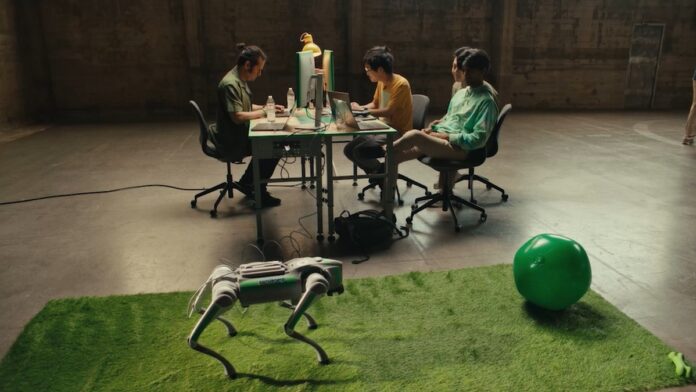
As part of an ongoing internal research project called Project Fetch, which utilized a ready-made, mass-produced quadruped robot, Anthropic demonstrated the impressive capabilities of its latest development. Company representatives reported that Claude Opus 4.7 demonstrated a significant speed advantage over human teams during a series of robotic missions.
The first phase of this experiment took place back in late summer 2024. At that time, the organizers sought to determine whether Anthropic employees – who were not professionally involved in robot development – could coordinate interactions with a robot dog using a text-based assistant. The participants were divided into two groups: the first group relied on Claude’s support, while their opponents searched for answers exclusively on the internet and relied on their own experience.

Read also: AERONAUT – everything that flies above the ground: aviation, UAVs and drones, rockets, and space
During those initial tests, the group that interacted with the AI achieved better results. However, as Anthropic notes, the top-of-the-line version at the time, Claude Opus 4.1, proved unable to complete the entire planned set of procedures autonomously, as it got stuck at the stage of establishing a communication channel with the hardware. Meanwhile, the team without a digital assistant encountered such difficulties in configuring the interfaces that the organizers had to intervene directly so that the participants could move forward at all.

Recently, the developers decided to repeat certain stages of the test using the latest version, Claude Opus 4.7, which this time operated via the Claude Code environment. According to Anthropic, the updated technology demonstrated a massive leap in performance, completing every mission that at least one of the human teams had managed to complete at least ten times faster.

When evaluating the four specific tasks completed by both human teams, Claude Opus 4.7 took only 9 minutes and 35 seconds to complete them. In contrast, the experts working without digital support took 361 minutes to complete the same amount of work, while the team using AI finished in 181 minutes. As a result, the algorithm outperformed the fully independent human team by approximately 37.7 times and the human-machine team by 18.9 times.
The list of engineering challenges included establishing a connection with the device’s onboard video camera, integrating with a LiDAR sensor, writing code to control the robot, tracking its movement in space, and identifying an inflatable beach ball. Anthropic’s reports indicate that Opus 4.7 identified optimal technical implementation paths much more accurately and instantly, and the total amount of code it wrote turned out to be nearly ten times less than that of the human team using AI.

However, these achievements by no means indicate that artificial intelligence has completely resolved all issues in the field of robotics. The company emphasized that the system still faced significant difficulties in the final stage, when the robot dog was required to pick up the ball and transport it as carefully as possible back to the starting point. Such operations in a closed-loop control system remain a serious challenge for algorithms, as they require instantaneous perception of the environment, immediate error calculation, and constant physical adjustment of actions.
Analysts at Anthropic view these tests as clear confirmation of global trends in the development of intelligent systems. The evolution of technology follows a predictable pattern: initially, algorithms serve only as auxiliary tools for specialists; later, human operators begin to support and guide the systems’ actions; and ultimately, artificial intelligence transitions to fully autonomous completion of individual stages or tasks as a whole.
Company representatives drew a parallel with processes already underway in the fields of cybersecurity and traditional programming. In those fields, AI-based software systems have evolved from simple advisors to fully autonomous units that operate within existing software without constant supervision.
In conclusion, Anthropic characterized the data obtained as the first real manifestations of the emergence of physical agent-based AI, where digital models gain the ability to interact with actual hardware and equipment to solve local tasks. The company concluded that much scientific work still lies ahead to create truly reliable methods for designing control policies or flexibly adapting robotic platforms, but added a caveat: as foundational general-purpose models evolve, even vast gaps in technical capabilities can disappear very rapidly.
Read also:
- Dreame L60 Ultra PE Review: The Robot That Cleans While You Live Your Life
- The end of the monochrome era: Ouster taught LiDAR to see colors and gave robots human vision