





© ROOT-NATION.com - Use of content is permitted with a backlink.
For a long time, artificial vision of machines has remained monochrome. LiDAR laser sensors, which serve as sensors for autonomous vehicles, industrial robotics systems, and inspection drones, have successfully created accurate three-dimensional maps of the environment, but all objects on them are displayed as one-color geometric shapes.
The Rev8 sensor family from Ouster is designed to change this situation radically. Instead of simply connecting a standard camera with a LiDAR module, the engineers have implemented a technology that integrates color data directly into each point that the sensor captures.

Modern autonomous perception systems usually fall into two categories. The first is systems based exclusively on video cameras, such as the optical system used by Tesla in its unfinished Full Self Driving technology. The second is a two-stage method of data fusion, where LiDAR is responsible for the accuracy of geometric parameters, a traditional camera captures color, and special software algorithms combine this information. The process of such stitching inevitably leads to calibration errors, delays in signal transmission, and spatial discrepancies, which can have critical consequences when a robot or car is moving fast through crowded city streets.

The Rev8 modification completely eliminates this complex architecture. Each individual point on the three-dimensional map created by this sensor already contains color information at the moment of capture, which frees the system from the need for additional software processing. Ouster’s representatives note that this is the first LiDAR in history to have color built in at the hardware level.

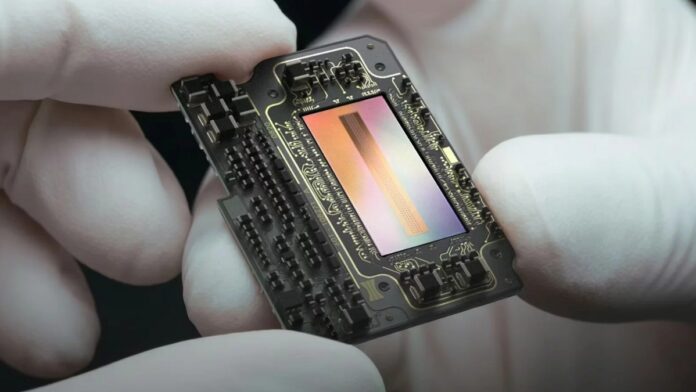
The technological basis of Ouster’s development is based on the new L4 microchip, which uses color algorithms from Fujifilm, a company known for its achievements in the image processing industry. This chip provides color processing directly at the hardware level. It has a computing power of 42.9 GMACs, is capable of capturing up to 20 trillion photons per second, and operates at a frequency of 40 kHz with an accuracy measured in picoseconds. Despite the complexity of these technical parameters, in practice, they mean that one single device can now independently recognize road signs, determine the beginning of braking of the car in front of it by the change in the color of its brake lights, or create topographic plans with natural color display. All of this is done without the need to connect auxiliary devices or calibrate.
OS1 Max is the flagship of the Rev8 lineup. This 256-channel device has a range of up to 200 meters with a 10% reflectivity of objects, meaning that it is able to capture even those surfaces that absorb most of the light directed at them. In favorable conditions, its range of operation reaches 500 meters. The sensor’s viewing angle is 45 degrees vertically and a full 360 degrees horizontally. Ouster claims that these figures are twice the range and resolution of the previous generation Rev7 devices.

The sensor demonstrates stable operation in an extremely wide range of light conditions: from deep twilight of 1 lux to extreme direct sunlight of 2 million lux. The color depth reaches 48 bits with a dynamic range of 116 dB. Such technical properties demonstrate the device’s ability to clearly distinguish fine details in both very bright and maximally dark areas of the frame.

Ouster CEO Angus Pakala emphasized that the Rev8 series is the most advanced family of laser scanners ever and sets completely new benchmarks in the industry. Thanks to the L4 silicon chip, the developers were able to realize the potential of digital architecture, providing a multiple increase in performance. The company was able to double the basic technical parameters and at the same time demonstrate the world’s first LiDAR with built-in color, which gives machines human-like three-dimensional vision, which is necessary for the development of next-generation physical artificial intelligence. Google, Volvo Autonomous Solutions, Skydio, PlusAI, and Seegrid were among the first customers to implement this technology. In total, about 22 companies operating in the fields of robotics, automotive, and smart infrastructure are already testing the new technology.
Read also:
- 10 Examples of the Strangest Uses of AI
- €339 and LiDAR: DJI introduces Lito series of drones for beginners