





© ROOT-NATION.com - Use of content is permitted with a backlink.
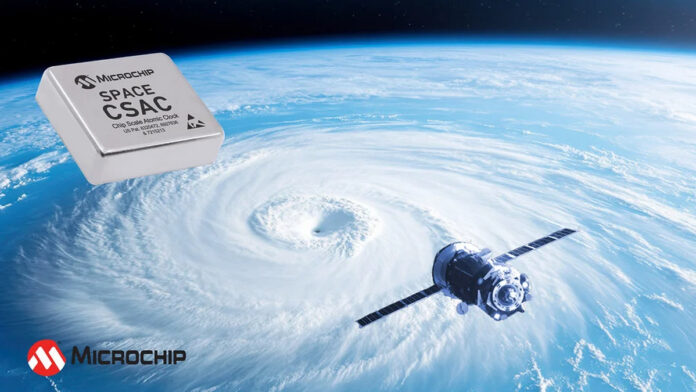
Microchip has launched a new miniature atomic clock designed for use in the space industry, which features enhanced radiation resistance and an extended operating temperature range.
This device is designed to maintain exceptionally accurate timekeeping on small spacecraft, particularly CubeSats and satellites operating in low Earth orbit (LEO), during periods when there is no access to external signals from global navigation satellite systems (GNSS).

Atomic clock mechanisms measure time using the natural resonant frequency of atoms, such as cesium. Their main advantage lies in their minuscule error rate, which is approximately 1 second in millions of years. The first versions of such clocks were the size of entire cabinets, as they required bulky systems to contain the atoms and record their reactions; but thanks to semiconductor technologies, they have been reduced to the size of a microchip, which led to the emergence of the term CSAC.
Microchip’s latest development is an improved version of the previous CSAC-SA45 model. The previous model had a rated resistance to the total absorbed dose of ionizing radiation of at least 20 kilorads (kRad), whereas in the new model, this figure has been increased to at least 30 kRad. The kRad rating reflects the cumulative radiation dose that the device can withstand, and a higher rating allows the equipment to operate in space for a longer period of time. At the same time, the operating temperature range has been expanded: whereas it previously ranged from -10°C to 70°C, it now ranges from -40°C to 80°C.

The device has retained virtually the same dimensions and power consumption. The housing volume is less than 17 cubic centimeters, and power consumption does not exceed 120 mW, making it suitable for installation in small satellites.
Orbiting spacecraft require highly accurate time references for communication, as well as for calculations related to positioning and navigation. They typically rely on signals from GNSS systems, such as GPS; however, in the absence of such signals, they use their own high-precision onboard clocks. The use of CSAC enables a satellite to maintain high time accuracy for extended periods without an external synchronization source.

Randy Brudzinski, Corporate Vice President of Microchip’s Frequency and Timing Systems Division, noted that atomic-clock-level accuracy is now available for integration even into the most compact CubeSat-format devices. According to him, this helps maintain synchronization and timing accuracy in environments where external sources of precise time are unavailable.
The Space CSAC-SA65 is now officially available for purchase.