





© ROOT-NATION.com - Use of content is permitted with a backlink.
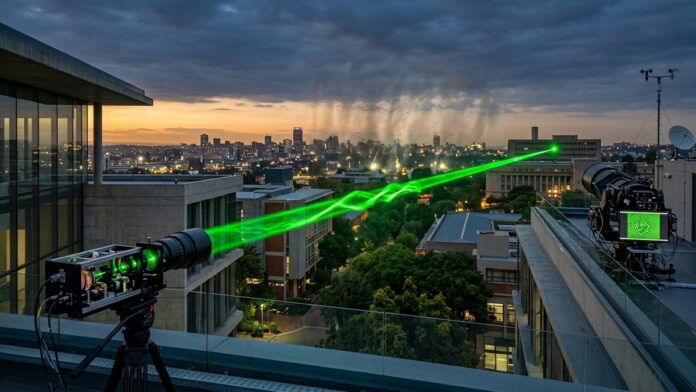
Researchers from the University of the Witwatersrand (Wits) and the University of Bordeaux in France have developed an innovative method for transmitting data through the atmosphere without the need to correct for distortions that typically disrupt optical communication channels. During an experiment conducted at Wits’ West Campus in Johannesburg, the researchers demonstrated that information encoded in a specific light – its topology – retains its integrity even when the laser beam carrying this data is subjected to severe distortions caused by atmospheric turbulence.
The findings, published in the journal *Science Advances*, could pave the way for the development of significantly more reliable long-distance optical communications, including links to satellites and spacecraft, as well as improve connectivity in remote and underserved regions.

Modern communication systems utilize various properties of light – including color, intensity, and polarization – to transmit information. Fiber-optic lines protect such signals from a significant amount of external interference; however, guiding a light beam through the open air is a much more challenging task. Fluctuations in temperature and air pressure create atmospheric turbulence that can distort the laser beam as it travels. This phenomenon can corrupt the data it carries. The Wits team took a radically different approach by encoding information into topology – a mathematical concept that describes properties that remain unchanged even when an object is stretched or distorted.
To better illustrate the method’s advantages, Professor Andrew Forbes, who heads the Structured Light Laboratory at the Wits School of Physics, compared it to how a coffee cup can be transformed into the shape of a doughnut. He noted that despite the drastic difference in appearance, both objects have one through-hole each. They can be stretched or reshaped without altering this fundamental characteristic. In the same way, a light beam can be significantly bent, but its topological properties will remain completely intact.
To implement this encoding in laser beams, the researchers used a special optical structure called a skyrmion. They then directed light beams between two buildings on the Wits campus, a distance of several hundred meters, exposing them to natural air turbulence. Although the shape of the light at the receiving end differed drastically from the original beam, the data contained in its topology remained intact. Lead author Cade Peters emphasized that small-scale laboratory tests had previously indicated the topology’s ability to ensure robust information transmission. However, it is only now that scientists have succeeded for the first time in demonstrating such robustness on a real optical link under natural atmospheric conditions.
Traditional outdoor optical communication systems typically require prior measurement of atmospheric distortions, followed by their compensation using specialized equipment and complex calculations. The newly developed method does not require measuring or correcting distortions for subsequent data retrieval. This approach has the potential to simplify future systems and reduce the technical and computational requirements involved in transmitting information under challenging environmental conditions.
Professor Mitchell Cox of the Optical Communications Laboratory at the Wits School of Electrical and Information Engineering emphasized that the ability to encode and transmit data using light has fundamentally transformed global communications. He added that as data volume demands grow, there is a need for new solutions to increase network capacity, reliability, and efficiency. The study demonstrates that topology is a scalable and, as yet, underutilized resource that has the potential to form the basis of the next generation of optical communications. The researchers also explored the potential for applying the method in both traditional and quantum communication networks, where maintaining data integrity is of paramount importance.
Regarding South Africa, Cade Peters noted that the discovery could eventually yield significant social benefits. He noted that the country is still facing serious challenges in ensuring reliable access to information and communication technologies, especially in remote and underserved communities. By developing new concepts for long-distance optical communication, the authors hope to contribute to global efforts to bridge the digital divide.
Read also: Physics Turned Upside Down: Scientists Have Created the World’s First Quantum Battery