





© ROOT-NATION.com - Use of content is permitted with a backlink.

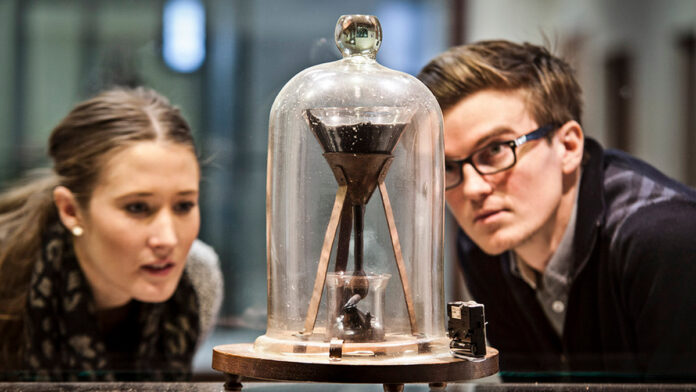
The world’s slowest scientific experiment, which is being conducted in Australia, has been going on for almost a century. This 97-year-old study clearly demonstrates that substances that appear to be solid can flow. Some scientific experiments are completed in minutes. Others take years to complete. However, there is a resin dripping study that has been going on for almost a hundred years and is still far from its conclusion. This experiment, conducted at the University of Queensland in Australia, has gained worldwide recognition as the longest continuous laboratory study in history. It dates back to 1927, when physicist Thomas Parnell decided to demonstrate a phenomenon that at first glance seems almost impossible: a material that looks completely solid can actually behave like a liquid.

The material around which this entire experiment is built is bitumen resin. It is a black substance that visually resembles tar and was previously widely used to provide waterproofing for boats. At room temperature, this substance seems absolutely hard to the touch. If you hit it with a hammer, it can shatter into small pieces, just like glass. However, from the point of view of physics, resin is not a true solid. It is an extremely viscous liquid, which means that it can flow, although it does so incredibly slowly.
To confirm his hypothesis, Parnell heated a certain amount of resin and poured it into a glass funnel. After that, he left the substance for several years to settle and stabilize. In 1930, the lower part of the funnel tube was cut off, which started the extremely slow downward movement of the resin. Since then, the essence of the experiment has been to constantly wait for the moment when the next drop of the substance separates from the funnel and falls into the chemical beaker below it.

It is because of this long wait that the experiment has become legendary. Since its launch, only nine drops have fallen. The ninth drop was separated in April 2014, during the procedure of replacing the glass on the bottom. The process of forming the tenth drop is underway right now.
The main reason for this enormous duration is the viscosity. Viscosity determines the degree to which a liquid resists its own flow. Ordinary water has a low viscosity level, so it pours out instantly. Honey is characterized by a higher viscosity, which makes it flow much slower. However, bitumen resin is in a completely different league. Representatives of the University of Queensland describe this substance as the densest of all known liquids on the planet, and the Guinness Book of Records records that this study proved that the resin is about 100 billion times more viscous than water.

That is why this experiment is such a valuable and effective educational tool. It forces us to rethink our everyday ideas about the nature of solids and liquids. People usually classify materials based on observations over short periods of time. If an object remains motionless in front of our eyes, we consider it to be solid.
However, scientific processes often unfold over time periods that far exceed the limits of human patience. A majestic mountain may seem unshakable and eternal, but it is gradually being destroyed by erosion. Glass seems absolutely rigid to us, but materials can demonstrate completely different properties under certain conditions. Resin clearly proves that certain substances can be perceived as solid objects in everyday life, but still continue to flow when viewed through the prism of long periods of time.

This experiment also became a unique lesson in patience for centuries. The history of the experiment is filled with amazing unfortunate accidents and almost-caught moments. For many decades, no one had been able to see the drops falling with their own eyes. They always separated at the most inopportune time, or the equipment failed and the cameras did not record the event. The eighth drop fell in 2000, and the ninth separated in 2014. Today, the experiment can be watched in real time via the Internet, which has turned one of the slowest phenomena in world science into a kind of global online waiting game.
The uniqueness of this research is not in the use of sophisticated technology. Its structure is as simple as possible: a portion of resin, a glass funnel, a chemical beaker, and time. However, it is precisely this simplicity that holds the secret of success. The experiment makes an elusive physical idea visible to everyone. It transforms the abstract term “viscosity” from a dry textbook definition into a phenomenon that becomes understandable through one single image – a drop that takes years to form and fall.
The resin dripping experiment was not created for the sake of speed, spectacle, or instant results. It serves as a powerful reminder that natural processes do not always adapt to the pace expected by humanity. Certain truths are revealed only when someone has the endurance to continue long and careful observation. The experiment is successfully continuing even almost a hundred years after its start. And right now, somewhere in the depths of this glass funnel, the next drop is slowly making its way down.
Read also:
- Breakthrough Development: Scientists Create Artificial Muscles Activated by Ultrasound
- NASA scientists are preparing to study the impact of solar storms on Mars