





© ROOT-NATION.com - Use of content is permitted with a backlink.
AMD’s latest processors, accelerators, and integrated solutions are designed to boost the performance of PCs and cloud services. For users, that ultimately means one thing: faster, smoother experiences at a reasonable price.
When a company puts a rack of server processors on stage, it’s hard to imagine how any of this could have anything to do with your morning alarm clock or the robot vacuum cleaner in the hallway. That’s why presentations such as AMD Advancing AI usually fly under the radar of the general public – this is the domain of data center engineers, not everyday electronics users. And yet, this time it’s worth taking a closer look. Because behind the megawatts, terabytes of HBM4, and percentage gains in performance lies a simple idea: artificial intelligence is no longer just becoming something you talk to – it is starting to become something that acts.
Read also: OpenAI’s Astra: When an Algorithm Reaches What Took Mathematicians Decades to Achieve
TABLE OF CONTENTS:
Three Floors of the Same Building
The easiest way to visualize what AMD presented is as a three-story building. On the top floor are the “model factories” – massive computing facilities where the largest language models are trained and operated. The middle floor is enterprise infrastructure: the backend that handles email, documents, and corporate chatbots. And on the ground floor, closest to the street, are edge devices: laptops, cars, robots, and medical equipment.

Previously, artificial intelligence was discussed mostly in the context of the top floor: the more powerful the model, the better the chatbot. Now, AMD’s focus has clearly shifted toward the concept of “agentic” AI – systems that don’t simply respond to a prompt, but can independently plan a sequence of actions, interact with other services, write and execute code, and sometimes even coordinate with other agents. The difference is roughly the same as between an employee who waits for instructions at every step and one who is given a task and decides for themselves how to get it done.
Read also: Everything You Need to Know About AI Browsers: A Loud Debut, a Quiet Finish
Helios: The Rack That Determines How Affordable Your Favorite Chatbot Will Be
The headline announcement is Helios, a server rack built around 72 Instinct MI455X accelerators and 18 new Epyc servers, connected through AMD’s proprietary networking and ROCm software stack. That configuration alone probably doesn’t mean much to the average user. But the end result does. According to AMD, Helios can deliver up to 30% more generated tokens per dollar spent compared with its main competitor’s solution. And that is a metric anyone who pays for an AI service can understand.

Notably, AMD says that some of the industry’s biggest players plan to run their frontend systems on this infrastructure. If that proves true in practice, future versions of popular assistants will likely run at least partly on AMD hardware – even if all the user ever sees is a browser window. And “more tokens per dollar” ultimately means one of two things – or potentially both: cheaper plans and higher usage limits, or faster responses at the same price.
Read also: Anthropic Peers Inside AI: What Really Lies Within Claude’s J-Space
Epyc 9006: The Boring Processor That Determines Whether You Actually Get Help
The least flashy part of the announcement – the new Epyc 9006 processors – is actually the one that matters most to users. AMD divides the data center into three roles: servers for agentic workloads (code execution, sandboxes, and connections to third-party services), accelerator host servers, and traditional application infrastructure.
Imagine a simple scenario: you ask a digital assistant to go through years of your emails, documents, and messenger conversations, and then run a few scripts to analyze everything. If outdated hardware is sitting behind that request, the task will simply “get stuck in the queue.”
The top-end Epyc 9006 configuration offers up to 256 compute cores and 512 threads in a single processor, up to 16 memory channels, and support for the latest generation of PCIe. In other words, it provides the kind of headroom that allows an agent to build a complete picture in seconds rather than minutes.
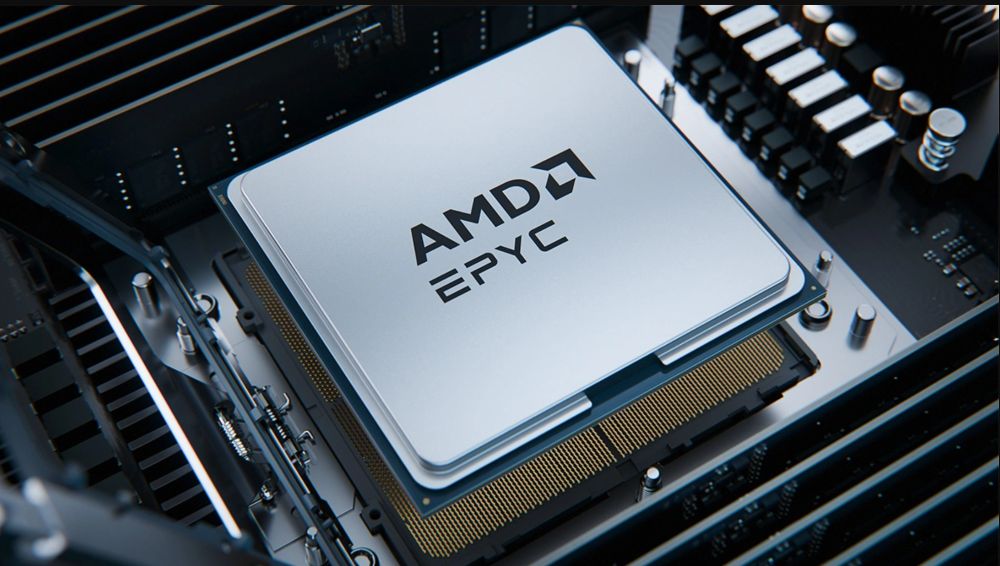

An average user will never buy an Epyc processor. But whether a corporate AI assistant becomes a genuinely useful tool or remains just another clumsy button in the work chat depends largely on how powerful that “invisible” server-side infrastructure is.
Read also: Passkeys Instead of Passwords: Is the World Ready for a New Authentication System?
MI400: When Computing Power Becomes a Matter of Trust
The new Instinct MI400 family of accelerators, including the flagship MI455X and the MI430X designed for scientific workloads, may seem like a purely technical topic at first glance. But one aspect reaches far beyond data centers: the emphasis on “sovereign” AI – infrastructure that countries and large institutions can control themselves, without depending on someone else’s cloud.

For an abstract weather app, this makes little difference. But as soon as medical data, financial information, or government decisions are involved, the difference between “a model running in someone else’s cloud” and “a model running on your own hardware under your own jurisdiction” is no longer a minor detail. These are precisely the kinds of infrastructure decisions that determine who ultimately controls your personal data when you use AI services in healthcare, banking, or government services.
Read also: Planning to Buy a Laptop? Answer These Three Questions
ROCm.ai: AI That Accelerates AI
Another important piece of the puzzle is the ROCm.ai software platform, designed to address one of AMD’s long-standing weaknesses in the AI development ecosystem: the complexity of configuring an environment for its GPUs. The company is introducing an updated command-line interface for installing and managing the environment, built-in “skills” for coding assistants, and a dedicated agentic system that can automatically optimize workloads during inference.

According to AMD, these automated optimizations can deliver an average 3.3× increase in inference performance and a 2.4× improvement in training performance compared with the previous version of the platform on the same hardware. Even if the real-world gains turn out to be more modest than the marketing figures suggest, the direction itself is important. If the software ecosystem genuinely becomes easier to use, AMD hardware could stop being the “backup option for those who couldn’t get Nvidia” and become a fully-fledged alternative – including for small development teams and enthusiasts running AI workloads at home.
Read also: Everything You Need to Know About Moonshot AI’s Kimi K3: How Chinese Startup Challenged AI Giants
Ryzen AI Embedded X100: When AI Gets Up from the Desk
Perhaps the most interesting part of the entire presentation, at least for me, is what AMD calls “physical AI.” We are no longer talking about cloud-based agents or even models running on a laptop, but about machines that can independently perceive the physical world and act within it. That is where the new Ryzen AI Embedded X100 chip comes in. It features up to 16 Zen 5 cores, an integrated GPU, and a powerful neural processing unit on a single chip, targeting applications in robotics, industry, healthcare, and defense systems.

This hardware is not intended for an ordinary laptop or smartphone – at least not yet. Its purpose is different: processing sensor data in real time and controlling actuators with minimal latency in situations where delays can be costly, from surgical instruments to industrial robots operating alongside people. According to AMD, compared with competing processors, the chip delivers significantly higher performance in multithreaded workloads, better graphics performance, and substantially higher token-generation throughput. The company also claims an advantage over specialized robotics solutions in workloads such as signal processing for advanced ultrasound. Add to that an industrial operating temperature range and a claimed lifespan of up to ten years of continuous 24/7 operation – specifications that make much more sense on a factory floor or in a hospital than in a gaming PC.
The practical takeaway is simple: “physical” AI is unlikely to arrive as a single spectacular gadget. Instead, we are likely looking at an entire generation of devices built around full-fledged heterogeneous computing systems – a cleaning robot that actually cleans, a waiter robot that can navigate a crowded dining room, or a bartender robot that doesn’t spill the drinks.
Read also: How Wearables and AI Glasses Are Rewriting the Logic of Technological Civilization
Kria AI and the Partner Network: Robotics as a Construction Kit
AMD complements this picture with the Kria AI family of modules based on the same X100 chip, along with a “Robotics Developer Platform” – a collection of open tools and libraries. The idea is simple: instead of a robot manufacturer spending months designing its own board, choosing a separate processor, accelerator, and sensors, and then integrating everything into a single system, it can start with a ready-made computing module – essentially a “brain in a box.”

If this approach works, it could significantly lower the barrier to entry for robotics development – much like affordable single-board computers once opened the door to hobbyist robotics, only now on an industrial scale. And the cheaper prototyping becomes, the faster robots are likely to move beyond factories and into offices, hotels, and eventually our homes. Inevitably, that will bring a new set of questions: about privacy, physical and digital security, and how different an autonomous robotic agent really is from an ordinary tool.
Read also: Key You’ve Been Ignoring for Years: Hidden Potential of Windows Key
What to Take Away from All This
The entire picture – from Helios racks to X100 embedded chips – converges on one vision: AI is ceasing to be exclusively a cloud service and becoming infrastructure woven into everyday life. An office assistant that can genuinely take over part of the routine workload; a service capable of handling official matters through access to a “sovereign” model operating under its own country’s jurisdiction; industrial robots that can adapt to new tasks without completely redesigning the production line – these are the kinds of scenarios AMD is trying to bring closer through hardware.
Of course, a significant portion of the presentation consists of carefully selected benchmarks, where comparisons with competitors naturally tend to favor the presenter, and performance multipliers should be viewed with a healthy degree of skepticism. But if we strip away the marketing rhetoric, the shift in direction is clear: AMD is no longer simply offering a cheaper alternative to the market leader. It is trying to build an end-to-end ecosystem – from massive computing farms all the way to a robot working on a factory floor.
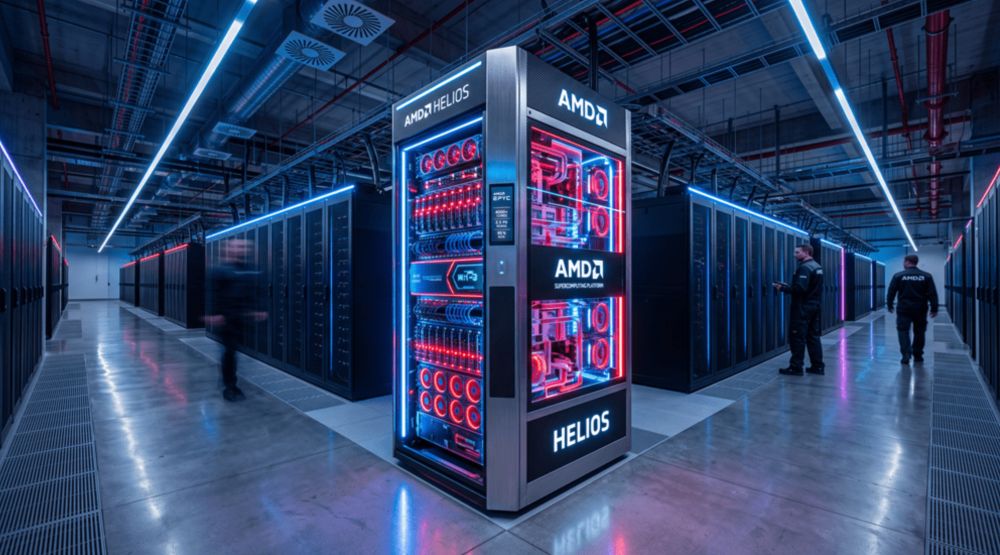

So instead of getting caught up in the specifications of a flagship accelerator, the average user should ask a different, much more practical question: am I ready for a world in which AI doesn’t just answer, but acts? Helios accelerates the model, Epyc provides its server-side foundation, ROCm.ai optimizes how it runs, and the Ryzen AI Embedded X100 turns computation into physical movement. Everything else – laws, ethical standards, and common sense – is no longer a problem for engineers alone. It is a task for society.
Read also: AI in Medicine: Is the Future Already Here?

