





© ROOT-NATION.com - Use of content is permitted with a backlink.
Many internet users know that Proton Mail is the world’s largest secure email service. It offers end-to-end encryption along with a wide range of privacy-focused security features designed to protect personal communication. What many people do not realize, however, is that Proton is much more than just email. The ecosystem also includes a VPN service, an encrypted Calendar, a Password manager, and Proton Drive cloud storage with built-in document creation tools. Today, we’ll take a closer look at all of these services.
TABLE OF CONTENTS:
Why this matters
We live in an era where “free” often means paying with your data. Gmail scans emails to serve advertising. Facebook has visibility into who you communicate with and when. Every search query, every click, every message becomes input for systems that build a digital profile of the user. Most people have come to accept this as normal. However, it is not necessarily normal in any principled sense – it has simply become standard practice because a credible alternative has been largely absent. Proton Mail has attempted to address this gap, and it appears to have done so with a degree of success.

A Swiss company founded by physicists from CERN now serves over 100 million users worldwide. It has evolved from a simple email service into a full ecosystem of privacy-focused digital tools. Its trajectory illustrates what can happen when technical idealism meets sustained market demand. It also reflects a broader shift: privacy is no longer framed as paranoia, but as a deliberate choice that users can make consciously.
Born from anxiety
There are companies born out of profit motives. There are those that emerge from technical challenges. Proton was born out of anxiety.
In 2013, the world became aware of the scale of digital surveillance when Edward Snowden disclosed documents about mass surveillance by the NSA. For a group of scientists at CERN – the European Organization for Nuclear Research – this was a turning point. Among them was Harvard PhD student Andy Yen, who was working on searches for supersymmetry in the ATLAS experiment. Together with his colleagues, he decided to build something fundamentally different: a highly secure email system based on end-to-end encryption.
Three young entrepreneurs, inspired by their time at CERN, launched ProtonMail – a encrypted email service built on a fundamentally different approach to data protection. “Access to user data is technically impossible due to how we implemented encryption,” Yen stated. End-to-end encryption meant that by the time an email reached the company’s servers, it was already encrypted – and even the founders themselves could not read it.

Within three days of launch, 10,000 people signed up for the service. This was not the result of a marketing budget, but rather a response to a broader sense of concern that was spreading globally at the time: concern about corporations reading private correspondence and governments retaining metadata.
The company has been based in Geneva since its founding in 2014. The name, incidentally, is not accidental: the founders had worked on the Large Hadron Collider, where protons are accelerated. Hence the name ProtonMail.
Read also: Key Takeaways from Google I/O 2026
The technology that makes the promise possible
To understand how Proton Mail differs from Gmail or Outlook, it is necessary to examine what “end-to-end encryption” actually means – and why it implies more than simply being “secure.”
A conventional email service stores messages on its servers in a readable format. Google, for example, can – and in the past openly did before moving away from the practice under regulatory and public pressure – scan email content to serve advertising. It can also be required by court order to hand over messages to law enforcement. In the event of a breach, the data is exposed in readable form to attackers.

Proton Mail uses PGP standards, end-to-end encryption, and zero-access encryption for email, calendar, and contacts. This means that even the developers themselves cannot decrypt or read user messages. Encryption keys are generated and stored exclusively on the user’s device, while Proton’s servers retain only encrypted data that cannot be interpreted without those keys.
The cryptographic methods required for this architecture were well within the capabilities of a team experienced in developing detector systems for the Large Hadron Collider. When Proton Mail claimed that its encryption was mathematically robust, this assertion was grounded in the expertise of its engineers.
Another relevant aspect is transparency. Proton Mail is largely open source, meaning that external researchers can independently verify what the code actually does, rather than relying solely on trust. In the privacy domain, where trust functions as a form of currency, this is not a secondary detail but a foundational principle.
Read also: What is ANEEL and why thorium could change nuclear energy
Ecosystem: from email to AI assistant
Over the course of a decade, Proton Mail has evolved from a simple email service into a full-fledged digital ecosystem. Today, the Proton brand brings together several interconnected products.

Proton Mail – the flagship privacy-focused email service
The service allows users to create @proton.me and @protonmail.com addresses, send encrypted emails and attachments, and protect messages with a password even when communicating with recipients outside the Proton ecosystem.
Emails between Proton users are encrypted automatically and end-to-end. For external recipients (such as Gmail or Outlook users), senders can set a password and an expiration time, after which the message becomes inaccessible. This approach is intended for sharing sensitive information with people who do not use encrypted email services.

A separate feature is Proton Bridge, an application that allows Proton Mail to be used with traditional email clients (Apple Mail, Outlook, Thunderbird) via IMAP and SMTP protocols. This is particularly relevant for users who prefer conventional interfaces but do not want to give up encryption.
Business-oriented features include support for custom domains (allowing a company to use addresses such as [email protected] while still relying on Proton’s encrypted infrastructure), a catch-all function for collecting emails sent to any address within a domain, as well as filters, labels, and folders for inbox organization.
Proton VPN – Swiss protection against online surveillance
Proton VPN supports more than 20,000 servers across 140 countries, allowing users to connect to the fastest or most convenient location. The service hides the user’s real IP address and operates under Swiss privacy laws, which are among the strictest in the world.
Among the key features that distinguish Proton VPN from its competitors are several notable capabilities.

NetShield is a built-in blocker for ads, trackers, and malicious domains. It works without requiring a browser extension – everything operates directly within the VPN application. This enables a cleaner browsing experience across all devices, including mobile phones and smart TVs. Recent updates have reportedly made NetShield significantly more effective at blocking ads and trackers than earlier versions.
Secure Core is a form of double VPN routing: the connection passes through two servers before reaching its final destination. If one server were to be compromised, the second layer helps preserve the privacy of the connection. When enabled, traffic is first routed through dedicated servers in Iceland, Sweden, or Switzerland.
Stealth protocol masks VPN traffic, making Proton VPN more resilient against firewalls and deep packet inspection in countries such as China or the UAE.
The free tier of Proton VPN remains one of the most competitive on the market. Following an update in late 2025, the number of available countries increased from 5 to 10. It offers unlimited bandwidth, no advertisements, and full access to core privacy protection features without logging.
Proton Drive – encrypted cloud storage
Proton Drive is a cloud storage service with end-to-end encryption, where only the user and any explicitly authorized recipients can access stored files. Even Proton itself cannot decrypt the data.
The service uses modern cryptographic approaches, including ECC Curve25519 and the OpenPGP standard. Files are encrypted on the client side before being uploaded to Proton’s servers. Each user has their own key pair: the public key is used for encryption, while the private key remains exclusively under the user’s control. Large files are split into 4 MB blocks, with each block encrypted and hashed separately to ensure integrity verification.

The free plan provides 5 GB of encrypted storage with no restrictions on individual file size. Paid plans increase available storage up to 3 TB.
Among the features introduced in 2025 are Albums, a tool for storing photos and videos with end-to-end encryption, protected from advertising targeting and AI model training. The platform also added real-time collaborative editing for encrypted spreadsheets. A new Proton Drive SDK reportedly improves upload speeds by 30% and download speeds by 70% compared to the previous version.
Proton Docs is a built-in document editor with end-to-end encryption and real-time collaboration support, positioned as an alternative to Google Docs for users who prioritize privacy.
Proton Docs – a privacy-focused alternative to Google Docs with end-to-end encryption
Proton Docs is a built-in document editor with end-to-end encryption and real-time collaboration support. It is positioned as an alternative to Google Docs for users who prioritize privacy and data protection.

Proton Docs – an online document editor from Proton positioned as a privacy-focused alternative to Google Docs
The service operates within Proton Drive and places a strong emphasis on security and data privacy.
Core features include:
- real-time collaborative document editing
- comments and suggestion mode for edits
- support for .docx file format
- cloud storage for documents
- browser-based access
- end-to-end encryption
The key feature of Proton Docs is privacy. The company states that even it does not have access to the contents of users’ documents. Data is stored in Switzerland, where relatively strict privacy laws apply.
In terms of functionality, the service still lags behind Google Docs or Microsoft 365, particularly for large teams or complex office workflows. However, for journalists, activists, IT professionals, lawyers, or users who prefer not to entrust their documents to major tech platforms, it can be a relevant alternative.
Proton Pass – password manager and digital identity protection tool
The Proton Pass vault is protected with AES-256 GCM encryption, a widely used standard in banking and government systems. Proton encrypts all stored data, including password fields, usernames, email addresses, notes, and even URLs. As a result, even Proton itself cannot see which websites a user has saved.
A distinguishing feature of Proton Pass is its integration with SimpleLogin. This makes Proton Pass one of the few password managers that also extends to identity protection. It functions as a form of identity manager for a user’s digital life. When registering on a new website, Proton Pass can automatically generate a unique email alias, helping users avoid exposing their primary email address.

The premium plan includes an unlimited number of aliases, support for custom domains for email aliases, a built-in two-factor authentication (2FA) tool, dark web monitoring that notifies users if their data appears in breached databases, and Proton Sentinel – an AI-assisted account protection system designed to block unauthorized logins even if an attacker has the correct password.
Proton Pass also supports passkeys, a passwordless authentication standard developed by Apple, Google, and Microsoft. Users can store and synchronize passkeys across devices and sign in using biometric authentication such as fingerprint or Face ID instead of traditional passwords.
Proton Calendar – encrypted calendar service
Proton Calendar addresses a problem that is often overlooked: Google Calendar has visibility into users’ meetings, medical appointments, business negotiations, and personal plans. Proton Calendar encrypts even event titles and notes, meaning this information is not accessible to Proton’s servers.

The service is fully integrated with Proton Mail: meeting invitations received via email are automatically added to the calendar without sharing data with third parties. It supports synchronization across devices and CalDAV standards for compatibility with external applications.
Lumo – AI assistant for users who do not want to share their conversations
Lumo is an AI assistant launched on 23 July 2025. It is based on open models running directly on Proton’s infrastructure, with no activity logs, zero-access encryption, and no use of user data for model training.

Conversations are not recorded on the server side, and any chat history a user chooses to save is encrypted in a way that prevents even Proton from reading it. The service also includes a “ghost mode,” where sessions are fully discarded after the user closes them.

Lumo supports most standard AI assistant features, including document summarization, help with writing emails, code generation, and file uploads. Optional web search is available but disabled by default to minimize data exposure.
In a landscape where services such as ChatGPT, Gemini, and Copilot may use user prompts to improve their models, Lumo offers an alternative: an AI assistant that does not retain user context after a session ends.
Read also: John Ternus: The Engineer Apple Has Been Waiting For for Quarter Century
Limits of privacy: scandals and reality
Any honest discussion of Proton Mail must also address where its protections end and legal realities begin.
In 2021, the company was involved in a controversy after it was required to provide the IP address of a user – reported to be a climate activist – to law enforcement under a legally binding request from Swiss authorities. French police had submitted the request via Swiss legal channels through Europol. Proton Mail complied with the order and provided the IP address and device information, which contributed to arrests in France.
The reaction was significant. Proton Mail removed the statement “we do not keep any IP logs” from its website. The company also updated its privacy policy to more clearly reflect its obligations under Swiss law and the circumstances under which it may be required to disclose limited metadata.
Later, in 2024, a similar case occurred. As part of a terrorism-related investigation, Proton Mail was reportedly required to provide the recovery email address of a Catalan activist to Spanish police. This information helped establish the individual’s identity and ultimately contributed to an arrest.
These cases illustrate several points. First, Proton Mail is not a tool for bypassing the law – the company complies with legally binding orders issued under the jurisdictions in which it operates. Second, encryption protects message content, but not always the surrounding metadata. Third – and this is important – Proton Mail does not inherently know the real-world identity of its users. In such cases, the company had no legal alternative other than to comply with a Swiss court order.
A practical takeaway for users requiring a higher level of anonymity is that additional measures such as VPNs or the Tor network can be used when accessing the service. These layers provide additional protection and are also recommended by Proton itself.
Switzerland as both protection and constraint
Choosing Geneva as its headquarters is both an advantage and a limitation. Switzerland is not a member of the EU and does not participate in intelligence-sharing agreements that bind, for example, the United States, the United Kingdom, and Australia. Its domestic privacy legislation is considered among the strictest in the world. Requests from foreign governments must pass through Swiss courts, which acts as a significant procedural filter.
However, Switzerland has its own law enforcement authorities and judicial system. A company based there is subject to Swiss criminal law, which cannot be bypassed through technical measures. The institutional culture of CERN – independence from any single government, neutrality, and resistance to state capture – has influenced Proton’s corporate identity. But identity and legal reality remain distinct.
Read also: Quantum Networks as Alternative to Classical Internet: What to Expect
Mission or business?
Proton AG is formally structured under a non-profit foundation, the Proton Foundation, which governs the commercial company. This unusual setup is designed to make a potential acquisition by a large technology company more difficult.
As Yen has stated: “As soon as a company starts offering a product or service for free, it uses data as the basis for monetization. And those data are customer data. The internet was originally designed as a tool for freedom, information exchange, and knowledge. It has now become a tool for mass surveillance.”
This framing may appear idealistic, but it is supported by a specific business model: Proton generates revenue exclusively through subscriptions, without advertising or data sales. Today, more than 100 million individuals and organizations worldwide use the Proton ecosystem. This is no longer a small startup driven by enthusiasm, but a functioning business that demonstrates that privacy can be commercially viable.
Read also: Algorithm Without Fear or Doubt: Why AI Cannot Be Trusted with War
Who is Proton Mail for?
It would be a mistake to assume that Proton Mail is intended only for privacy advocates, dissidents, or technical specialists. In practice, its user base is significantly broader.
Journalists who communicate with sources. Lawyers and medical professionals who are bound by confidentiality obligations. Entrepreneurs who do not want competitors to potentially access their correspondence. Activists operating in repressive regimes. And increasingly, ordinary users who are simply uncomfortable with the sense of constant digital surveillance.

After each major surveillance scandal, each large-scale data breach, and each new report revealing that another major technology company has been collecting more data than it publicly claimed, Proton’s user registrations increase. It is a telling metric.
Read also: Project Silica Explained: A Look at “Digital Immortality”
Pricing and the real cost of privacy
Proton aims to maintain accessibility, and a free tier is available. Anyone can create a free account and use the basic versions of Proton Mail, Proton Calendar, Proton Drive, and Proton VPN.
However, the full capabilities are unlocked through paid plans. Mail Plus starts at $3.99 per month with annual billing and includes 15 GB of storage, up to 10 email addresses, and access to Proton Drive, Proton Calendar, and Proton Bridge. Proton Unlimited, a comprehensive plan priced at $9.99 per month with annual billing, includes premium versions of all services: Mail, Calendar, Drive, Pass, VPN, and basic access to Lumo.

For families, Proton offers Proton Duo and Proton Family plans. For business users, there are separate enterprise tiers ranging from Mail Essentials to Workspace Premium, priced from $6.99 to $19.99 per user per month with annual billing. All plans include zero-access encryption and a 14-day free trial.
A notable detail is that Proton accepts payments not only via credit cards and PayPal, but also via cash, bank transfers, and Bitcoin, allowing users to maintain a higher degree of anonymity even when subscribing to paid services.
How to sign up: step-by-step guide
One of the advantages of Proton Mail is that registration does not require providing a real name, phone number, or linking an external account. The process is as follows.

Step 1. Go to the website. Open the this pageу in your browser and select the Free plan. If you want to maximize anonymity, you can use a VPN or the Tor browser before registration so that your IP address is not directly exposed during account creation.
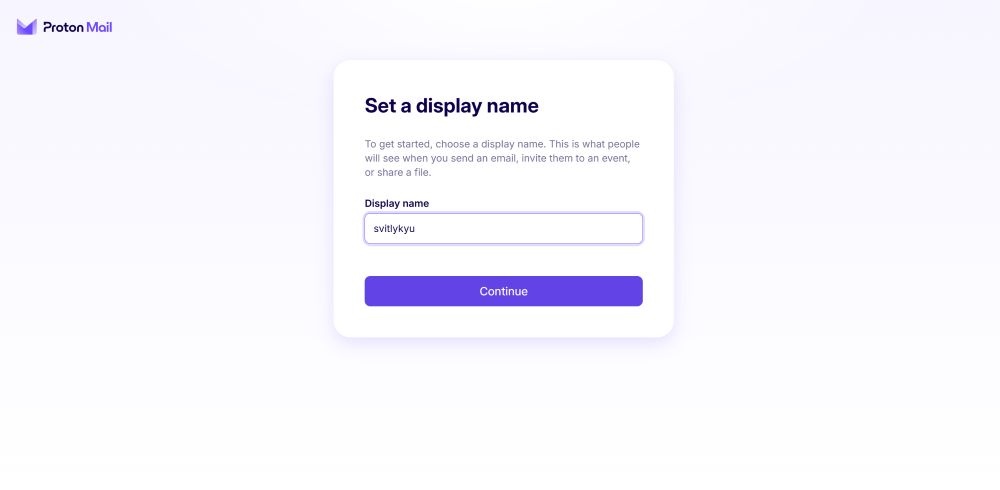
Step 2. Choose a username. By default, your address will end in @proton.me. You can change it to @protonmail.com by clicking the arrow next to @proton.me. The username is the only part other users will see. If privacy is important to you, choose a name that does not reveal your identity.


Step 3. Create a strong password. Unlike Gmail, Proton cannot reset your password through identity verification. If you forget it, your data may be permanently inaccessible. For this reason, this step is critical.
Step 4. Save the Recovery Kit. Proton will prompt you to download a Recovery Kit, which contains the information needed to regain access to your account. Confirm the download by checking the box and clicking Continue. This step is essential: if you lose or forget your password, the recovery phrase is the only way to restore access to your account. It should be printed or stored in a secure offline location, outside of any digital environment.

Step 5. Confirm that you are human. Proton may ask you to complete a simple CAPTCHA or verification step. Importantly, the service does not require a phone number for free account registration – unlike Google or Microsoft.

If verification still requests a phone number, you may need to use an alternative verification method if available.
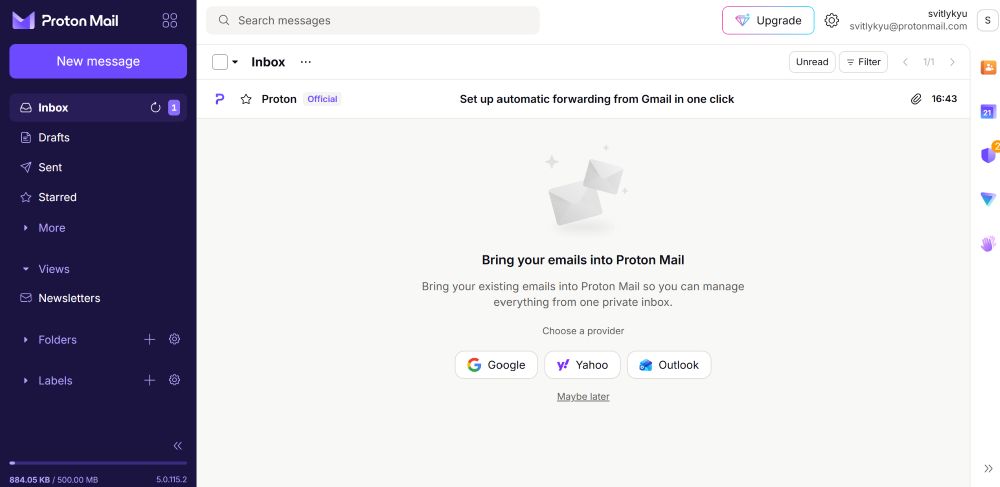
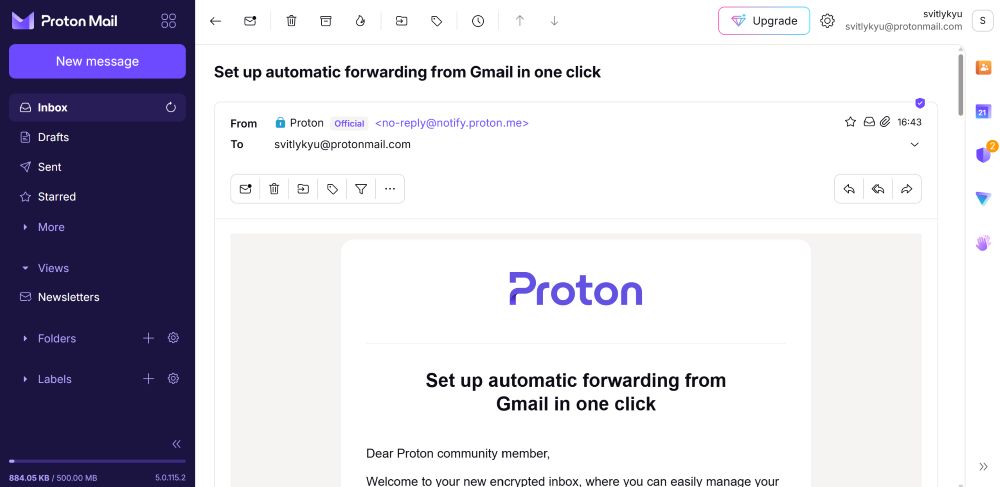
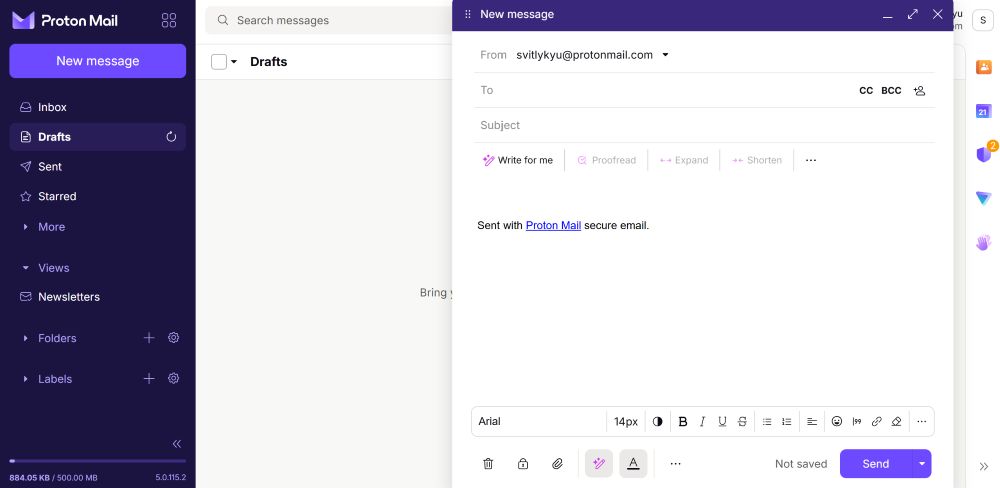
Step 6. Done. Your encrypted email account is now ready – you can start sending and receiving emails.

Additional security settings. For enhanced protection, Proton Mail offers two-factor authentication (2FA). After logging into your account, it is recommended to enable 2FA in the settings. This helps prevent unauthorized access even if your password is compromised.
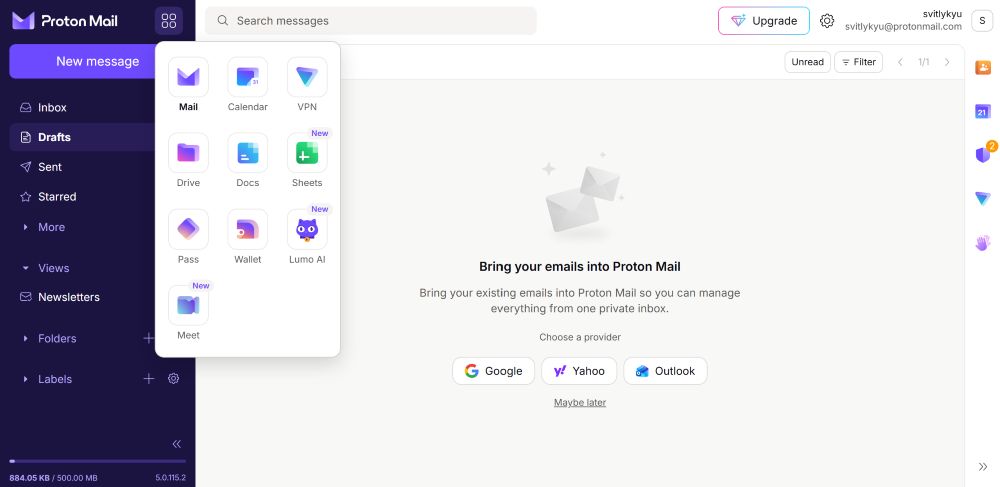
A distinctive Proton Mail security feature is its dual-password mode, which allows users to set separate passwords for encryption keys and for mailbox access, adding an additional layer of protection.
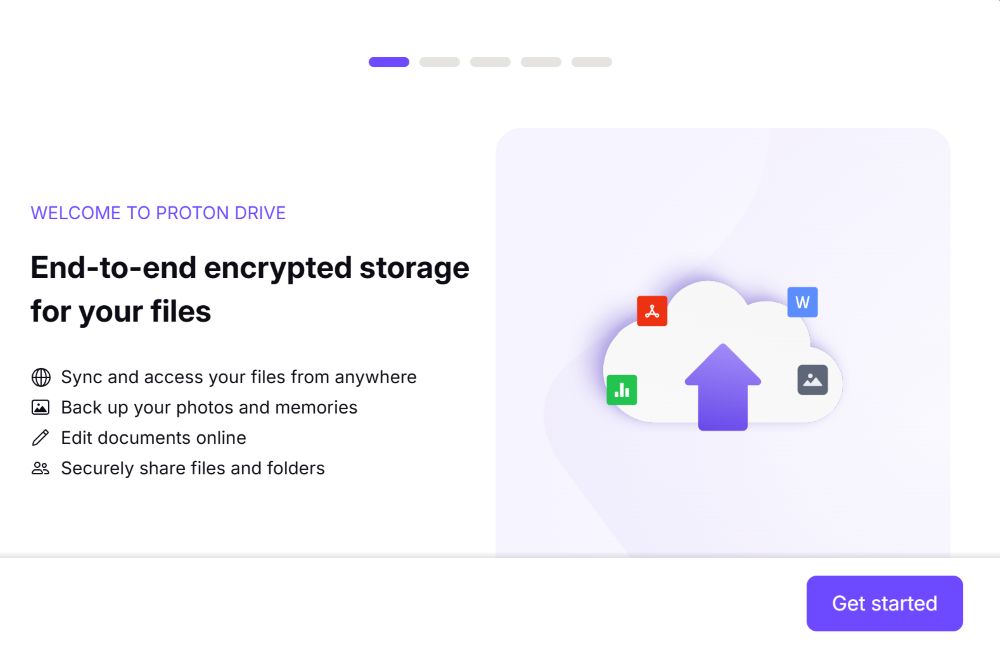
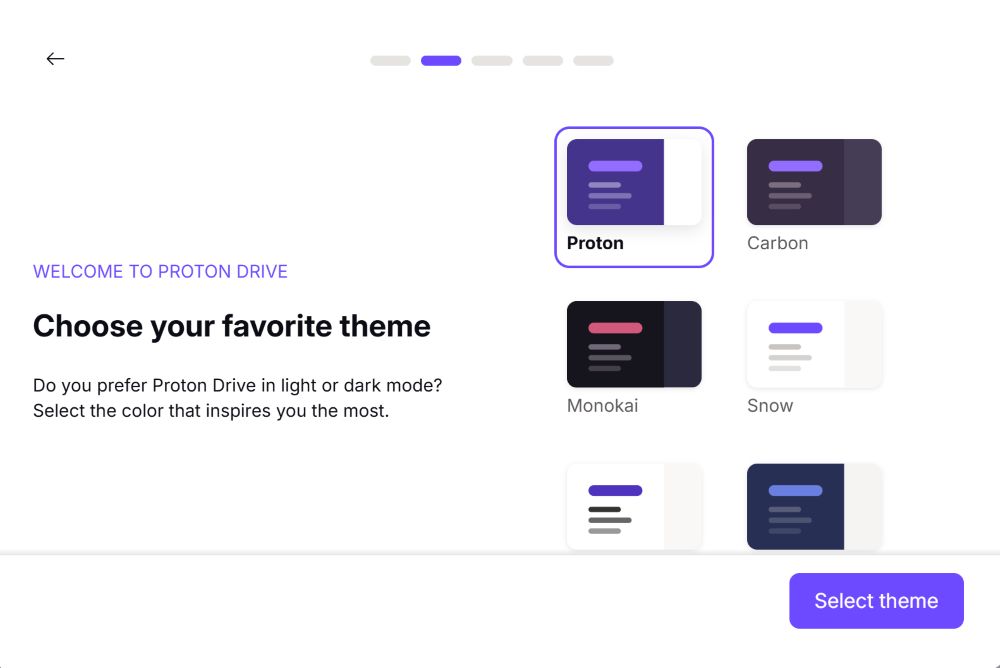
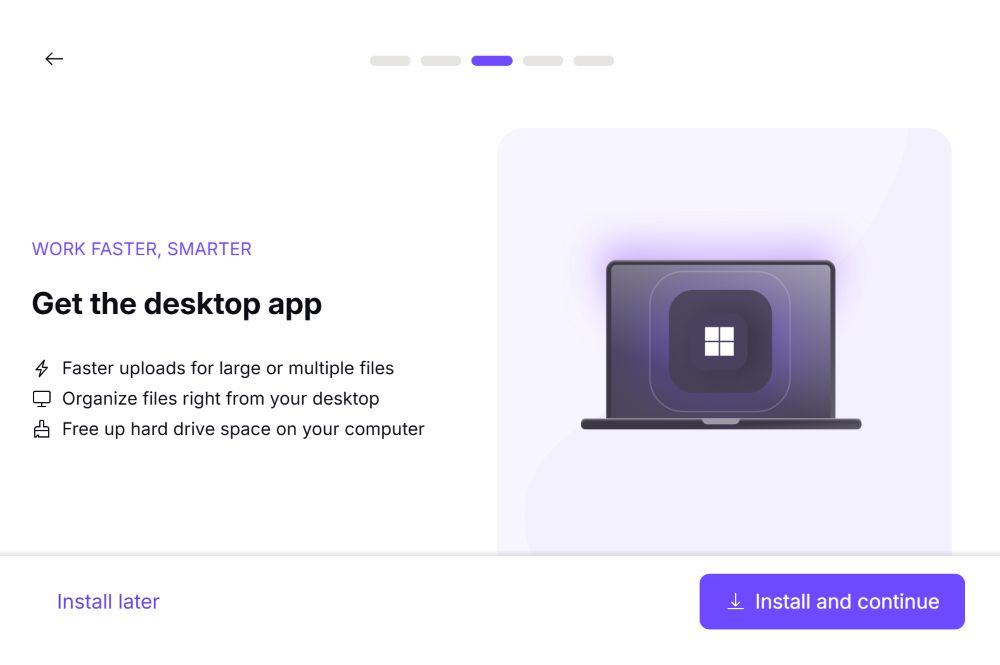
For mobile devices, Proton Mail offers dedicated desktop applications for Windows, macOS, and Linux that integrate with the operating system and provide native notifications without relying on a browser. Mobile applications are available for both iOS and Android.
Privacy as infrastructure
Proton Mail is more than an email service. It is an argument in favour of a particular vision of the internet – one in which communication between two individuals belongs only to those two parties, not to a corporation serving ads, not to a government conducting surveillance, and not to attackers searching for vulnerabilities.
There is a certain irony in the fact that the strongest practical case for this idea is not a philosophical treatise or a legislative initiative, but a Swiss company with annual revenues measured in hundreds of millions of dollars. Proton has demonstrated that people are willing to pay for privacy. This suggests that privacy is not a niche concern of a technical elite, but a basic human need that can be addressed through market mechanisms.
Of course, Proton Mail is not a universal solution. It does not protect against everything. It is subject to Swiss law. It cannot help if a user’s device is compromised. However, it does make mass, indiscriminate surveillance significantly more difficult – and that has a limited but tangible value.
In a world where privacy is increasingly becoming an expensive commodity, Proton Mail offers something relatively rare: trust backed by mathematics.

