





© ROOT-NATION.com - Use of content is permitted with a backlink.
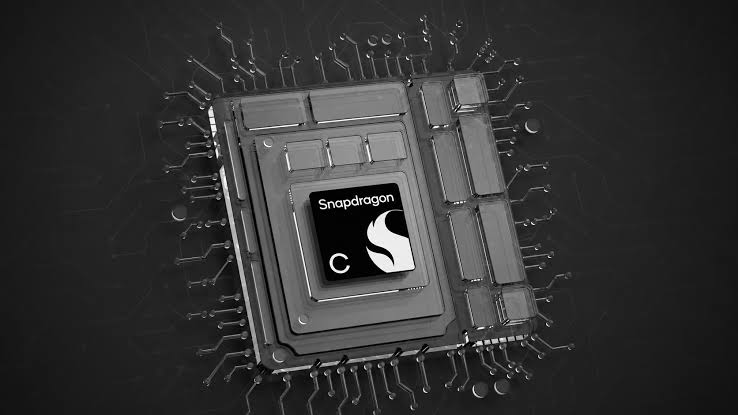
Qualcomm is making a confident move into the budget laptop market with Snapdragon C. The platform has more in common with smartphone hardware than with traditional laptop processors. But that is not necessarily a drawback: the MacBook Neo offers a similar approach. Let’s take a closer look at what this means.
For years, budget laptops have been products defined by compromise. When spending up to $400, buyers generally had to accept a dim display, a plastic chassis that could feel somewhat hollow, and a battery that lasted barely half a working day before a power outlet became necessary. This was not simply a matter of poor design or manufacturers cutting corners. It was largely the result of a segment that had been built for decades around the same limited selection of Intel processors, which effectively defined what was possible at this price point. Now, an unexpected player is stepping into this established formula.
Read also: How to Keep Your Child Safe Online: A Parent’s Guide
TABLE OF CONTENTS:
A Bet on Smartphone DNA
The newly announced Qualcomm Snapdragon C platform is not an attempt to replicate the success of the flagship Snapdragon X Elite in a smaller package. Instead, it reflects a simple reality: most people who buy an inexpensive laptop do not need enormous computing power. What they need is a device that starts quickly, runs quietly, and lasts through the day without requiring a trip to the nearest power outlet. Qualcomm is bringing years of experience in designing mobile chips to precisely this segment.
The platform’s technical specifications leave little doubt about its origins. It features an eight-core Kryo CPU, Adreno A643 graphics, a dedicated Hexagon AI engine, support for LPDDR5 memory, and UFS storage instead of the NVMe SSDs commonly used in laptops. These are all components that have been refined over years in smartphones rather than laptops. The 6 nm manufacturing process is another clear indication of its mobile roots. It is not the most advanced process node available today, but it is mature and cost-effective, helping Qualcomm keep production costs under control.
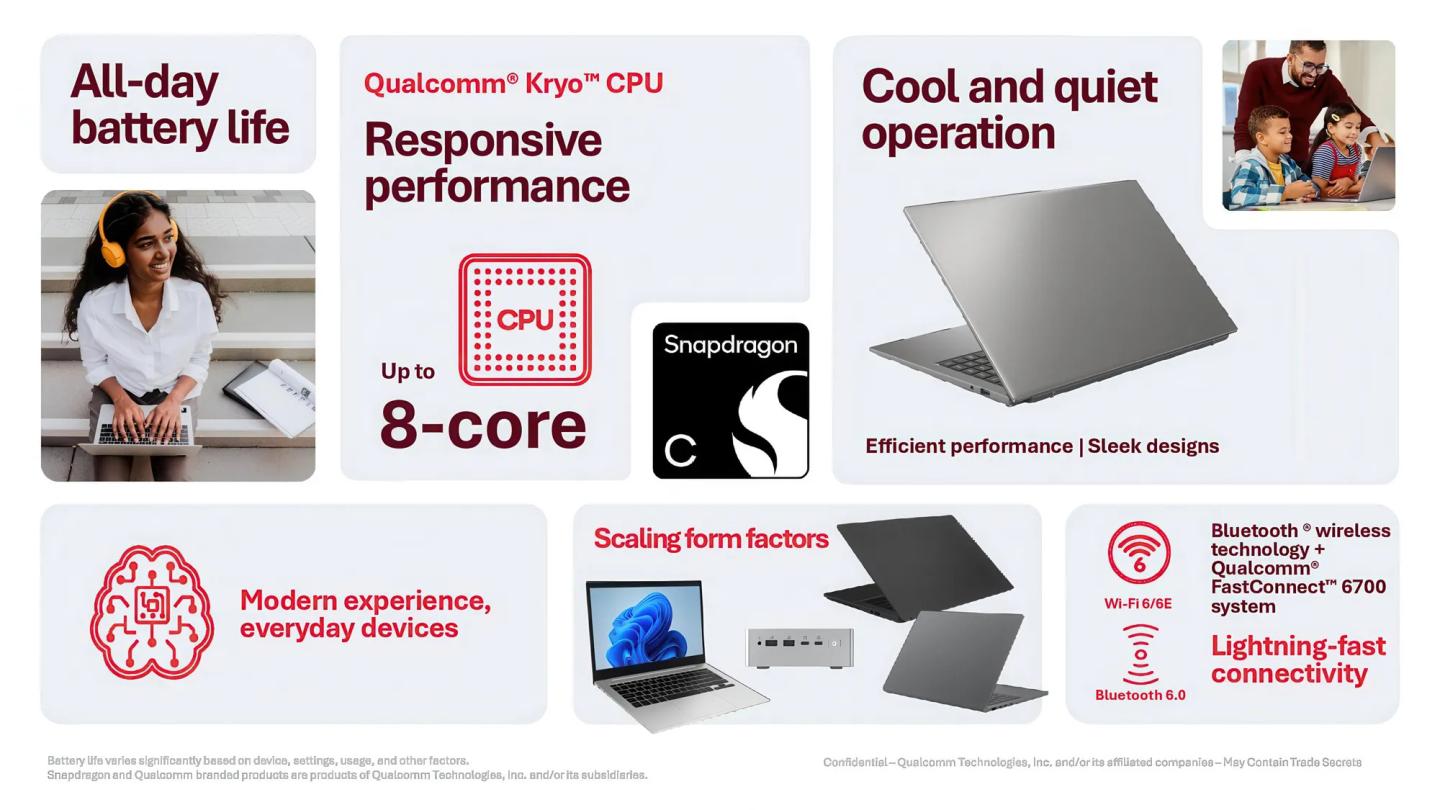
The most controversial decision will undoubtedly be the use of UFS storage. For someone accustomed to the performance of NVMe drives, this may look like a step backward. But it is worth looking at the decision pragmatically: in a segment where every dollar of production cost affects the final price, UFS allows manufacturers to save on components, reduce power consumption, and simplify the board design. For typical tasks such as web browsing, office applications, and video calls, the difference in storage performance is also barely noticeable.
Read also: Anthropic Peers Inside AI: What Really Lies Within Claude’s J-Space
AI Where You Least Expect It
One feature that deserves particular attention is the inclusion of a dedicated neural processing unit in an entry-level chip. Just a few years ago, putting an NPU into a budget laptop would have seemed like an unnecessary marketing exercise. Today, the situation is different: Windows 11 is increasingly moving AI-related workloads – such as speech recognition, image processing, and video-call effects – to local processing rather than the cloud. In this context, a dedicated block for these tasks is no longer a luxury but a practical advantage. In workloads where a low-end Intel processor might struggle, Snapdragon C could handle them more smoothly.
Battery Life Claims – and Why They Should Be Treated With Caution
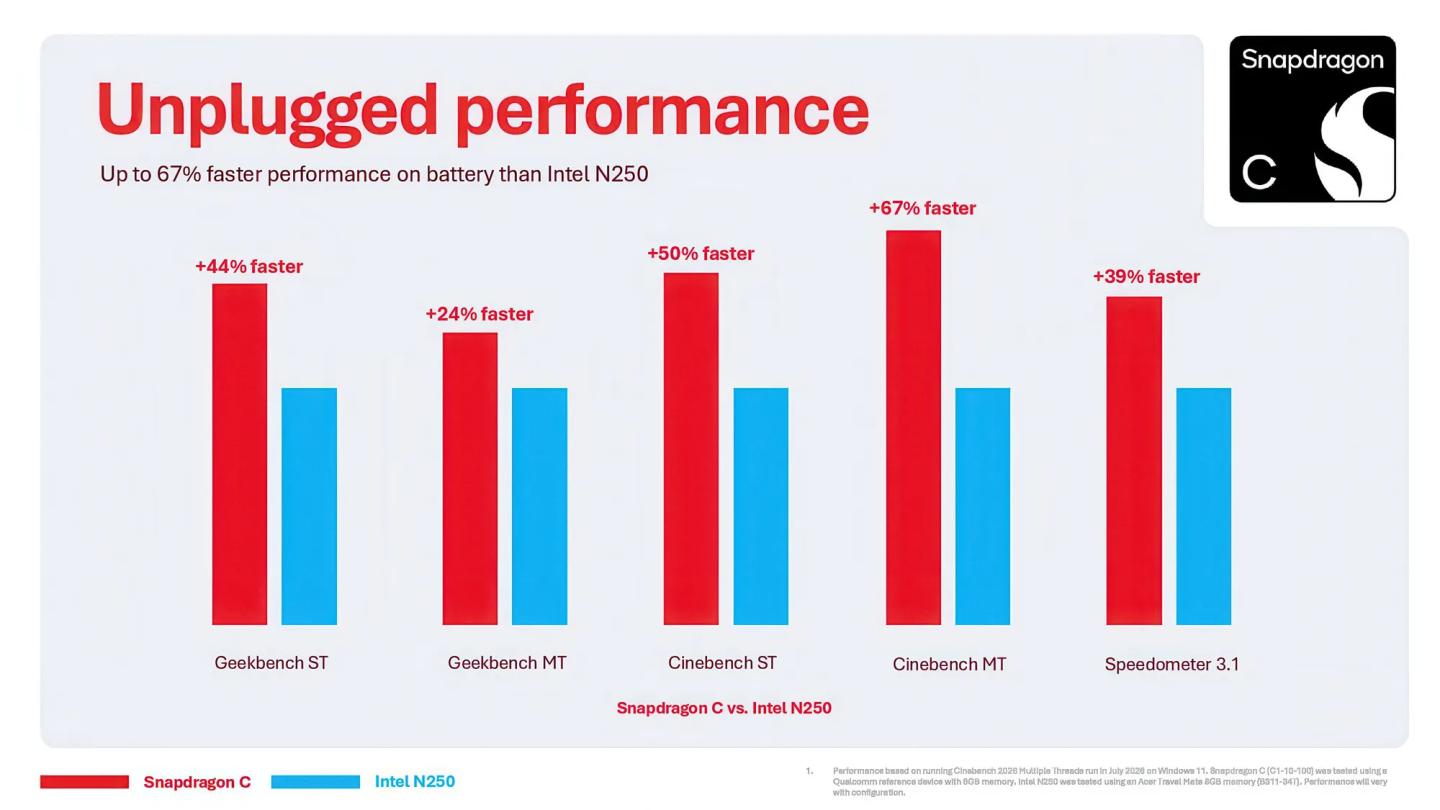
Qualcomm claims a 67% advantage in battery life over the Intel N250. The figure is certainly impressive, and if it holds up even partially on real-world devices rather than only in the manufacturer’s lab tests, it could become the strongest argument in favor of the new platform. However, it is worth keeping one obvious point in mind: the comparison was made against one specific, relatively low-power x64 chip, rather than across Intel’s or AMD’s full range of competing solutions. The real picture will only become clear once the first Snapdragon C laptops reach independent reviewers.
Read also: Everything You Need to Know About AI Browsers: A Loud Debut, a Quiet Finish
Deliberate Limitations Rather Than Hidden Drawbacks
What is telling is that Qualcomm is not trying to present Snapdragon C as a universal solution. The platform supports only a single external display via eDP 1.4 and is limited to 4K at 60 Hz, while its USB 3.1 ports top out at 5 Gbps. This means that connecting two monitors through a single dock or working with high-speed external storage is essentially off the table. The Adreno A643 GPU, despite supporting DirectX 12, is also aimed more at multimedia and everyday applications than gaming.
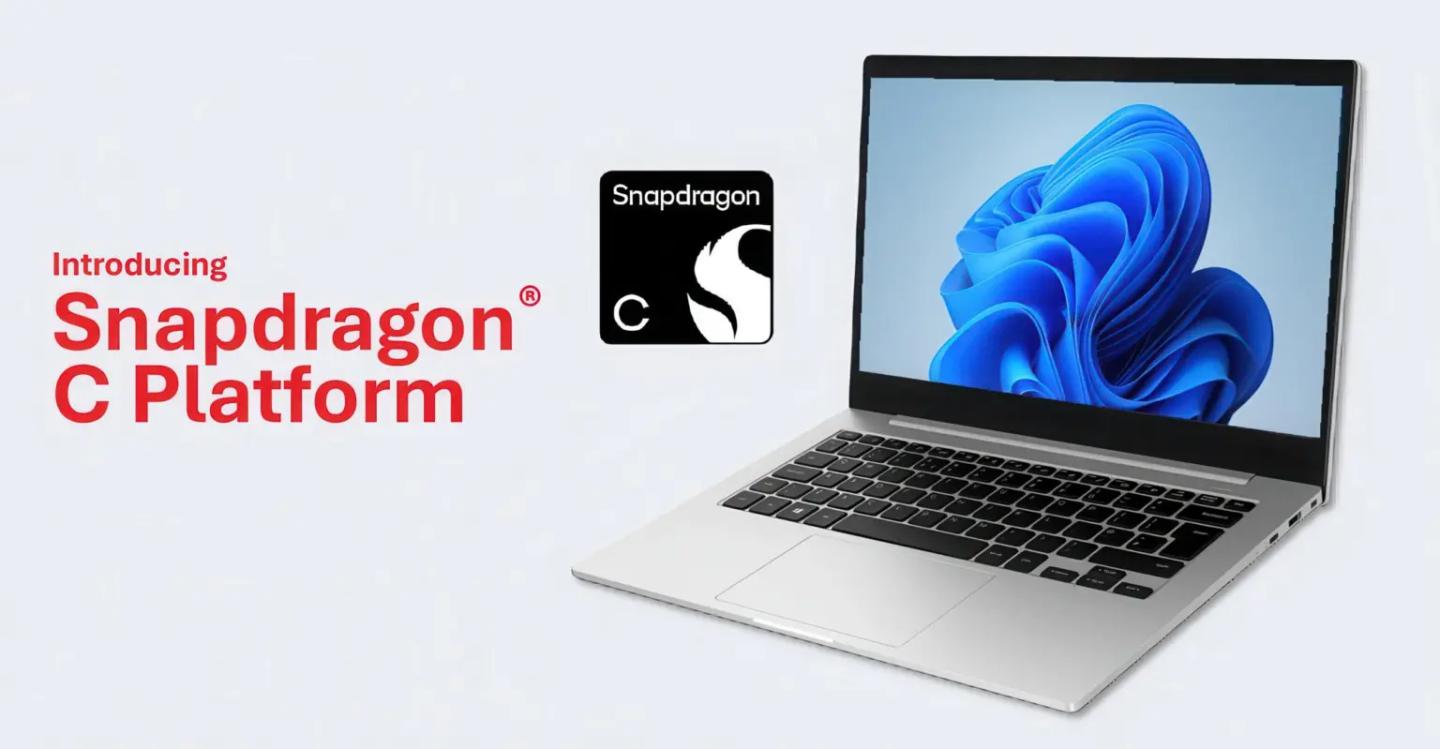
These limitations should be viewed not so much as drawbacks as a deliberate choice of priorities. Qualcomm has clearly defined its target audience: users who need a lightweight, quiet laptop with long battery life for web browsing, documents, streaming, and video calls – and who are unlikely to connect a second monitor or gaming controller.
Read also: Everything You Need to Know About Moonshot AI’s Kimi K3: How Chinese Startup Challenged AI Giants
Who Benefits Most
It is telling that the partners already preparing devices based on the new platform include Acer, ASUS, Lenovo, and HP. These are not niche experiments, but major players in the budget segment that have traditionally relied almost exclusively on Intel chips. Their willingness to explore an alternative suggests that manufacturers themselves are growing tired of the familiar “cheap, slow, mediocre battery life” formula and are looking for a way to refresh their offerings without significantly increasing prices.
The IFA 2026 trade show in Berlin is widely expected to be the first major venue for showcasing finished devices. The event has traditionally been geared toward mainstream consumers rather than technology enthusiasts, making it a logical choice. Budget-laptop buyers rarely follow in-depth technical reviews, but they tend to respond well to straightforward promises such as “all-day battery life.”
Read also: OpenAI’s Astra: When an Algorithm Reaches What Took Mathematicians Decades to Achieve
Is It Really a Threat to the Status Quo?
It would be an exaggeration to claim that a single chipset can reshape an entire market. Snapdragon C does not offer breakthrough performance, does not compete with premium ARM solutions, and comes with some very specific technical limitations. Its real value, however, is not in being impressive, but in finally shaking up a segment that has been evolving largely on autopilot for years.
If laptop manufacturers approach pricing sensibly and the battery-life claims hold up, even partially, the budget segment could finally get something it has been missing for years: genuine choice. At that point, buying a budget laptop may no longer be a matter of settling for what is available, but a deliberate decision – perhaps for the first time in many years.
Read also: Planning to Buy a Laptop? Answer These Three Questions

