





© ROOT-NATION.com - Use of content is permitted with a backlink.
Today we examine the ambitious Project Silica, a research initiative that explores the possibility of creating storage media capable of outlasting modern civilization. Developed by Microsoft, the project addresses a fundamental challenge of the 21st century: how to preserve humanity’s data in a form that can survive not just generations, but potentially the collapse of current technological infrastructures.

Project Silica is not merely another attempt to refine archival media. It represents a shift in the underlying paradigm of data preservation – focusing on information intended to remain accessible not for five or twenty years, but potentially for up to 10,000 years. While such timelines may sound speculative, the project reflects ongoing practical research rather than abstract futurism.
Read also: Giant Awakens: Microsoft Publicly Acknowledges Windows Issues
TABLE OF CONTENTS:
Archives That Age Faster Than We Do
Humanity is generating data at a pace that would have seemed implausible in the early 2000s. Every second, thousands of hours of video, millions of photographs, and vast streams of telemetry from industrial systems are created, alongside continuous flows of financial transactions, medical records, and genetic data. Added to this are scientific simulation outputs, satellite-based climate observations, geological models, space mission datasets, digitized museum collections, and government archives transitioning into digital form.
For the first time, the collective memory of humanity exists primarily in digital format. Yet this shift reveals a fundamental paradox: the storage media used to preserve this information often have significantly shorter lifespans than the data they contain.

Magnetic tape, which remains a primary medium for archival storage in large data centers, typically offers a lifespan of 20–30 years under controlled conditions, including stable temperature, humidity, and routine maintenance. Hard disk drives are even more vulnerable: mechanical components wear out, magnetic layers degrade, and controllers fail. Solid-state drives, despite having no moving parts, are also limited by finite write cycles and gradual charge leakage in memory cells.
As a result, archiving becomes less a static act of “storage” and more an ongoing process of migration. Data must be periodically transferred to new media, checksums verified, copies duplicated, and backups created. Each cycle carries financial, energy, and logistical costs, as well as additional risk of error, corruption, or partial data loss.
Data centers devote substantial resources not only to maintaining servers but also to preserving the archives themselves. Infrastructure requires continuous power, cooling, physical protection, and hardware refresh cycles. In effect, digital memory depends on constant technical support; it cannot simply remain dormant while waiting to be accessed.
Modern archivists therefore operate not only as custodians of history but also as managers of technological risk. Their work increasingly focuses on mitigating material degradation, format obsolescence, and shifting technical standards. The challenge extends beyond physical media: file formats age, software becomes unsupported, and hardware interfaces lose compatibility. Data may survive physically yet become unreadable.
This leads to a strategic question of civilizational scale: how can critically important data – scientific discoveries, medical protocols, cultural heritage, technical blueprints, knowledge bases – be preserved not for decades, but for millennia? Is it possible to create a storage medium that does not require constant migration, does not depend on continuous power consumption, and can withstand shifts in technological eras?
This is no longer merely a matter of convenience or cost efficiency. It concerns the long-term survival of knowledge itself. A civilization unable to preserve its collective memory risks repeatedly starting from scratch.
Read also: Prospects for DDR SDRAM: Future Developments and Key Challenges
The Fragility of Memory
The vulnerability of human memory and the challenge of long-term knowledge preservation have long been explored in science fiction. In the works of Isaac Asimov, the preservation of information is often depicted as central to the survival of civilization. A notable example is the concept of the “Foundation,” in which curated archives of knowledge are intended to endure the collapse of an empire.

In Fahrenheit 451, Ray Bradbury depicts the fragility of culture, suggesting that it can disappear along with the physical carriers of text. He highlights the risk of losing valuable information due to negligence or censorship. Stanisław Lem, in turn, reflects on information as a primary resource of the future, while also noting the possibility of its loss as a result of technological or civilizational failure.
In the trilogy The Three-Body Problem, Liu Cixin portrays a civilization attempting to preserve knowledge under conditions of global catastrophe and extreme external threats. Archives recorded on stable media or transmitted through advanced technological means become a critical safeguard for the continuity of science and culture across generations. Concepts that previously appeared in literature as narrative hypotheses or philosophical concerns are now acquiring practical engineering relevance. The long-term preservation of knowledge is increasingly shifting from metaphorical reflection to the domain of material technology.
Read also: Everything We Know About the Discombobulator – America’s Newest Weapon
Glass Instead of Magnets: A Technology That Alters the Landscape
Microsoft’s approach is notable for its conceptual simplicity, though it presents significant engineering challenges, as it involves data storage in glass.
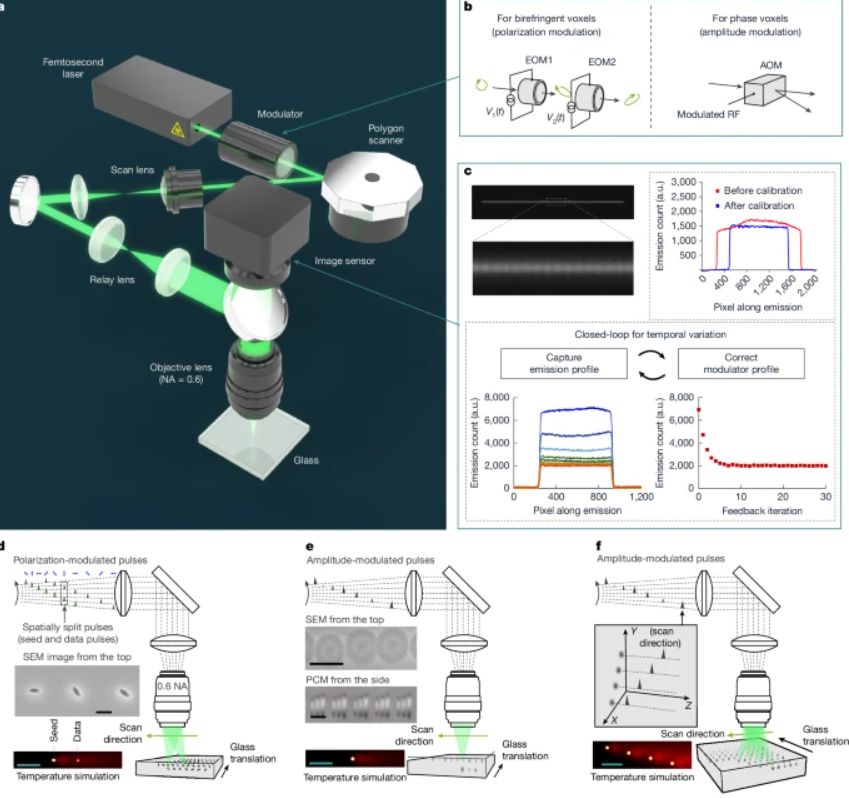
This method does not rely on surface engraving or microtext, as seen in certain novelty applications. Instead, it employs ultrafast femtosecond lasers – light pulses lasting one quadrillionth of a second. Such extremely brief pulses allow precise modification of the material’s internal structure without causing damage or overheating.

The laser creates microscopic structures within the bulk of the glass, known as voxels (volumetric pixels). Unlike traditional two-dimensional storage media, data is recorded in three dimensions. Information is encoded not only in the spatial coordinates of each voxel but also in its orientation, size, and phase characteristics. Each microstructure therefore carries multiple informational parameters.
This enables multilayered, three-dimensional data storage within the material. Because the data is embedded throughout the volume of the glass rather than on its surface, it exhibits significantly increased resistance to external factors.

Glass as a storage medium offers several fundamental advantages. First, it is resistant to water. Unlike paper or magnetic media, a glass plate is not affected by flooding or high humidity.
Second, the material is chemically inert. Its composition does not react with air, it does not oxidize, and it is not susceptible to corrosion in the conventional sense.
Third, glass exhibits high thermal stability. It can withstand significant temperature fluctuations without losing structural integrity. This property is particularly important for archival storage, as it reduces dependence on strict temperature-controlled environments and complex infrastructure.

Finally, a key advantage is the absence of magnetic degradation. Unlike tapes or hard drives, where information is stored in magnetic domains, glass is not affected by demagnetization, electromagnetic fields, or the gradual “blurring” of bits.
According to researchers, this medium can preserve data for up to 10,000 years without loss. This estimate is based not on theoretical assumptions but on accelerated aging tests and modeling of long-term physical processes within the material.
It is also notable that the results were published in Nature, one of the most respected scientific journals globally. Publication in this journal indicates that the work underwent a rigorous peer-review process, including independent expert evaluation, and that the methodology was verified for scientific accuracy.
In summary, this is not an experiment designed for a press release, but a thoroughly developed technology with a solid scientific foundation. If scaled to industrial production, glass could become the first storage medium in history capable of providing a genuinely long-term, civilization-scale horizon for information preservation.
Read also: Everything About Palantir’s Dataroom: How Ukraine Turns the War into a Defense AI Laboratory
From High-Purity Quartz to Everyday Glass
Early experiments in glass data storage used high-purity quartz. This material provided the necessary optical transparency, structural uniformity, and stability under laser processing. The technical results were promising: high storage density, reliable readout, and predictable longevity.
However, this approach had a clear limitation – cost. High-purity quartz is expensive to produce, requires specialized suppliers, and involves complex manufacturing processes. As a result, such developments remained largely confined to laboratory or niche applications, far from widespread implementation.
A key development was the adaptation of the technology to borosilicate glass. This is a well-known and widely used material that combines thermal resistance, mechanical strength, and chemical inertness.
Notably, borosilicate glass is used not only for laboratory test tubes and flasks but also for oven doors and heat-resistant kitchenware.

This is a mass-produced material with globally established manufacturing and a well-understood supply chain. Its availability and relatively low cost significantly alter the economic feasibility of the project.
The shift from specialized quartz to borosilicate effectively removes the main barrier to commercialization – both financial and production-related. The technology is no longer dependent on a limited set of suppliers or exclusive raw materials.
As a result, a solution that previously appeared confined to a narrow scientific context now shows potential for industrial scalability. This transition – from a laboratory demonstration to a technology potentially suitable for mass production – represents the core advancement.
Read also: Silicon–Carbon (Si-C) Batteries: An Overview of a New Trend in the Smartphone Market
Engineering Breakthrough: Speed, Simplification, and AI
Storing terabytes of information in a 2 mm glass plate involves not only materials science but also complex optical engineering.
In the latest version of the technology, Microsoft implemented several critical improvements. First, the system eliminates the need for complex polarization. Previously, data writing required highly precise polarization alignment of the laser light. The current approach uses the concept of phase voxels, where a single laser pulse is sufficient to encode a data unit. This change significantly simplifies the hardware requirements.

Second, multi-beam writing. The system is now capable of forming multiple voxels in parallel, enabling a significant increase in writing speed – a critical factor for commercial applications.
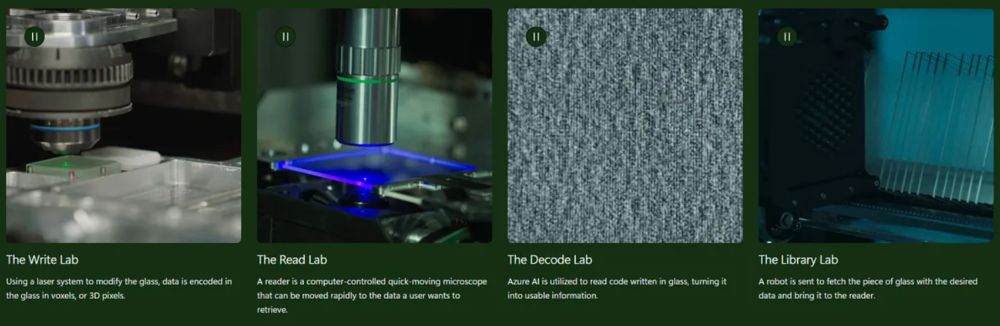
Third, machine learning–assisted reading. Previously, decoding required a complex setup with multiple cameras. Today, a single optical lens combined with machine learning algorithms is sufficient. The AI analyzes light patterns, corrects errors, and reconstructs data in real time.
At this stage, the system is no longer a laboratory demonstration but a technological platform poised for industrial-scale development.
10,000 Years – What Does This Figure Mean?
The Microsoft Research team developed a specialized, non-destructive accelerated aging method to assess the longevity of data stored in glass. These laboratory procedures simulate the effects of time – temperature fluctuations, prolonged thermal exposure, and other factors that normally act over centuries. This approach allows researchers to predict the material’s behavior over very long timescales without waiting for multiple generations.
Test results indicate that archives created using this technology can remain readable for at least 10,000 years. For digital storage media, this represents an unprecedented level of longevity.
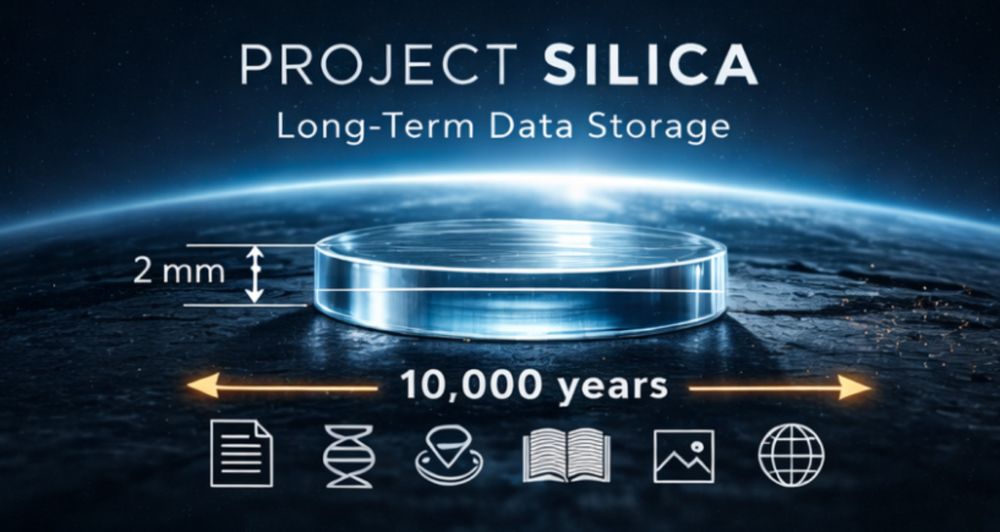

Ten thousand years represents a timescale that exceeds the history of most modern states and political systems. In effect, it corresponds to the scope of major civilizational epochs.
This is not intended for temporary or operational data – such as a corporate server backup or accounting archives. The potential applications are far broader: preserving government records and regulatory documents, digital copies of cultural and historical heritage, results of fundamental scientific research, large medical and genomic databases, as well as long-term climate observations and biodiversity data.
This concerns information that holds value not for a single business cycle but for future generations. For this reason, the technology can be regarded as a strategic-level solution, serving as an infrastructure for long-term knowledge preservation.
Read also: Structural Crisis of the DRAM Market and Its Impact on Consumer Electronics
Digital Immortality as a Geopolitical Factor
Long-term data storage technology is no longer solely an engineering challenge. It is increasingly an element of national security and a strategic-level infrastructure. Archives define not only the past but also the boundaries of the future. Those who control archives shape the interpretation of history; those who can preserve knowledge maintain the capacity for recovery after crises, wars, and disasters.
In the 21st century, information has become a critical resource for civilization. Government records, scientific databases, medical research, cultural collections, and climate observations all require a medium capable of outlasting multiple technological cycles. Magnetic tapes degrade, hard drives fail, and data centers depend on electricity and political stability. In a world of climate risks, industrial accidents, and digital conflicts, long-term archiving is no longer purely a technical issue – it has existential significance.
If the technology Microsoft is developing under Project Silica is commercialized, it could establish a new standard for archival infrastructure. This is not merely an upgrade of existing storage media, but a paradigm shift: moving from systems that require continuous maintenance to materials capable of physically preserving information for millennia without intervention.
Until a few years ago, data storage in glass was largely seen as a science-fiction concept rather than an engineering plan – think of all those “memory crystals” in novels and films. Today, however, it is a technology supported by experimental validation, tested methods for writing and reading, and a feasible path toward scaling. A glass plate roughly two millimeters thick, able to withstand extreme temperatures, humidity, and the passage of time, moves from laboratory prototype to a potential infrastructural medium.
This represents more than just a storage device. It is an effort to free human memory from the constraints of short-lived magnetic and electronic systems, which age physically and obsolesce faster than generations change. If Silica is deployed at industrial scale, digital immortality ceases to be metaphorical.
For the first time in history, humanity could have a technical guarantee that its data – its history – will not disappear with the next server failure or energy crisis.
Read also:
- All About Starship V3: Technological Platform for the Next Spaceflight Era
- Breakthrough Development: Scientists Create Artificial Muscles Activated by Ultrasound
- Atomic Horizon: How Humanity Pushes Chips to Edge of Possibility

