





© ROOT-NATION.com - Use of content is permitted with a backlink.
AI models perform well on various tasks, such as generating images, writing text, or creating 3D models. However, they are not as useful when it comes to testing robots or vehicle designs in various environments. To create an AI system capable of simulating a wide range of physical scenarios, engineers need a massive amount of physical data on a scale that is not yet available.
Read also: AERONAUT – everything that flies above the ground: aviation, UAVs and drones, rockets, and space

Neural networks take a long time to obtain even a few data points they can interpret. They rely on algorithms to calculate physical properties at various points on a 3D shape, and this process takes so long that it limits the amount of data that can be used, for example, to verify the safety and aerodynamics of aircraft designs. However, researchers at MIT and Tsinghua University have developed a new approach to pre-training called GeoPT. It virtually simulates everyday mechanical interactions in 3D, showing how particles come to a stop when they reach a specific part of an object.
Read also: Makerly Expands Its Industrial Offering with High-Precision Metal 3D Printing
Such simulations help models understand how physics works, enabling them to simulate the real world more accurately, reach peak performance faster, and train on up to 60% less data compared to leading models. Soon, the project may help predict how vehicles, everyday objects, or robots will react to wind, water, and collisions. According to the researchers, this work could be a step toward a foundational system that helps AI tools generalize knowledge across different tasks.

“Our universal model is flexible enough to help create a model of the world for physics,” says one of the paper’s authors, MIT graduate student Minghao Guo. “Many models, such as those that generate data and videos for robotics, are already well-suited to text and visual data, but thanks to their physical accuracy, they will produce more realistic results.”
Read also: The era of cheap hardware is over: AI companies have secured RAM supplies for the next 5 years
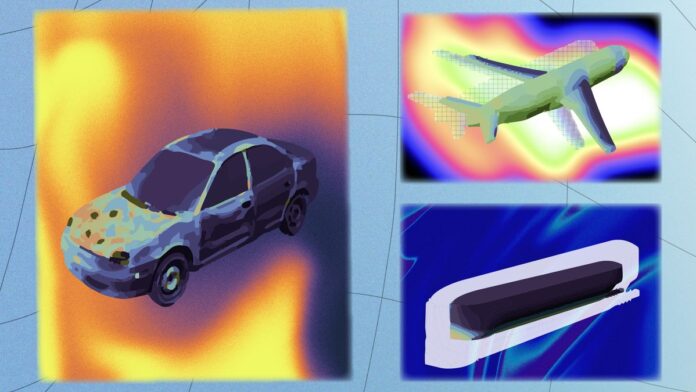
To use GeoPT, users simply need to upload 3D models of objects such as warships, passenger planes, and trucks, and specify the direction and speed of the force they want to simulate. The result is a kind of heat map that shows how the object is affected in different areas. If you know the speed and direction of the force you want to simulate, you can recreate it in GeoPT. This makes it possible to simulate what a car will look like after colliding with a wall, how light reflects off objects, and whether a boat will stay afloat during rough waves.

GeoPT’s capabilities stem from a series of interactions between tiny particles and complex 3D shapes. GeoPT studied 1.3 million samples of synthetic dynamics in which tiny spheres moved at different speeds and at different angles until they came to rest at a specific point on an object. These particles effectively “stick” to the object upon contact, rather than passing through it or bouncing off. The researchers found that GeoPT performed well in simulating industrial scenarios and reached peak performance faster than other tools, while requiring less labeled data.
Read also: A New Threat to the Industry: Gamers Are Creating Their Own Video Games with AI
On a dataset featuring complex 3D shapes and their response to airflow and surface pressure, GeoPT outperformed state-of-the-art models in terms of speed, accuracy, and efficiency. Similar results in terms of speed and accuracy were achieved when simulating fighter jets’ response to wind. When GeoPT was tested to simulate the behavior of a boat hull under the influence of air and waves, the system required 60% less meshed data to reproduce physical forces, and it achieved maximum accuracy four times faster than the best baseline models.

The system also successfully simulated what various types of cars would look like after colliding with another object. It accurately predicted the deformation of 3D vehicles while using less data than the most advanced baseline models.
“If your model performs well in industry tests, it means it’s capable of solving the most complex physical problems,” notes the paper’s co-author, MIT postdoctoral researcher Haixiu Wu. “GeoPT performed high-precision simulations with over 100 million mesh points in a matter of seconds. This could make the tool extremely useful for engineers seeking to validate vehicle designs without conducting a large number of physical experiments.” The researchers add that their system is only a preliminary version of a larger model they are working on. The team plans to scale up the system by training it on a wider variety of shapes and simulating more complex physical phenomena.
Read also: For the first time in history: AI has created new viruses from scratch