





© ROOT-NATION.com - Use of content is permitted with a backlink.
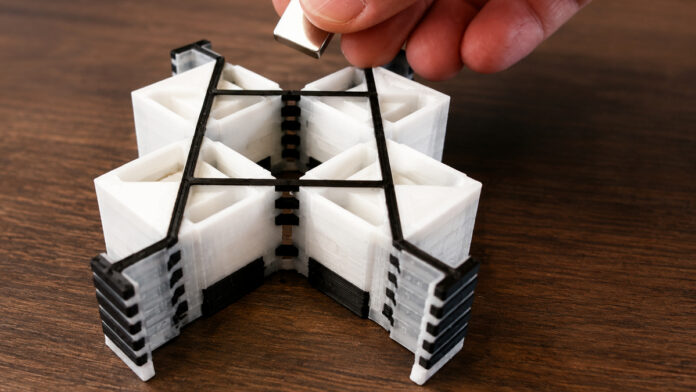
Engineers at MIT have developed an innovative system of modular components for creating smart, shape-shifting devices that maintain a seamless electrical connection in any configuration. The new technology makes it possible to design adaptive, interactive gadgets capable of autonomously recognizing their current spatial orientation without the use of external wires. According to the researchers, the 3D-printed blocks, dubbed “bifur-circuits,” are a type of mechanical metamaterial and open up a wide range of possibilities for the rapid design of rehabilitation furniture or robotic grippers.

The 3D-printed building blocks developed by MIT researchers belong to a class of structures known as mechanical metamaterials. Their combination allows for a significantly greater number of potential configurations compared to standard metamaterial systems.
In a study demonstrating the new technology, the researchers presented several interactive objects, including a chair that can transform into a table with a storage compartment or fold up completely for compact transport. This structure automatically locks into its current configuration and sends the corresponding information to an electronic display. These new metamaterials are also suitable for designing communication and sensor antennas that can change their geometry to adjust operating frequencies in response to changes in the environment without the use of bulky mechanical components.

Metamaterials simplify the fabrication of complex mechanical systems through the use of repeatable elements. Our work expands these design boundaries. If we consider mechanical metamaterials as building blocks, the technology we have developed offers a way to use their geometry to integrate internal intelligence directly into the hardware, which opens up many possibilities, notes Marwa Al-Alavi, a doctoral student in the Department of Mechanical Engineering and the lead author of the paper on these devices.
Mechanical metamaterials are programmable three-dimensional structures made up of periodic elements that can take on complex shapes thanks to their unique geometry. When compressed, pushed, or stretched, they can bend or twist along precisely defined trajectories.

In previous studies, MIT researchers used auxetic metamaterials to construct reconfigurable antennas that could change their configuration to three possible states depending on the degree of stretching. This allowed the antenna to dynamically adjust its frequency range without the need for complex moving parts. Subsequently, the team sought to increase the variety of antenna configurations but encountered a limitation because the auxetic metamaterials had only three fixed states.
In this study, the researchers created bifurcation blocks – auxetic metamaterials that can form significantly more shape variations depending on how the modular elements are connected and rotated. The blocks are also designed to be fully electrically modular. Thanks to the unique integration of conductive material, the electrical connections within the system are maintained regardless of the object’s rotation, compression, or twisting as it takes on new shapes.
To create interactive objects with numerous configuration options for bifurcation schemes, a property known as mechanical bifurcation is used. Mechanical bifurcation involves a sudden change in the behavior of a mechanism when the force applied to it reaches a critical point. For example, if you gradually bend a plastic ruler from one end, it will suddenly snap once a certain load threshold is reached.
In bifurcation schemes, such a bifurcation occurs when the connected blocks are rotated in a specific way around an axis of rotation. This property allows the interconnected elements to form more stable configurations than a single block could on its own. Adding new bifurcation loops to the overall system exponentially increases the number of possible configurations.

Bifurcation makes it possible to significantly expand this space of transformation. Adding just one additional element provides a vast number of new combinations within the same structure, explains Al-Alavi. Connecting and rotating components activates a unique electrical circuit between adjacent blocks. This interactivity allows the elements to exchange data with one another, enabling the structure to autonomously determine its current shape.
One of the most challenging tasks for the researchers was finding and implementing a conductive material that would remain flexible enough to bend while still ensuring adequate electrical conductivity. The conductive material turned out to be a constraint that the design process had to adapt to, and it was this material that determined the mechanism for signal transmission between the blocks, notes Al-Alavi. After refining the design to perfection, the researchers tested the durability of the transformable systems by subjecting them to compression more than 10,000 times. The structures showed no signs of deterioration in electrical conductivity.

In addition, the researchers developed a user-friendly design and simulation tool that simplifies the process of developing bifurcation circuits. This software generates instructions for a multi-material 3D printer capable of manufacturing transformable objects in a single printing cycle. The versatility of bifurcation circuits was demonstrated by the creation of a chair that reads its own geometry as it transforms into a tea table, as well as a shape-shifting controller that launches one of several video games depending on the selected configuration.
In the future, bifurcation schemes may find applications in fields such as interactive rehabilitation devices, adaptive grippers for modular soft robotics, or transformable shelters capable of responding to weather changes following a natural disaster.
Read also: From Snapshot to Spectacle: How AI Motion Apps Are Redefining Mobile Photography