





© ROOT-NATION.com - Use of content is permitted with a backlink.

A small brain implant no bigger than a blueberry is finally leaving the lab. Motif Neurotech has received official permission from the FDA to conduct the first human clinical trial of its device. The target audience is patients with resistant depression that cannot be overcome by conventional methods. In fact, this is a huge step for the company, which aims to introduce engineering solutions into everyday psychiatric practice.
In America alone, nearly 3 million people live with forms of depression that are not treated by medication or talking to a therapist. Motif’s approach is radically different: instead of chemistry, they offer direct interaction with neural circuits. During the trials, doctors will check whether electrical stimulation can make a difference where other methods simply “wash their hands of it.”

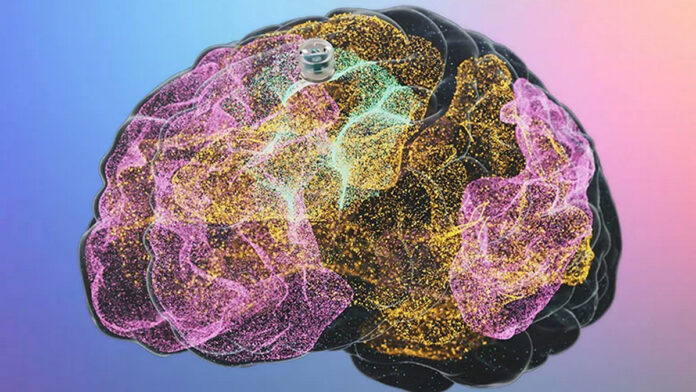
The DOT (Digitally programmable Over-brain Therapeutic) device works by sending electrical impulses to brain areas associated with depression. It is noteworthy that, unlike traditional implants, DOT does not pierce the brain tissue through. Surgeons place it in the skull directly above the dura mater. This significantly reduces the risks that usually accompany invasive neurosurgery.
Motif engineers have made the system completely wireless. There are no implanted batteries or wires running under the skin. This compact design not only simplifies the procedure itself, but also makes the patient’s life more comfortable. In addition, the system can be programmed, which allows you to adjust the stimulation with high precision over time.
“We want this technology to become for mental health what the glucose monitor has become for diabetics,” says Jacob Robinson, a professor at Rice University and co-founder and CEO of Motif. For him, it’s a personal story: to go from a government-funded concept at Rice University to a real product that is about to start changing people’s lives. It’s pretty cool.
This early study will involve adults whose condition has not improved after many treatment attempts. The researchers will carefully evaluate the safety, operation of the device itself, and the first signs of its effectiveness. It is worth noting that this will be the first time that the DOT system will be tested in real-world conditions on real patients.

The project involves leading institutions, including Baylor College of Medicine and Massachusetts General Brigham. Such cooperation is necessary to collect the most accurate data and test the device on different groups of people. Interesting fact: Motif received a research permit just four years after its founding. This is incredibly fast for the field of neurocomputer interfaces, where bureaucracy and technical complexity usually stretch processes for decades.
At the same time, Motif joined a federal initiative that focuses on treating behavioral disorders through data analysis. The program, led by ARPA-H, helps to test new therapies faster. Thanks to this funding, Motif will collect additional information in parallel with the main clinical tests. Scientists want to understand who responds best to such stimulation and how the effect changes over time.
Read also:
- Neurotechnology for the mass market: NAOX unveils EEG headphones at #CES2026
- Gabe Newell’s Starfish Neuroscience Сhallenges Neuralink