





© ROOT-NATION.com - Use of content is permitted with a backlink.
The arms race among leading military powers, including the United States and China, has rapidly shifted to the development of unmanned maritime vehicles. This process is fundamentally changing the strategy of warfare across the vast waters of the Indo-Pacific region. Recently, U.S. special operations forces carried out a covert operation in which remotely piloted boats attacked and sank a decommissioned target vessel off the coast of the Philippines.
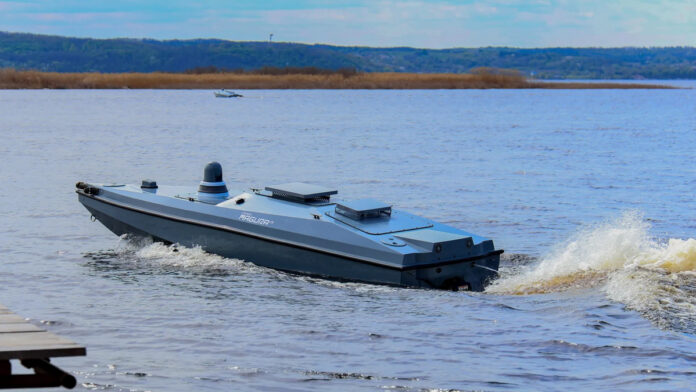
These maneuvers were not publicized to the general public, but a video recording of the event was obtained by Bloomberg News journalists. This incident marked the first test of Magura-class unmanned systems in the Pacific Ocean. Previously, these Ukrainian-designed vessels demonstrated tremendous effectiveness in neutralizing warships of the Russian Black Sea Fleet.
Read also: AERONAUT – everything that flies above the ground: aviation, UAVs and drones, rockets, and space

Events in Ukrainian territories and the Middle East have clearly demonstrated the high value of low-cost unmanned aerial vehicles. Similarly, maritime robotic platforms are now becoming crucial in the Pacific Ocean, an area thirty times larger than the landmass of the United States and consisting primarily of water. With this in mind, defense agencies from Washington to Beijing are engaged in a fierce rivalry for the right to be the first to saturate the water’s surface and depths with such systems. According to Thomas Shugart, a former U.S. submarine commander and analyst at the Center for a New American Security, the region is in critical need of precisely such dispersed, resilient, and cost-effective systems. They are capable of preventing China from operating freely in the waters around Taiwan and along the First Island Chain, which spans the area from Japanese territories through Taiwan to Southeast Asia.
Of course, deploying and managing large-scale fleets consisting of unmanned vehicles presents significant challenges. Deep-sea vehicles are much more expensive and structurally more complex than their surface counterparts, and maintaining stable communication with them is significantly more difficult due to their depth underwater. Despite this, they are capable of carrying out missions in high-risk areas, performing a wide range of operations: from gathering intelligence and laying mines to launching missile strikes. This significantly enhances the capabilities of traditional naval forces and allows manned cruisers and submarines to be preserved for prolonged phases of armed conflict. Rintaro Inoue, an expert at the Tokyo Institute of Geoeconomics, emphasizes that this approach allows commanders to keep their most valuable personnel and expensive combat platforms outside the enemy’s strike range.
The effectiveness of these technologies was confirmed in early June, when a 7.3-meter-long autonomous surface vehicle (ASV) named Corsair was deployed for the first time to successfully evacuate the crew of a U.S. Army AH-64 Apache helicopter that had crashed near the Omani coast. A month before this incident, Ukrainian forces used Magura boats to deliver serious strikes against Russian ships in Crimean waters. The relatively low cost of such devices – measured in several hundred thousand dollars per unit (which is significantly less than the price of a modern American torpedo), allows countries with small defense budgets and limited human resources to resist much stronger adversaries.

For example, the U.S. strategy for defending Taiwan, known as “Hellscape,” is built around the idea of saturating the strait between mainland China and this semiconductor hub with a large number of affordable anti-ship weapons. A key role in this plan is assigned to surface drones such as the Magura, which are essentially high-speed boats filled with explosives. At the same time, Taiwan is developing its own counterpart – the Kaui-Chi unmanned strike boat – which is viewed as a fundamental element of national defense. The island’s government intends to purchase 1,320 of these vessels, which, according to local media reports, will cost the budget $888 million.
Oleg Roginsky, the Ukrainian head of the London-based startup Uforce, which manufactures Magura boats, stated that his company is in negotiations with a number of countries in the Indo-Pacific region and is considering the possibility of building at least two production facilities directly in that part of the world. He emphasized that the successful use of these vessels in the destruction of approximately ten Russian warships is the main proof of their ability to operate effectively in Pacific waters, since having real combat experience is a key factor in promoting such technologies on the market.
Read also:
- Weapons in the war against drug cartels: Honduras to purchase Ukrainian drones
- Hunting Shahed: Ukrainian drones receive a unique autonomous interception system