



© ROOT-NATION.com - Use of content is permitted with a backlink.
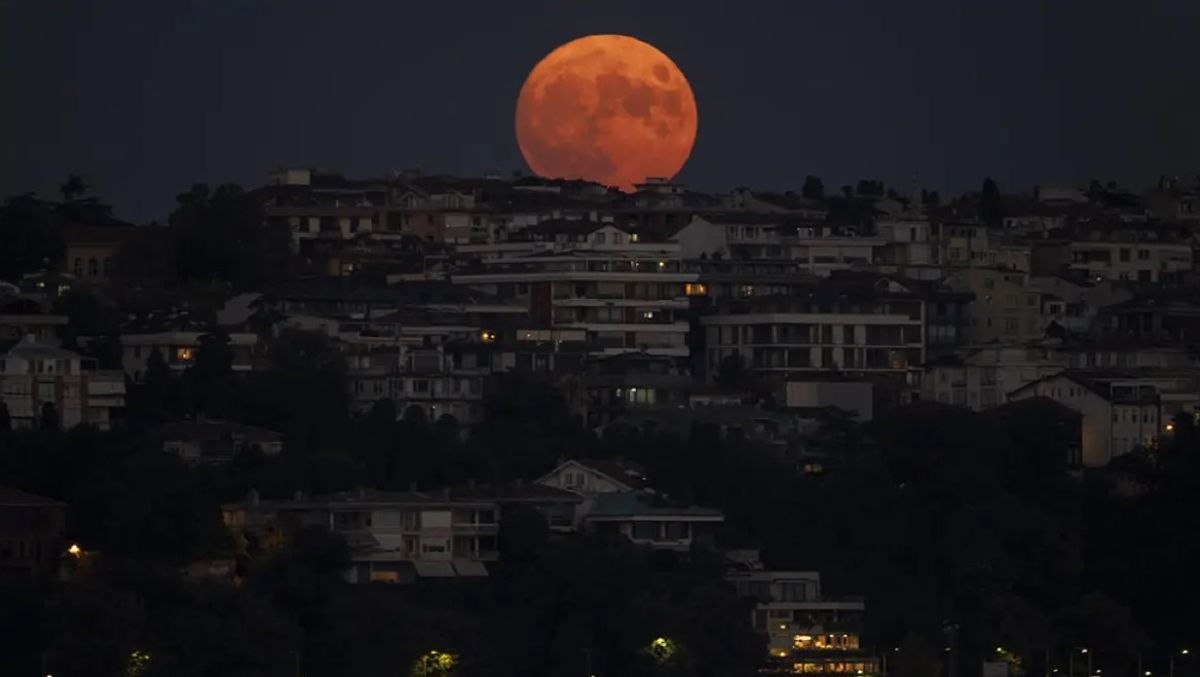
Recently, a total lunar eclipse took place, during which the Moon took on a distinctive reddish hue. This phenomenon, known as the Blood Moon, created a spectacular sight for observers around the world. Today, we’ll explore how the Blood Moon occurs and why it doesn’t appear during every eclipse.
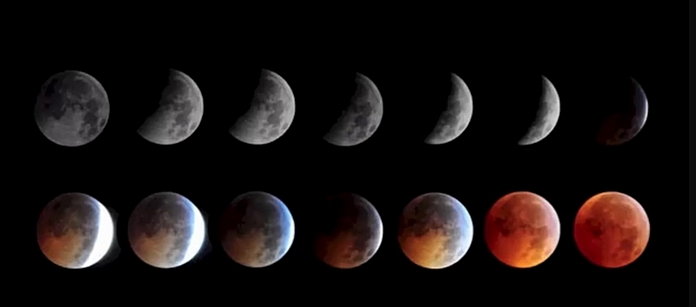
TABLE OF CONTENTS:
What is a Blood Moon?
The Blood Moon is not a separate astronomical object, but a phenomenon of a total lunar eclipse with a characteristic reddish tint. Essentially, it is an optical effect caused by the scattering of light in Earth’s atmosphere, operating on the same principle as red sunrises and sunsets.
A total lunar eclipse occurs when the Moon fully enters the central shadow of Earth, known as the umbra (“deep eclipse”). During this time, sunlight passes through Earth’s atmosphere, where blue light is scattered while red and orange wavelengths reach the Moon, creating the effect of a “bloody” glow. Astronomers also refer to this phenomenon as the “red lunar phase.”
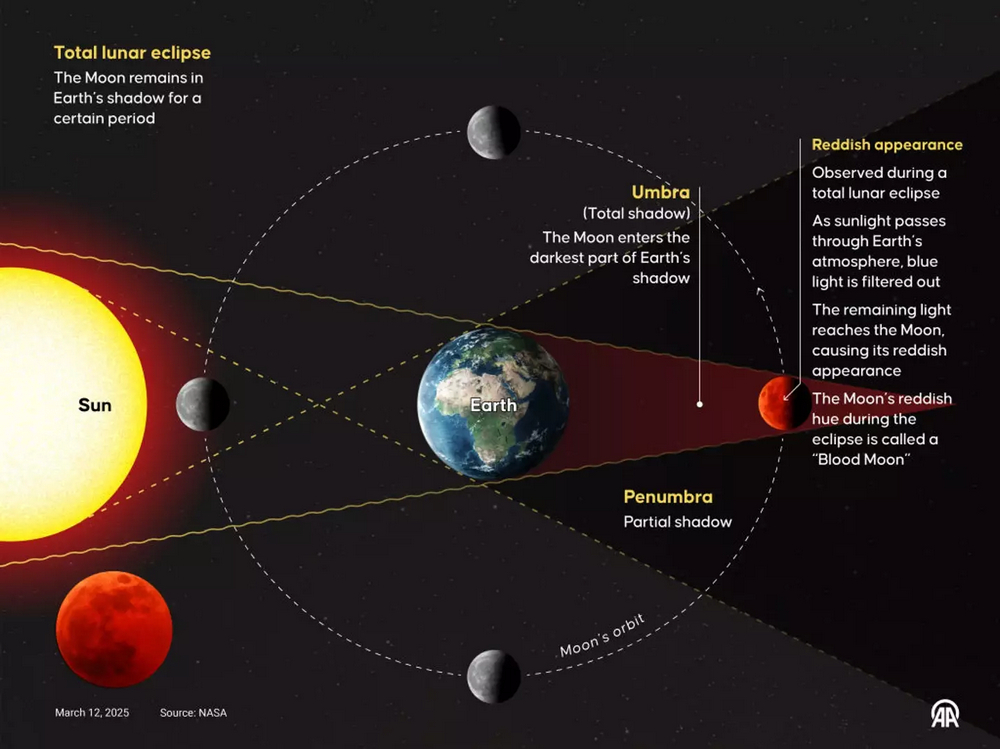
The intensity of the reddish hue depends on the state of Earth’s atmosphere. Volcanic eruptions, smoke from wildfires, or heavy pollution can make the Moon appear either darker and more saturated or, conversely, paler. NASA notes that the exact shade of a Blood Moon can only be predicted by taking into account the concentration of aerosols in the stratosphere at the time of the eclipse.
Read also:Mysterious Object 3I/ATLAS: Comet or Extraterrestrial?
Why does the Blood Moon not appear every time?
Not every total lunar eclipse results in a Blood Moon because of the specifics of the Moon’s orbit. The Moon’s orbit is tilted about 5 degrees relative to Earth’s orbit around the Sun. Due to this tilt, most full Moons do not pass directly through the central part of Earth’s shadow – the umbra. When the Moon only partially passes through the umbra or grazes its edge, a partial eclipse occurs, and the reddish hue is barely visible.
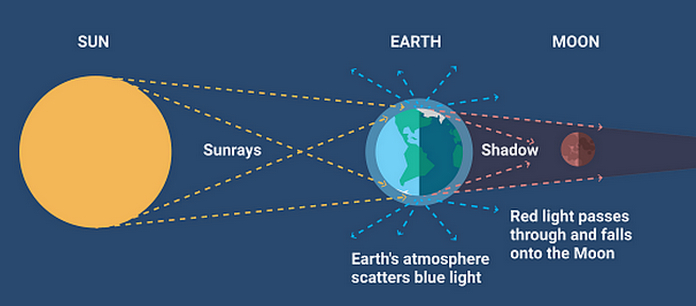
Another key factor is the relative position of Earth and the Moon at the time of the eclipse. Earth’s central shadow forms a cone that widens toward the Moon. For a vivid Blood Moon to appear, the Moon must pass entirely through this conical shadow at an optimal angle. Even a slight vertical or horizontal offset from the shadow’s center results in a less intense – or even imperceptible – reddish glow.
Additionally, the color intensity and visibility of a Blood Moon are influenced by Earth’s atmospheric conditions at the time of the eclipse. Dust, wildfire smoke, volcanic emissions, and pollution alter the scattering of sunlight that passes through the atmosphere and reaches the Moon. As a result, even when the Moon fully enters Earth’s umbra, its color can range from bright red to dark copper, and sometimes the phenomenon may be barely noticeable to the naked eye. Thus, the rarity of a Blood Moon is determined by the combined effects of orbital mechanics and Earth’s atmospheric conditions.
Read also:15 Creepiest Space Objects and Concepts That Defy Explanation
Frequency of lunar eclipses
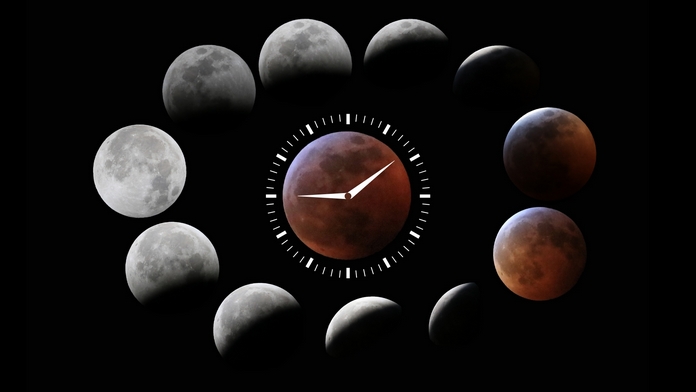
On Earth, there are typically two to four lunar eclipses each year, but only about 29% of them are total eclipses. Blood Moons occur even more rarely – roughly once every 2–3 years in a given region, depending on geography and visibility. For anyone who missed the recent total lunar eclipse and hopes to catch the next one, patience will be required: this natural spectacle will next be visible only on the eve of New Year’s 2028.
The next partial or penumbral lunar eclipses this year are expected to be visible from various parts of the world, including Asia, Europe, and Africa. Exact dates can be found in astronomical calendars, which take into account the Moon’s precise orbital parameters and the Sun’s position.
The scientific significance of the Blood Moon
The Blood Moon also serves as a tool for astronomers to study Earth’s atmosphere. The intensity and hue of the red light allow scientists to estimate aerosol and dust concentrations in the stratosphere. This phenomenon is also used to test light-scattering models and to measure the Moon’s orbit with high precision.

Additionally, lunar eclipses serve as a natural laboratory for testing the optical systems of telescopes and cameras, since during a Blood Moon the Moon provides a natural source of high-contrast red light. Astronomers also use these eclipses to train students and to promote science to the wider public.
Read also: How to Spot Fake Photos: New Challenges of the Digital Age
The historical significance of the Blood Moon
The Blood Moon has fascinated people for centuries and even influenced historical events. For instance, Christopher Columbus used the prediction of the lunar eclipse in 1504 to “frighten” the local Arawak people in Jamaica, compelling them to provide assistance to his crew.
This story illustrates just how powerful an impression astronomical phenomena could have on people who had no scientific explanation for them. Today, we understand that the Blood Moon is a natural optical effect, and we can observe it without fear, gaining instead both awe-inspiring experiences and scientific insights.
Read also:
- Nine of the Strangest and Most Mysterious Weapons
- Could Thorium Be a Breakthrough in Energy Technology?

