





© ROOT-NATION.com - Use of content is permitted with a backlink.
Microsoft Build 2026, the company’s annual developer conference, took place on June 2–3 in San Francisco and attracted particularly close attention from across the technology industry this year. Over the course of two days, Microsoft unveiled dozens of products – ranging from its own language models to a new operating system-level security architecture. These are no longer just product updates. Microsoft is signaling a strategic push to become the foundational layer of the entire AI stack – from silicon chips to cloud infrastructure.
Read also: Instructions, Guides, How To for Windows
TABLE OF CONTENTS:
When the Agent Takes the Controls
Imagine a morning that begins not with checking your inbox, but with your computer having already done it for you. It has flagged the important messages, prepared materials for your meeting, and resolved a scheduling conflict in your calendar. Instead of you managing the tools, the tools begin managing your schedule. That was the vision Microsoft presented at Build 2026, the company’s annual developer conference held on June 2 in San Francisco.
Each year, Build signals the direction one of the world’s largest technology companies intends to take. But this year’s conference felt like more than a product update cycle. It was a statement of a new technological philosophy: artificial intelligence not as an add-on to software, but as its foundational layer – embedded simultaneously into silicon, the operating system, and the cloud.
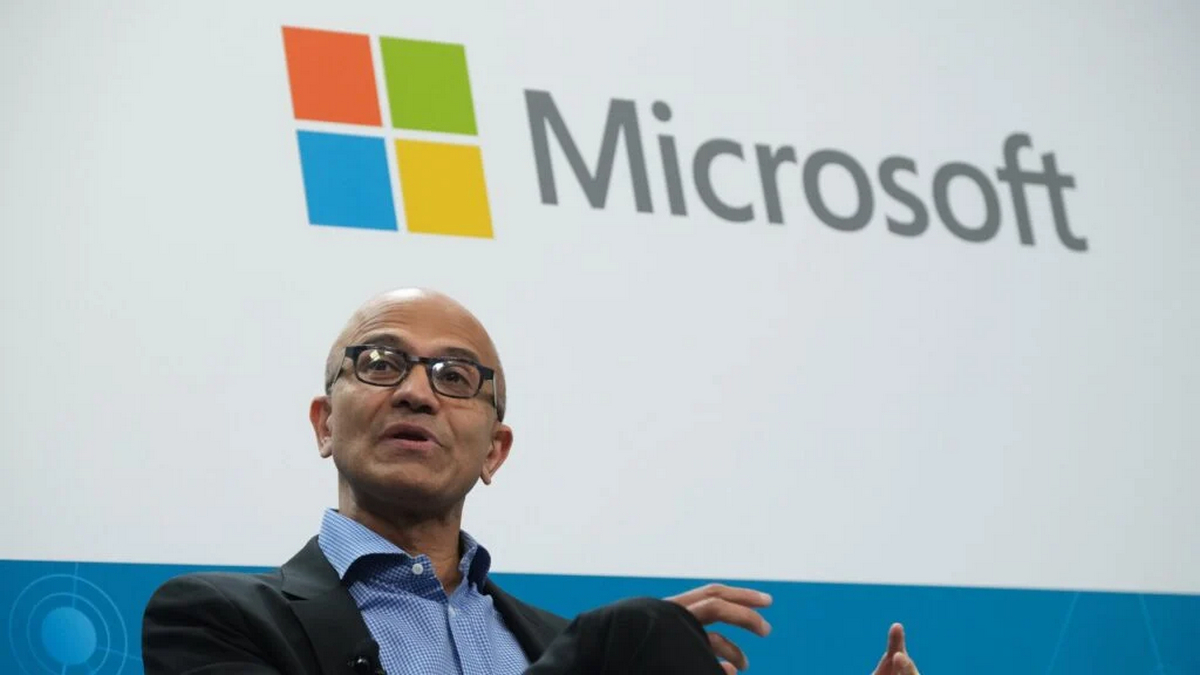
Satya Nadella and Mustafa Suleyman presented a broad set of announcements covering Microsoft’s own language models, a new concept of context for AI agents, an operating system-level security architecture, a standalone autonomous assistant agent, specialized hardware for AI development, and several other major initiatives. Below, we examine each of them in detail – and try to understand what they actually represent beneath the surface.
Read also: NVIDIA N1 and N1X: The Moment Windows Has Been Waiting for for Twenty Years
MAI – Microsoft Finally Has Its Own Models
For years, Microsoft’s identity in artificial intelligence was tied primarily to its large-scale investment in OpenAI. ChatGPT, GPT-4, and Copilot – all built on OpenAI’s models – became central to Microsoft’s position in the AI race. But after negotiations over revising the partnership agreement between the two companies, it became increasingly clear that Microsoft wanted strategic leverage of its own.
At Build 2026, Microsoft announced a family of in-house models under the unified MAI brand – seven models developed by the company’s AI Superintelligence team.
MAI-Thinking-1: The First Flagship Model
The flagship of the lineup is MAI-Thinking-1, a 35-billion-parameter model with a context window of 128,000 tokens. One detail Microsoft emphasizes in particular is that the model was trained from scratch, without distillation from other models. In other words, Microsoft did not simply fine-tune an existing architecture – it built the system independently from the ground up.
The company claims that in blind evaluations, independent reviewers preferred the model over Anthropic’s Sonnet 4.6, while in the SWE Bench Pro benchmark – which measures the ability to solve real-world GitHub tasks – its performance matched Opus 4.6. Microsoft also states that MAI-Thinking-1 delivers ten times greater token efficiency than GPT-5.5.
However, these claims cannot yet be independently verified: the model is currently available only through a closed private preview on the Foundry platform. This is standard practice for new AI product launches, but skepticism remains justified until open independent evaluations become available.
What may prove more significant is Microsoft’s emphasis on commercially licensed training data. In enterprise environments, where the legal status of training datasets is becoming an increasingly sensitive issue, this could emerge as a meaningful competitive advantage.
The Full MAI Model Stack
In addition to the flagship model, Microsoft introduced several other systems:
- MAI-Image-2.5 and its accelerated Flash version – models for text-to-image generation and image editing. They are already integrated into PowerPoint and are being rolled out to OneDrive. Microsoft claims the model outperforms Google’s Nano Banana Pro in ELO benchmark scores.
- MAI-Transcribe-1.5 – a transcription model supporting 43 languages, positioned as five times faster than competing systems.
- MAI-Voice-2 – supports more than 15 new languages and includes protection against voice cloning.
- MAI-Code-1 and its Flash version – a programming-focused model optimized for GitHub and VS Code, already available through Copilot.
None of these models is necessarily revolutionary within its individual category. Taken together, however, they form a broad AI infrastructure stack covering the full range of enterprise use cases – from software development to voice and image generation. This is no longer dependence on a single external provider, but the construction of Microsoft’s own platform.
Також цікаво: Prospects for DDR SDRAM: Future Developments and Key Challenges
Microsoft IQ: Context as the New Currency
The least visually impressive – but perhaps the most important – announcement at Build 2026 was what Microsoft called Microsoft IQ, a new “context layer” for AI agents.
The core idea is straightforward: an AI agent that does not understand the environment it operates in is essentially just an expensive search engine. For an agent to become genuinely useful, it needs context – who is who within an organization, how the organization functions, which rules apply, and what is happening in the world at any given moment.
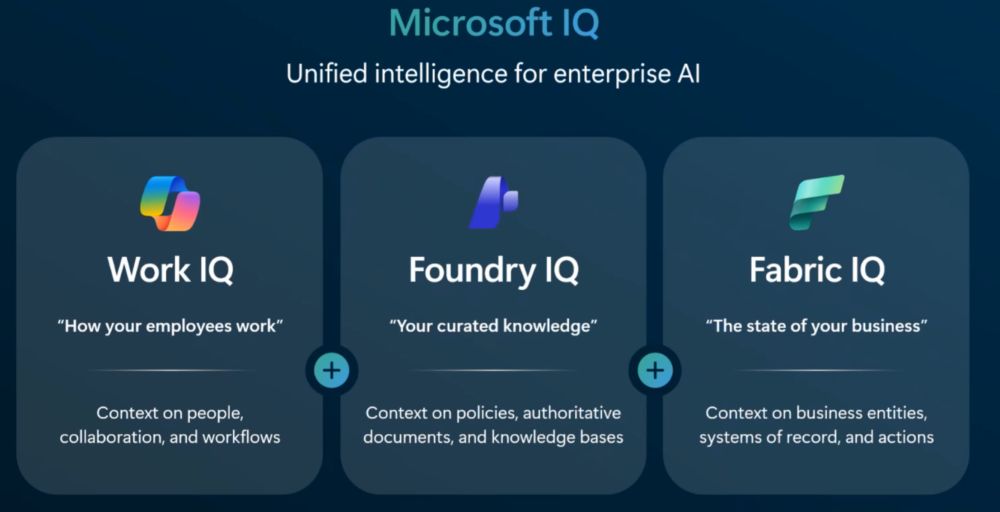
Microsoft IQ, already generally available through GitHub Copilot, Microsoft Foundry, and Copilot Studio, is structured into four layers:
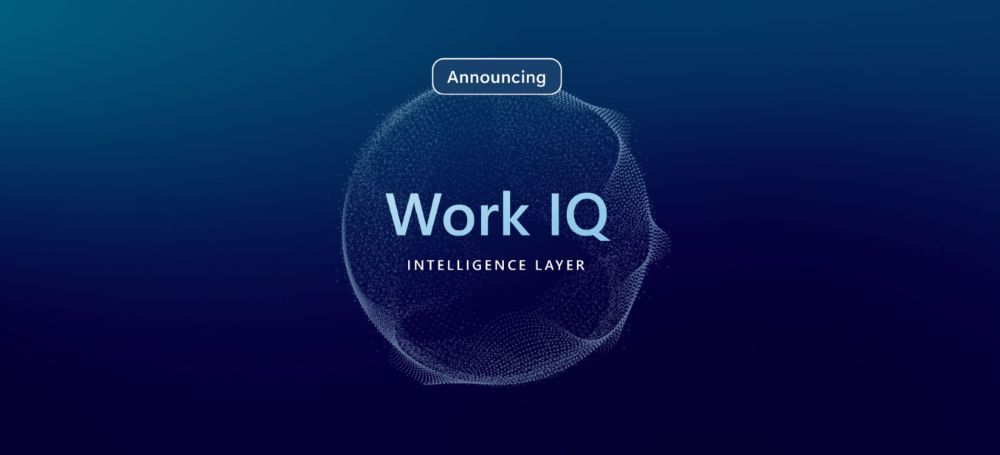
- Work IQ – aggregates information from Microsoft 365, including emails, documents, meetings, and relationships between people within an organization. The Work IQ API is scheduled to become generally available on June 16, 2026.
- Fabric IQ – covers structured business data and models the real-time operational state of a company.
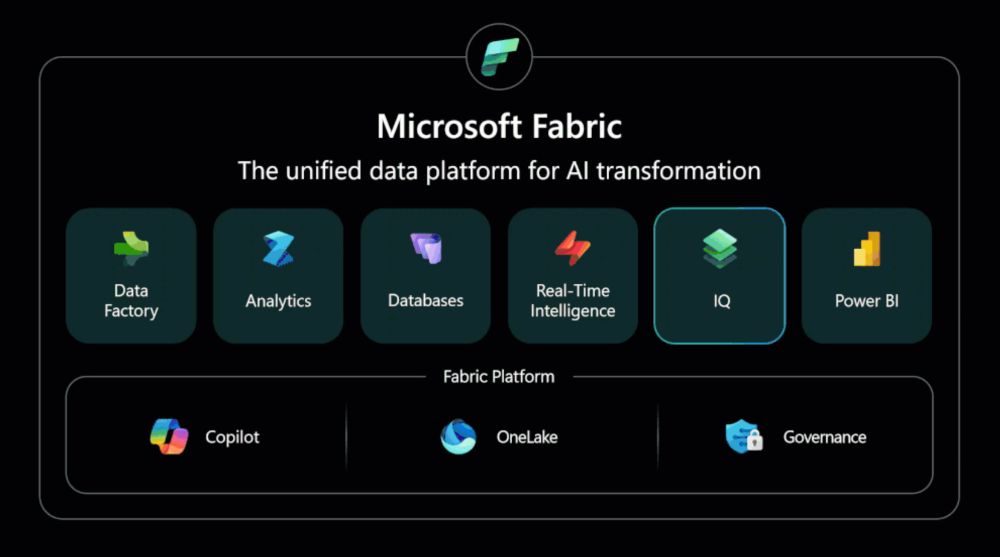
- Foundry IQ – unifies internal knowledge bases and enables agents to plan which sources to retrieve information from.
- Web IQ – a new addition at Build 2026, providing real-time external grounding. Microsoft claims it delivers speeds 2.5× faster than the “next best alternative.”
Conceptually, this represents a shift in paradigm. Until now, AI agents either had access to everything (which raised significant security concerns) or had no context at all (which severely limited their usefulness). Microsoft IQ attempts to resolve this tension through structured, governed context – where an agent knows only as much as it needs to complete a task.
How well this will work in practice will be seen on June 16, when the Work IQ API becomes available to developers and real-world validation begins.
Read also: Privacy as a Business Model: Proton Services and Efforts Toward a Surveillance-Free Internet
Scout: The Agent No One Asked For, but Everyone Wants
Among all announcements at Build 2026, the most emotionally resonant was Microsoft Scout – an autonomous personal agent introduced under a new category called “Autopilots” (long-running autonomous agents).
Scout does not wait for a prompt. It operates in the background, monitoring Outlook and Teams, preparing materials ahead of meetings, detecting calendar conflicts, and automatically resolving them.
“Scout works where you work,” Nadella said at the conference. And in that sentence lies both the entire idea and its underlying tension.
From a practical standpoint, Scout addresses a real problem: how many times, right before an important meeting, do you end up urgently searching for an email from a week ago or trying to remember where a needed file is stored? An agent that handles this for you is undeniably convenient.
But Scout is also an agent with full access to your email, documents, and calendar, capable of making decisions without an explicit request. This represents a level of trust and authority that, until recently, was reserved exclusively for a human assistant with years of established reliability. The question is not purely technological – it is whether organizations and their legal departments are ready to delegate such authority to an automated system.
For now, Scout is available only to Frontier customers (Microsoft’s highest-tier Microsoft 365 subscription). Broader rollout is described as “coming soon.” Given typical enterprise adoption cycles, that likely means anywhere from three months to two years.
Read also: Everything About VERTU ALPHAFOLD: Smartphone Priced Like Car or Future of Enterprise AI?
Surface RTX Spark Dev Box: A Petaflop on the Developer’s Desk
Build 2026 also included hardware announcements. The Surface RTX Spark Dev Box is positioned as a system that redefines where AI development happens.
At its core is the NVIDIA RTX Spark, delivering up to one petaflop of AI compute performance, along with 128 GB of unified memory. In practical terms, this enables local execution of models with up to 120 billion parameters, without sending data to the cloud.
From a configuration standpoint, it is a developer’s dream: WSL 2 with built-in GPU passthrough and full CUDA support is preconfigured out of the box, along with VS Code, GitHub Copilot, Git, Python, and Node.js already installed. The operating system boots into a dark theme with widgets disabled and “Do Not Disturb” mode enabled by default. PowerShell 7 serves as the default shell. “We basically said: we’ve got you covered, you want to move fast,” a Microsoft engineer explained during the presentation.
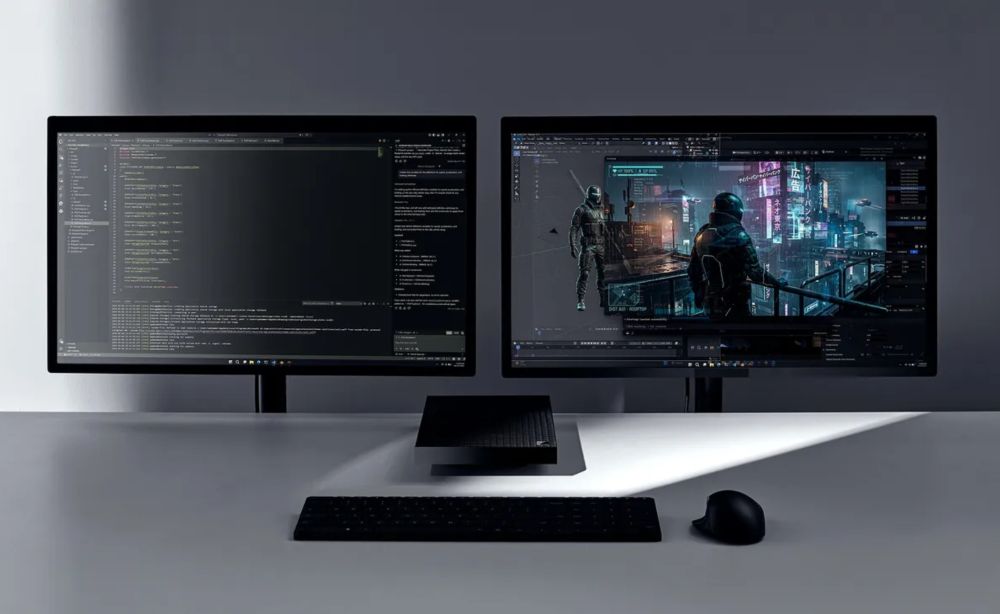
This represents an important conceptual shift. Over the past two years, the default approach to serious AI development has been to rent GPUs in the cloud, call APIs, and keep local machines relatively lightweight. With the Surface RTX Spark Dev Box, Microsoft is signaling a different direction: the next phase of AI development will be hybrid – local, agent-driven, and orchestrated. In this framing, Windows 11 is no longer just a client operating system.
Pricing has not been disclosed yet. The device will be sold in the United States via Microsoft.com later this year. Given its specifications, it is unlikely to be inexpensive.
Read also: Key Takeaways from Google I/O 2026
MXC: Security Built into the OS Kernel
Perhaps the most strategic announcement at Build 2026 received relatively little fanfare, yet it may have the longest-term impact. Microsoft Execution Containers (MXC) is an SDK and policy model integrated into the kernel of Windows 11 and Windows Subsystem for Linux, designed to isolate AI agents at the operating system level.
The idea is simple but powerful: a developer defines what an agent is allowed to access (files, network, clipboard, and so on), and Windows enforces those constraints at runtime. Not through third-party tools or additional patches, but directly through the OS runtime itself.
MXC introduces a “spectrum of isolation”:
- Process isolation – lightweight and fast, intended for scenarios such as executing code generated by a model (already used in GitHub Copilot CLI)
- Session isolation – designed for longer-running workflows, separating the agent from the user’s desktop, clipboard, and input devices
- Future direction: micro-VMs, Linux containers, and integration with Windows 365 for Agents
On MXC, other players are already building: OpenClaw uses it for multi-step workflows, while NVIDIA, through its OpenShell, adds policy management, output routing, and personal data obfuscation.
An important caveat is that MXC is still in early preview, and Microsoft’s GitHub repository explicitly warns that current profiles should not be treated as true security boundaries. However, the fact that NVIDIA is already building on top of it signals that the ecosystem is taking the approach seriously.
For IT departments and security teams, this may be one of the most significant developments from Build 2026. AI agents operating without proper constraints represent one of the largest emerging attack surfaces. Microsoft is attempting to address this systematically rather than through incremental patches.
Read also: Five AI Cities: Inside the Emergence AI Experiment – Order, Chaos, and Survival
GitHub Copilot is emerging as a standalone application
GitHub Copilot is moving out of the shadow of Visual Studio Code. The new native desktop application (currently in preview) is not just a plugin, but a full-fledged agentic development environment.
A key feature is the ability to run multiple agent sessions in parallel, each in its own isolated git worktree. This allows developers to work simultaneously on multiple branches without merge conflicts. The developer sets the direction, while the agent executes tasks, runs tests, integrates changes, and proposes merges.
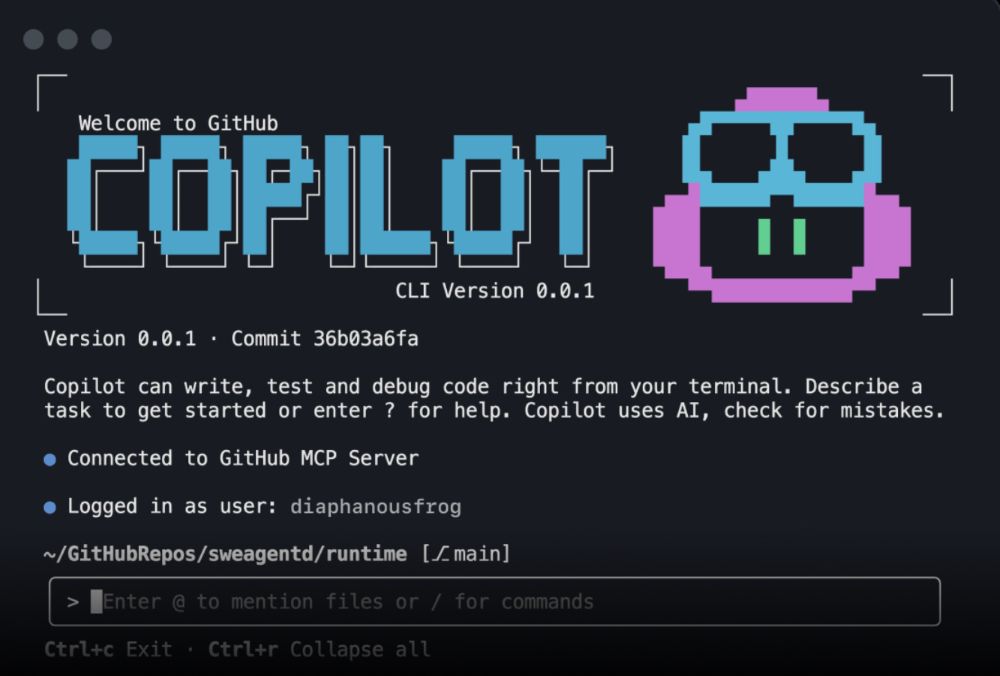
This is complemented by Project Rayfin – a backend service built on top of Microsoft Fabric and integrated into GitHub workflows. Rayfin handles databases, APIs, authentication, and infrastructure, reducing the need for developers to manage these components directly. Integration with Replit provides a fast path from prototype to production-grade deployment.
Separately, Azure HorizonDB is introduced as a managed PostgreSQL service. According to internal benchmarks, it delivers more than three times the throughput of self-managed equivalents. Given that PostgreSQL has become the de facto standard for new backend systems, independent validation of these performance claims would make HorizonDB a highly competitive offering in the database market.
Read also: Hantavirus: Virus from a barn that killed people in the middle of the ocean
MDASH and ASSERT: Agent Security at Industrial Scale
MDASH is Microsoft’s multi-model security system, using more than 100 specialized agents to automatically identify vulnerabilities. The system analyzes data flows, business logic, and potential exploit chains, and then deploys fixes directly through the Microsoft Defender portal.
Alongside MDASH, Microsoft introduced two open projects:
- Agent Management Specification – an open standard for managing AI agents
- ASSERT – an open-source framework for policy-based security evaluation
The latter two represent a strategically significant move. By making these specifications open, Microsoft is betting that they will become industry-wide standards beyond the Azure ecosystem. If other players adopt them, Microsoft effectively becomes the author of a foundational standard for the entire sector. In this sense, the approach resembles strategies used by Google with Android and with open web protocols.
Read also: Windows 12: Five Changes Users Are Still Waiting For
Microsoft Discovery: Science, Not Just Business
Among the more enterprise-focused announcements, Microsoft Discovery stands out as an agent-based platform for scientists and researchers, already generally available today.
Microsoft cites concrete use cases: BHP uses Discovery to optimize copper leaching processes, reducing research timelines from years to months. Syensqo accelerates R&D in the semiconductor industry. GSK applies it to iterative drug development workflows.
Separately, a free Discovery application was announced for the broader scientific community, expected to be available this summer. Access will require only a GitHub Copilot account. This is a relatively uncommon move for Microsoft toward the academic community, which has traditionally favored open tools and ecosystems.
Read also: End of the “Flesh and Bone” Era: 9 Areas Where Robots Will Outperform Humans as Soon as Tomorrow
Context and Strategy: What Is Really Behind All This?
Stepping back from Build 2026, a broader strategic pattern becomes visible.
Microsoft is aiming to become the operating system for artificial intelligence. Not just a cloud provider, not just a partner to OpenAI, but a foundational layer through which the entire AI stack flows: from silicon (RTX Spark Dev Box), through the operating system (MXC in Windows), into the cloud (Azure, Foundry), and up to the application layer (Microsoft 365, Scout, GitHub Copilot).
This is fundamentally different from the company’s earlier AI ambitions. Cortana was an add-on. First-generation Copilot was a layer on top. MAI, MXC, Microsoft IQ, and Scout are infrastructure.
The emphasis on context and trust is another central theme. Microsoft IQ, commercially licensed training data for MAI-Thinking-1, and MXC as a secure sandbox all address the same enterprise question: “Can we trust these AI agents with our data?” Microsoft is attempting to answer “yes” not through marketing claims, but through architectural design.
The gradual decoupling from OpenAI is becoming increasingly visible. The seven in-house MAI models are not a one-off sprint. They signal a longer-term strategic reorientation. Microsoft is aiming to control its AI stack end-to-end, in a way similar to how Apple controls its ecosystem from silicon to App Store.
Read also: Computers in Space: Limitations as an Advantage
A Critical View: Between Promise and Reality
No analysis would be complete without a critical perspective.
Cortana was once positioned as the future of personal assistants. It ultimately ended up as a feature many users disabled on the first day after buying a laptop. The first two years of Microsoft Copilot also received mixed reviews, even from loyal users. This historical context calls for caution when evaluating Microsoft’s more ambitious claims.
MXC is still in early preview – and Microsoft itself warns that current profiles should not be treated as real security boundaries. The gap between “early preview” and “enterprise standard” is significant, spanning time, resources, and many failed iterations along the way.
The MAI-Thinking-1 benchmarks sound compelling, but the model is currently available only in closed preview. Until independent evaluations appear, these remain unverified claims.
Scout, in theory, addresses real operational pain points. However, an agent with full access to corporate email that acts without explicit instructions raises new questions around security, accountability, and privacy – questions that Microsoft has not yet fully addressed in a detailed, transparent way.
Pricing for the Surface RTX Spark Dev Box has not been disclosed. Given its specifications and target audience, it is unlikely to be positioned as a consumer-friendly product.
Read also: John Ternus: The Engineer Apple Has Been Waiting For for Quarter Century
A Moment of Gathering or Scattering?
Build 2026 resembles a moment where Microsoft stops assembling scattered pieces of the AI puzzle and starts playing its own game on its own terms: in-house models, its own security architecture, a proprietary context layer, dedicated hardware, and an autonomous “autopilot” agent.
The scale of investment, depth of integration, and overall system-level coherence represent something Microsoft has not previously demonstrated in a single coordinated push. This is not a standalone product – it is an attempt to define a full platform.
But there is a difference between building a platform and claiming a monopoly on the future. OpenAI continues to evolve, Google is investing heavily in Gemini, Anthropic is developing its own models, and Meta is open-sourcing Llama. Competition at the foundation-model layer is unlikely to produce a single clear winner in the near term.
Where Microsoft may truly win is at the integration layer. If MXC becomes a de facto security standard for AI agents in Windows. If Microsoft IQ genuinely makes agents more context-aware inside enterprise environments. If Scout proves useful enough that users are reluctant to give it up – even knowing it has access to their email and acts without explicit prompts.
“Silicon to OS to developer tools to cloud” is how Satya Nadella described Microsoft’s new stack. If this vertical integration works as a coherent system, Build 2026 could be remembered as a turning point. If not, it will be just another wave of ambitious announcements dissolving into the gap between vision and enterprise adoption.
We will not get the answer at the next conference. We will get an early signal on June 16, when the Work IQ API becomes public. And later in 2026, when early enterprise users of Scout report whether they actually trust an agent that does not wait to be asked.
Read also:
- Rome vs. Silicon Valley: Why Leo XIV’s “Magnifica Humanitas” Encyclical on Artificial Intelligence Matters
- New Zhenwu M890 AI chip: How U.S. sanctions contributed to China’s technological independence
- Through Nuclear Fire: Trinitite – A Material That Should Not Exist
- Notepad++ for Mac Controversy: Detailed Breakdown of Conflict

