





© ROOT-NATION.com - Use of content is permitted with a backlink.
Чи легко можна розпізнати фальшиві фотографії? Повірте, не все так просто у сучасних реаліях. Це доводить нове дослідження від Microsoft.
An American tech corporation conducted a large-scale study and gently hinted at an uncomfortable truth: we’re like blind kittens in a world of machine vision. It turns out that most people can correctly tell whether a photo is real or AI-generated only slightly more than half the time. In other words, if reality were a game, we’d have lost during the loading screen.
To make sure we don’t remain blissfully unaware, the company launched an online quiz called Real or Not?. Users are given 15 chances to guess whether they’re looking at a genuine photo or a product of artificial imagination. And no, it’s not just a meme-style game – it’s a wake-up call. Deepfakes aren’t a novelty anymore; they’re already a regular part of your feed.
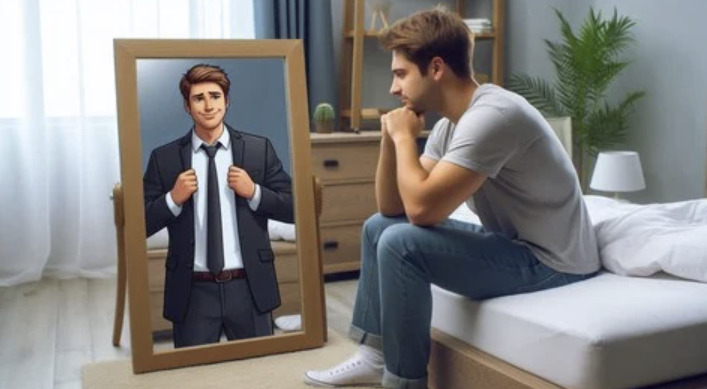
Alongside the quiz, the company conducted a global survey involving over 12,500 participants. In total, that’s 287,000 individual judgments – each pointing to one conclusion: humanity seems to be losing to artificial intelligence even at the beginner difficulty level, with an average accuracy rate of just 62%. Not exactly reassuring, considering that’s only slightly better than blind guessing.
This isn’t just a warning bell – it’s a full-blown fire alarm. While we confidently think of ourselves as tech-savvy, neural networks are already generating portraits that can fool even professionals. And with every new update, these systems are becoming less “artificial” and more convincing – often more so than any Instagram filter ever created.
Read also: Cryptography: What It Is and How It Works
TABLE OF CONTENTS:
‘Real or Not?’ – a quiz that exposes illusions
A new quiz from Microsoft focuses on deepfake images – and it turns out, we still can’t reliably spot them. It all started innocently enough: a cute dog photo on Brad Smith’s LinkedIn page. At first glance, it looked like classic Monday clickbait – designed to rack up a few hundred likes and trigger a dose of oxytocin. But no. It was a visual trap, complete with a hidden clue.
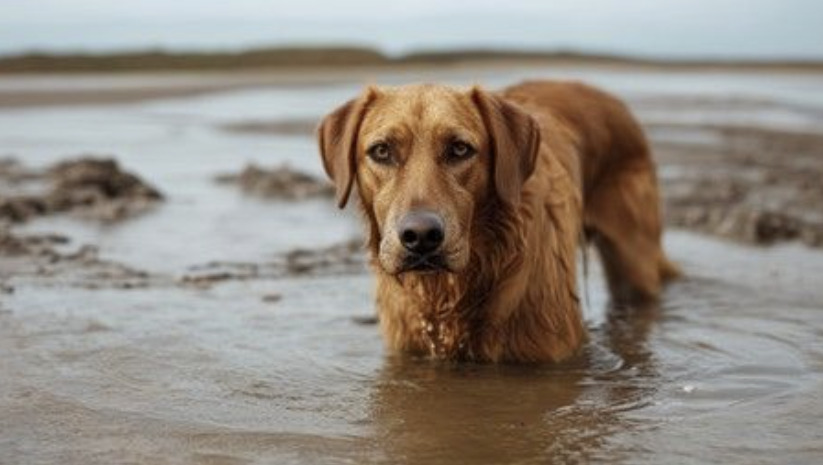
As it turns out, the photo of the four-legged friend had nothing to do with reality – aside from some masterfully generated fur. Brad Smith wasn’t just kicking off the week with an adorable image. Instead, he was launching a campaign for Microsoft’s new initiative: an online quiz that tests your ability to tell real images from glossy AI fabrications.
The concept feels like it’s been plucked from the future – a world where truth requires proof. And yet, the reality is more unsettling: even when confronted with an obvious fake, we look, blink, and hit “like.” Our brains haven’t updated their firmware for a new game where images no longer guarantee truth. In this landscape, even a dog on LinkedIn might be nothing more than a hallucination from deep within a neural net.
The game’s formula is deceptively simple: look, click, move to the next image. It feels like Tinder – only instead of a potential date, you’re served a potential fake. But once the initial fun wears off, most participants are left facing a sobering truth: their much-praised intuition is little more than a soap bubble. Especially when it comes to something seemingly harmless, like a sunset over city rooftops – a familiar, sterile shot that appears to hold no secrets.
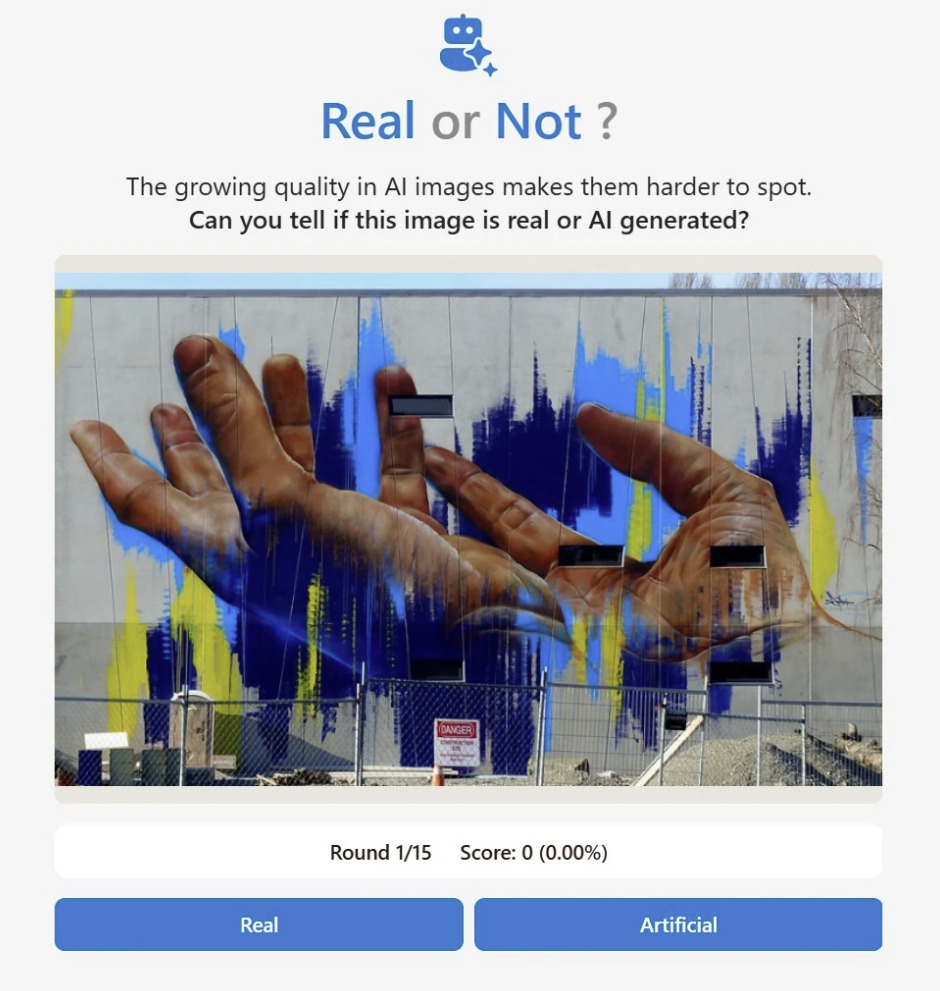
The quiz’s creators deliberately avoided playing tricks with optical illusions. The image set was grounded in everyday life: amateur snapshots mixed with visuals generated by Midjourney and DALL·E 3. No medieval Louvre under Martian siege or hyper-detailed portraits of grandmas with owl eyes. Just the ordinary – cities, nature, portraits, food, household items. The kind of content you scroll past daily on social media without a second thought: is it real, or is it already the product of an AI’s imagination?
Each participant received around ten images, carefully selected to cover all the major categories. The algorithm made sure everyone had an equal shot – no favoritism, just you and your internal lie detector.
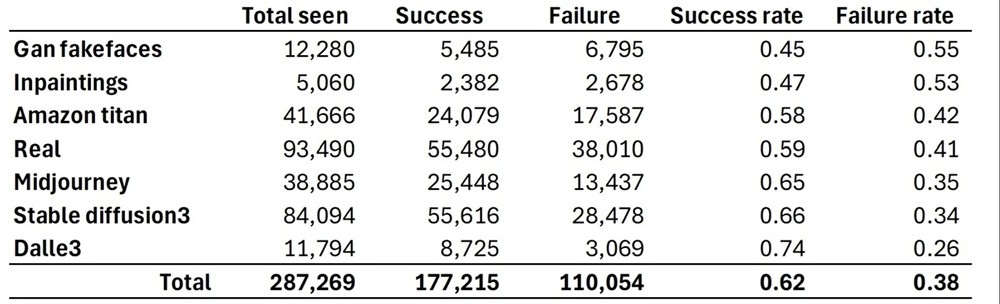
And yet, the standard deviation was surprisingly small: most participants landed in the 55–70% range. In other words, whether you’re a self-proclaimed Photoshop expert or someone who can barely tell a cat from a dog on the second try – your odds of spotting a deepfake aren’t much better than a coin toss. There was no hidden “class of the enlightened” who could see through the pixels. Even those who spend their days tweaking brightness and contrast failed just as often as Pavlo from next door, who barely knows how to update his phone.
Read also: OpenAI’s New Superpower: What Is a ChatGPT Agent?
Portraits are easy, landscapes are almost like the real thing
You’d think faces would be our strong suit. After all, evolution spent millions of years wiring us to read emotions before a person even opens their mouth. Spotting fear, aggression, or a fake smile used to be a matter of survival long before smartphones entered the picture. So it’s no surprise that portraits turned out to be the easiest category in the quiz. Still, with an error rate of 35%, it’s hardly a triumph of human perception – more like a soft failure.
When it comes to landscapes and cityscapes, the situation is more complicated – or rather, more disappointing. Looking at drone photos of a snowy fjord or a neon-lit city at night, our brain switches to “oh, that looks nice” mode and turns off critical thinking. Verifying whether the geography of Hong Kong at night is accurately depicted isn’t a matter of intuition; it requires cross-checking with something like Google Maps. The result is often disastrous. Most people get it wrong – not because they lack intelligence, but because our visual system evolved for survival in natural environments, not for identifying fake skyscrapers generated by tools like Midjourney.
Although these images may be unrealistic, we still perceive “something familiar” in them. Familiarity often translates to authenticity in our minds. This is how the cognitive trap works: our vision is tuned for quick scanning rather than detailed inspection. Anything that doesn’t obviously signal an error tends to pass through this filter unnoticed. As a result, we fail to notice details like a building sign written in an elvish script or shadows cast at incorrect angles.
Take a look – none of these photos are real; they are all creations of artificial intelligence:

Now, add time pressure to the mix. During the quiz, people selected answers in just 2–3 seconds, similar to an old flash game. When researchers allowed participants to examine the images for longer – up to 10 seconds – accuracy improved by about 8 percentage points. But who actually spends that much time scrutinizing photos in real life? We typically have less time than it takes to view someone else’s social media story. Two quick swipes, and suddenly we’re experts in landscape photography.
With this level of attention, we confidently like, repost a “photo from Mars,” and argue in family chats about the authenticity of pictures allegedly showing a destroyed hospital. That’s because we don’t verify; we simply trust our eyes. And as it turns out, our eyes are no longer the main source of truth – in fact, they’ve become its weakest link.
Read also: AI in Medicine: Is the Future Already Here?
Algorithms versus humans: who wins?
Researchers decided to run an experiment alongside this. If humans regularly fail at image recognition, why not let a machine try? They developed a tool combining statistical features (DCT, SRM) with semantic embeddings from CLIP. The result was over 95% accuracy on the same dataset. In other words, while humans squint at a sunset photo, debating whether it’s really Lisbon, the neural network unemotionally flags it as a fake and moves on.
But the issue goes beyond accuracy. The main problem is the erosion of the very concept of authenticity. When every image is seen as potentially fake, a psychological defense mechanism kicks in: a general disbelief. This has a counterproductive effect because if everything becomes “suspicious,” genuine photos get discarded along with deepfakes. This creates an ideal environment for misinformation – where creating fake content isn’t even necessary; it’s enough to cast doubt on everything we see.
Here is how few people guessed that these are real photos:
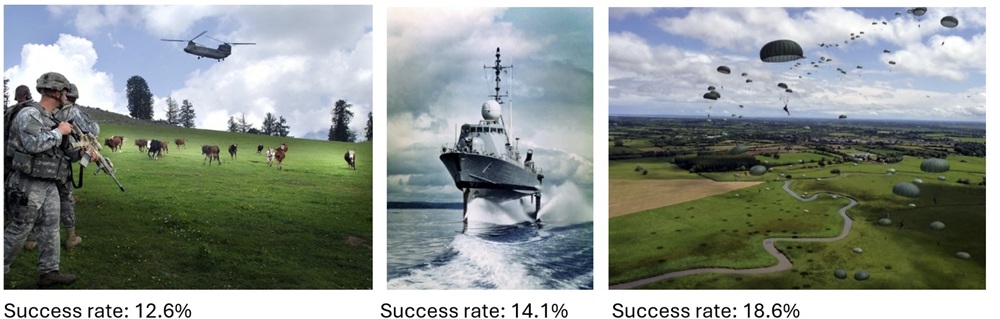
To restore some level of trust, Microsoft, Adobe, and several other companies are promoting the Content Credentials standard. The concept is straightforward: embed cryptographic signatures and an “editing passport” directly into a file’s metadata. If an image was generated by an AI model, the system automatically includes a C2PA tag that social platforms can read to alert users with messages like, “Warning: this is not a photo taken with an iPhone, but an AI-generated creation.”
Another approach involves digital watermarks embedded deep within the pixel structure, like invisible tattoos. These marks are designed to withstand cropping, filters, and minor edits. However, this remains largely theoretical. In practice, there are at least a dozen competing watermark standards, with each company playing its own tune. One service reads only Adobe’s marks, another only Google’s, while most platforms ignore them altogether, claiming it’s “not a priority.”
The result is a classic IT cacophony: the technology exists, but without a common language, it’s just a collection of tools operating in different keys. Until the industry reaches consensus, we’ll continue living in a reality where truth has less chance than a deepfake with good lighting and a strong bokeh effect.
Read also: “Superintelligence” – Breakthrough or Marketing Hype? An Analysis
What next?
If you still genuinely believed that a “trained eye” is enough to spot computer-generated fakes, here’s some cold hard data for you: an average accuracy of just 62%. That means two mistakes out of every five attempts. And this isn’t from casual scrolling on TikTok between snacks, but from a controlled experiment. In real life, the situation is likely even worse – more emotions, less focus, and no chance to say, “Sorry, let me take another look.”
Technology has long crossed the line where reality is just another rendering style. The average user, armed with confidence and outdated intuition, no longer stands a chance. Without assistance – whether through algorithmic detectors or simply the habit of questioning rather than liking – they become easy prey for generative AI.
Until global content labeling standards move beyond being just a topic for conference panels and become as commonplace and integrated as a wet wipe in fast food, there’s one thing left: a culture of constructive skepticism. Not paranoia or conspiracy against the truth, but simple digital caution. Because truth still exists today – it’s just no longer “obvious at first glance.”
So, be careful and attentive online, because the photo of a landscape you just received might very well be AI-generated.
Read also:
- Network-Centric Warfare: How Warfare Is Evolving in the 21st Century
- Instructions, Guides, How To for Windows

