





© ROOT-NATION.com - Use of content is permitted with a backlink.
Headlines like “Chinese Robot Demonstrates How It Works, Dances, and Exercises,” “AI-Powered Surgical Robot Learns to Remove Organs Independently,” and “Chinese Robot Dog Sets New Speed Record” illustrate some of the current achievements in robotics. Robots are being used in manufacturing, streamlining workflows, and improving daily life – in short, they represent practical progress in the field.

However, writers – particularly in science fiction – have long anticipated technological developments. Years ago, they imagined worlds where robots or androids live alongside humans, often giving these beings consciousness and emotions and placing them at the center of the story. Sometimes, these robots are even more compelling and “human-like” than the people around them. Here’s a selection of books that feature robots, androids, and cyborgs in all their complexity.
TABLE OF CONTENTS:
‘I, Robot,’ ‘The Foundation,’ Isaac Asimov
A good place to start is with one of the “big three” science fiction authors, Isaac Asimov, known for creating the “Three Laws of Robotics.” These laws were first introduced in his 1942 short story “Runaround”, which later became part of the collection I, Robot. Asimov also invented the profession of a robopsychologist – someone who interprets robot behavior using these laws – and coined the term “robotics,” a concept that, like many of his science fiction ideas, has since become part of the real world.
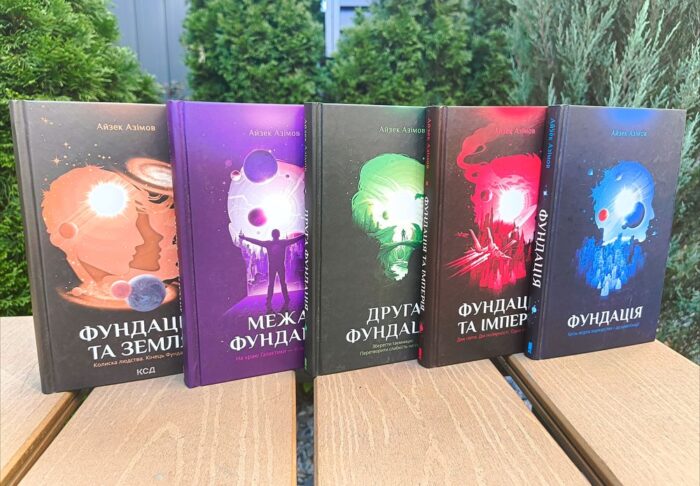
In the book Robots and Empire, the robots R. Daneel Olivaw and Giskard formulated the “Zeroth Law of Robotics”: a robot may not harm humanity, or, through inaction, allow humanity to come to harm. Later, R. Daneel Olivaw also appears in the Foundation series, a fictional universe spanning seven novels.
The series follows the decline of a powerful Galactic Empire and its accelerated recovery through the plan of psychohistorian Hari Seldon. The plan involves establishing a community of scientists on a remote planet to preserve knowledge and culture for the eventual restoration of civilization. At first, androids do not play a prominent role, but by the end, the significance of R. Daneel Olivaw in human history becomes clear. The book series served as the basis for the Apple TV+ series of the same name.
‘The Murderbot Diaries,’ Martha Wells
This series also inspired a TV adaptation, released this year on Apple TV+ – specifically, Murderbot Diaries: All Systems Red. The first story introduces us to the SecUnit, a security robot. Essentially, it’s a robot guard assigned to protect a group of scientists on a distant planet. But this robot is unusual: it once managed to hack its own control module, giving it independent thought. Now, it pretends to be an ordinary security unit, doing only the bare minimum required, enjoying watching TV shows, carrying some tragic memories, and getting irritated by humans. If these aren’t typical human traits, it’s hard to say what is.
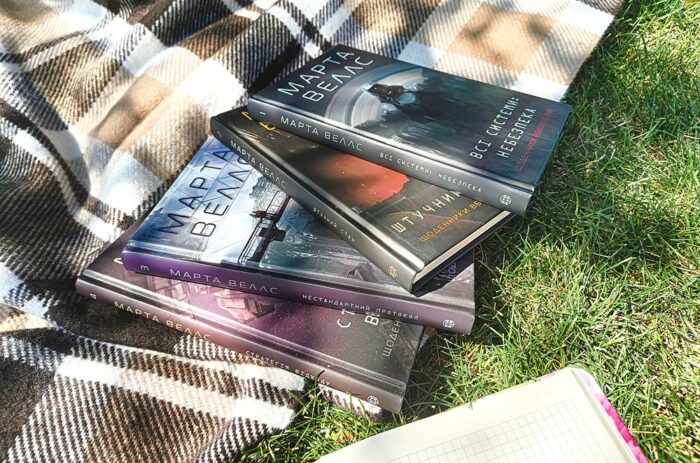
What happens when an android breaks free from its programmed constraints? It doesn’t automatically become a cold-blooded monster. In the case of the SecUnit, humans may irritate it, but it still protects them, helps out, and gradually develops new “human-like” traits that continue to unfold with each installment. The books are short, densely packed with events, and lightly seasoned with humor, making them easy to dive into and just as easy to surface from on the last page.
‘Lunar Chronicles’, Marissa Meyer
Androids and cyborgs appear across a variety of genres. One example is a retelling of popular fairy tales with a sci-fi and cyberpunk twist, set in an Asian-inspired world. This is the Lunar Chronicles series by Marissa Meyer.
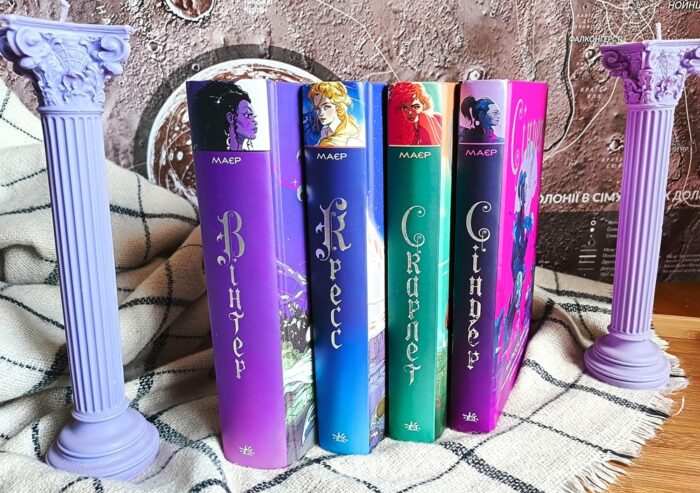
Cinder, the protagonist of the first book, is the top mechanic in New Beijing, an underprivileged orphan, and a cyborg. In this world, cyborgs are marginalized, feared, and treated as second-class citizens; their lives are tightly regulated, and they are the first candidates for testing experimental drugs against the local version of the plague. Cinder’s stepmother – who can only be described as a textbook villain – sends her as a “volunteer” for these experiments. From there, the story unfolds rapidly.
If you think this is light reading aimed at young women, consider that my 68-year-old father read the first two books in three days. Meanwhile, a friend who’s a devoted sci-fi fan went as far as checking the scientific plausibility of the story; she even “found a lecture summary on biophysics of aquatic organisms to read up on bioelectrogenesis in fish,” as she put it.
‘The Wild Robot,’ Peter Brown
Robots aren’t limited to adult literature. The Ukrainian publisher Vivat offers two charming books from Peter Brown’s trilogy – The Wild Robot and The Wild Robot Escapes. If the title sounds familiar, you might have seen DreamWorks’ animated adaptation, released last year. The book addresses timely themes like upbringing and differences, but it does so subtly, without hitting the reader over the head.
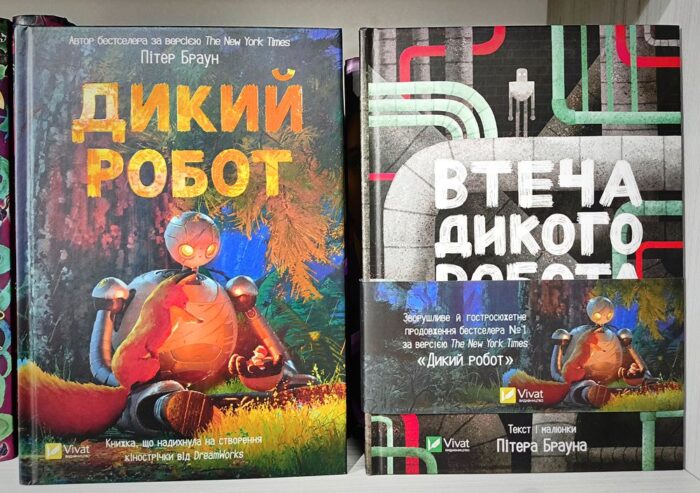
After a storm, a box washes up on an island, where a group of otters discovers a robot of the ROZZUM model, nicknamed Roz. This model can self-improve, so even in a challenging environment, Roz begins learning from the animals and gradually adapts to the wild. While robots don’t truly experience emotions, Roz seems to feel something in this new setting – primarily curiosity. At first, the animals are wary of her, but over time they warm up, especially after Roz takes on a maternal role for a gosling and eventually starts protecting the entire island. Not all robots are this kind-hearted, making Roz’s story particularly special. Overall, it’s a charming tale for younger and middle-grade readers.
‘Klara and the Sun,’ Kazuo Ishiguro
This dystopian novel by a Nobel laureate features companion androids sold to children – an already intriguing premise. The story follows a girl named Josie, who receives a companion android, Clara, from a store. Clara is inquisitive and observant, capable of reasoning (sometimes in unusual ways for an android), and even seems to experience emotions. She quickly senses that something is wrong with her charge and, with a level of dedication uncommon for androids, seeks to help her. The result gives the impression that, in this story, androids are somehow “more human” than the people around them, experiencing far more than one might expect.
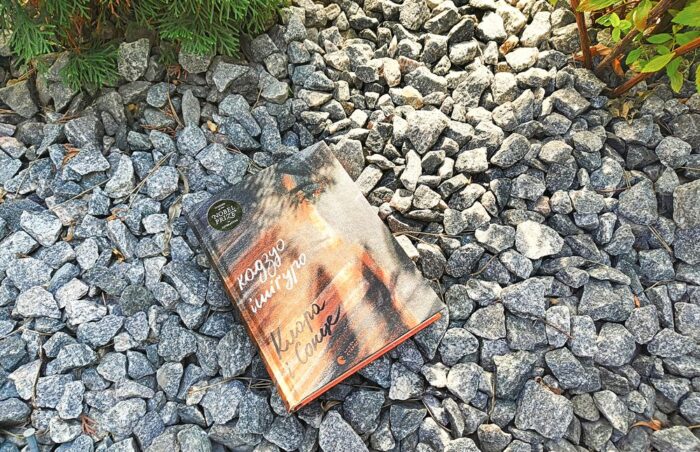
For me, the book left quite a few gaps, though perhaps that was intentional – the author seems to invite readers to imagine the society, the world, and the nature of the “illness” themselves. Don’t expect a deeply immersive experience, but visualizing the world could enhance it. Director Taika Waititi is taking on this task, with the adaptation set to release next year and Jenna Ortega cast as Clara.
‘Do Androids Dream of Electric Sheep?’, Philip K. Dick
This is one of Philip K. Dick’s most famous works – a blend of science fiction, dystopia, cyberpunk, and philosophical allegory. In this decayed, post-apocalyptic world, humans have created humanoid androids to serve them. Some of these androids, however, became too intelligent and sought freedom. On Earth, they are declared illegal and hunted by “bounty hunters.”
Androids can be identified using an empathy test, as they lack the ability to truly feel it; without empathy, they become ideal killing machines – strong, intelligent, and agile. However, there’s a complication: some humans also lack empathy, or they possess it but use it selectively or not as intended. Meanwhile, some androids appear to have it. This raises questions about the boundary between human and non-human, and whether those who “deactivate” non-empathetic androids might themselves become monstrous. For a deeper immersion in this universe, the films Blade Runner and its sequel Blade Runner 2049 are recommended.
‘The Hitchhiker’s Guide to the Galaxy,’ Douglas Adams
Another classic on this list is the humorous science fiction series by British author Douglas Adams. In the first book, The Hitchhiker’s Guide to the Galaxy, Earth is destroyed by a construction fleet. Fortunately, Arthur Dent and the interstellar traveler Ford Prefect manage to escape. They end up on a spaceship, are later ejected into open space, and against the odds are rescued by another ship. This second ship is the reason the book belongs on this list: its passenger is Marvin, the depressed robot.
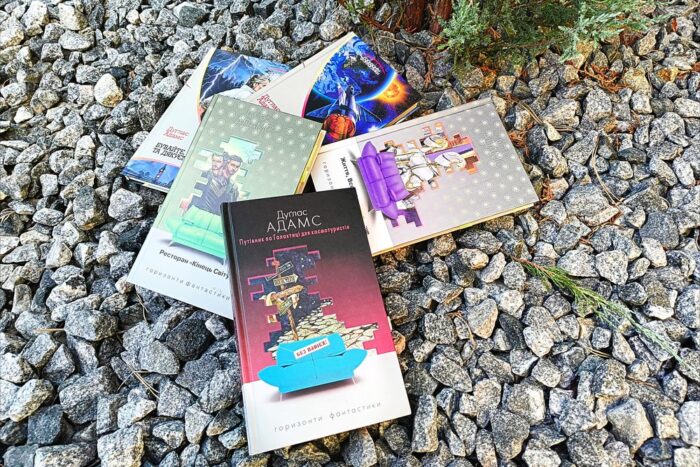
Marvin was created in the laboratories of the Sirius Cybernetics Corporation as part of a program to develop “Genuine People Prototypes.” He suffers from severe depression and boredom because he cannot fully utilize his incredibly advanced intellect. He complains of pain from diodes in his side, feels unloved, and in one lullaby even says he hates the night while counting electric sheep before bed – a clever nod, indeed. Very human-like, isn’t it? At one point, he interacts with a police spaceship, which subsequently commits suicide. Marvin is a fascinating character, and if you read metaphorically, his story could be seen as a commentary on the importance of realizing one’s potential – but with British humor, certainty is never guaranteed.
‘Carbone & Silicium’, Mathieu Bablet
And of course, graphic novels can’t be left out. The downside is that this one hasn’t been published yet. The upside? It’s coming very soon and is expected to be a complete art object in itself.
Here, we return to a post-apocalyptic setting: a world in decline, facing ecological and economic disasters, social crises – you get the idea. According to the description, Carbon and Silicium are the first of a new generation of androids, created to care for Earth’s aging population. They live in the protective cocoon of a laboratory but yearn to explore the outside world. During an escape attempt, Carbon and Silicium are separated. Confused and alone, they face three centuries of observing a dying Earth, plagued by countless problems and disasters. Whether these two androids will find their place in this world remains to be seen.
Honorable mention. ‘Iron Widow,’ Xiran Jay Zhao
I mentioned this impressive debut because, while robots appear, they serve more as a form than as the central theme suggested in the introduction. In this book, the authors skillfully blend mech fantasy with historical context, focusing on the rise of Empress Wu Zetian, who ruled China from 665 to 705.
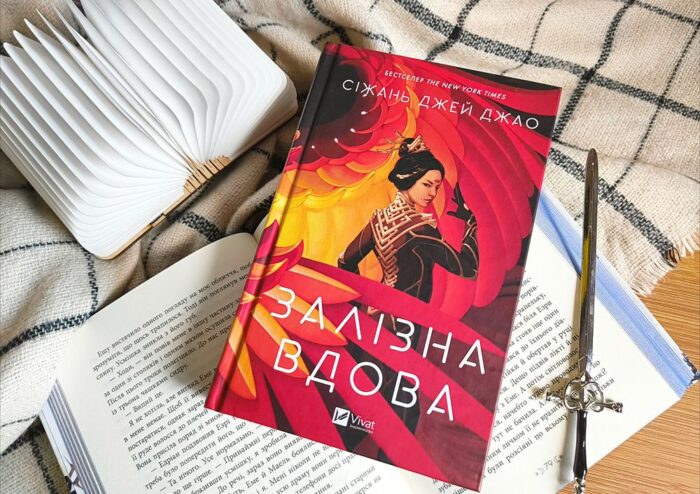
The country, inspired by medieval China, is under attack from monsters. To defend themselves, humans craft massive machines – chrysalids – made from a special metal. These machines can take multiple forms, shifting based on the pilot’s energy levels. Each mech is controlled via a neural interface by two pilots, typically a boy and a girl. In the usual pattern, the female pilot gives all her energy during operation and dies, while the male survives, triumphs, and becomes a hero. That was the standard – until Wu Zetian took the pilot’s seat. She takes control and starts breaking the system. A note for sensitive readers: this is the first book in a duology, with the second not yet released, and it contains some depictions of polyamorous relationships.
This is by no means an exhaustive list of books featuring robots, androids, or cyborgs. In fact, it’s intentionally incomplete – so that you, dear reader, have something to share in the comments when asked: “Do you have a favorite book about robots?”
Read also:
- No book is the same without a cat: 9 fictional cats that stay in your heart… and 1 real one
- Sex Robot Industry: New Rules in the Age of Technology

