




© ROOT-NATION.com - Use of content is permitted with a backlink.
TABLE OF CONTENTS:
The $0.34 Chip Powering Half of Humanity’s Gadgets: The Unexpected Story of the TP4056
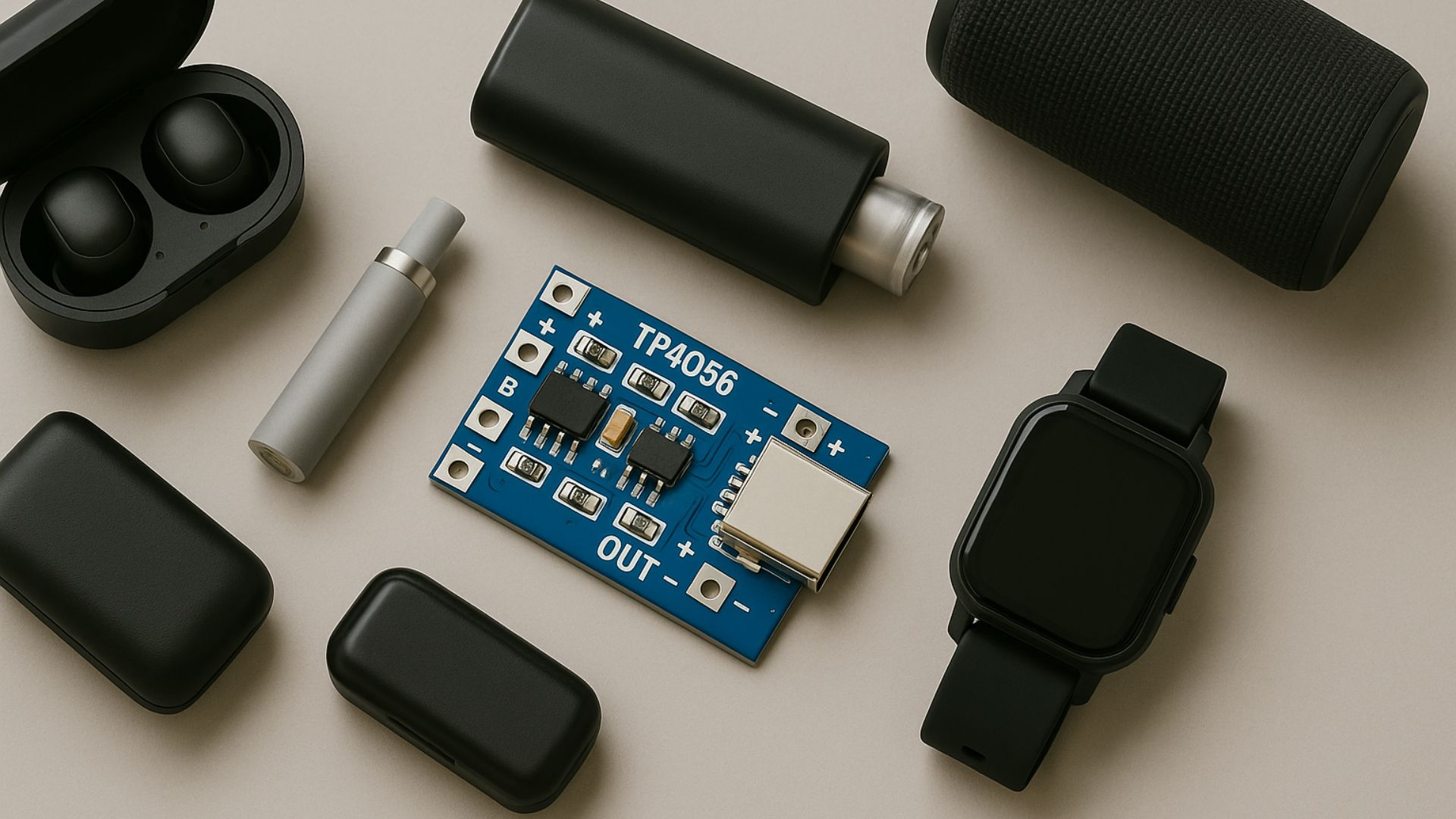
Look around you – wireless earphones, a power bank, a portable speaker, an e-cigarette, a smartwatch… What do they all have in common?
Inside each of them, there’s a high chance you’ll find the same tiny chip. It costs just a few cents, is produced by the millions, and is responsible for safely charging lithium-ion batteries.
This is the TP4056 – a chip you may not have heard of, yet it underpins a vast array of portable electronics. Its story is one of how a simple, inexpensive solution can enable millions of projects. Quite frankly, it’s one of the most intriguing tech stories of the past twenty years.
See prices on TP4056
When Li-ion charging was a privilege (2000-2008)
Picture the early 2000s. Lithium-ion batteries are just entering mainstream electronics, the Nokia 3310 still dominates the market, and the iPod has only just appeared. If you were a hobbyist or an electronics student wanting to build something portable using a Li-ion battery, you basically had two options – neither particularly convenient.
Option one: buy a branded charging controller from Linear Technology or Texas Instruments. Price: $10–$15 per chip. For context, your entire project might cost about the same. On top of that, you’d need numerous additional components, understand thermodynamics and CC/CV (constant current/constant voltage) algorithms, and hope nothing catches fire.
Option two: build your own solution from discrete components. That means combining transistors, resistors, comparators, and operational amplifiers, sketching a schematic on a napkin… and hoping your battery doesn’t explode overnight. Spoiler: lithium-ion batteries are finicky. Charge them to 4.3 V instead of 4.2 V – they swell. Discharge below 2.5 V – they die permanently. Charge at too high a current – they heat up and can catch fire.
A friend of mine who was into electronics back then used to say: “We either built projects with good old NiMH batteries, which you could charge however you wanted, or we went to work at a company that had the budget for proper chips.”
Basic solutions did exist, of course. Linear Technology produced the LTC4054 and LTC4056 – excellent linear chargers with all the necessary features. But this was a world for corporate engineers with substantial budgets. For hobbyists, it was too expensive, too complicated, and overall too much to handle.
The Chinese miracle: Nanjing Top Power (2008-2010)
Now imagine a company in Nanjing, China – Nanjing Top Power ASIC Corp., founded in 2003, specializing in PMICs (Power Management ICs). Sometime between 2008 and 2010, they released a chip called TP4056.
What is it? A full-featured linear charging controller for a single lithium-ion cell, housed in a compact package and requiring minimal external components. Functionally, it’s almost a copy of what Linear Technology offered – but here’s the catch: the price was orders of magnitude lower.
There’s an interesting detail in the naming: LTC4054, LTC4056… and then TP4056. The similarity is striking, right? Engineers immediately raised an eyebrow: “Is this a clone?” But honestly, no one looked too closely. When something works, costs next to nothing, and solves your problem, questions about intellectual property tend to take a back seat.
The TP4056 did everything that was needed:
- Fixed voltage of 4.2V with an accuracy of ±1.5%
- Automatic charging termination when the current drops to 10% of the maximum
- Thermal control (if the chip overheats, it reduces the current itself)
- Pre-charging with low current for ‘dead’ batteries
- Status indication via LEDs
- And all this WITHOUT an external shunt resistor and blocking diode
For its time, it was magic. Magic for pennies.
2012: When everything exploded (in a good way)
It was 2012. I remember that period well – that’s when a real boom started on forums like BudgetLightForum and CandlePowerForums. People were sharing photos of tiny blue boards that had arrived from AliExpress.
Imagine this: you order a package of ten modules for five dollars. Five dollars. For ten fully functional lithium-ion battery chargers – each of which would have previously cost nearly half of your entire project budget.
A real quote from a 2012 review: “This charger is a very small module for DIY people… any module with the TP4056 will have identical performance.” In other words – it didn’t matter where you bought it, it worked the same. Maximum standardization.
And that was the start. The DIY power bank became a weekend project. Take a couple of 18650 cells from a disassembled laptop battery, a TP4056 module, a case from an old point-and-shoot camera, a USB port from a cheap Chinese kit – and voilà, a portable phone charger. Does it work? Yes. Safe? If your hands are in the right place – yes.
The Arduino forums of that time tell another story, filled with threads like:
- ‘Can it be charged under load?’
- ‘How many modules can be connected in parallel?’
- ‘What RPROG resistor should I use for my battery?’
- ‘Help, why is it heating up?’
It was a grassroots encyclopedia of knowledge, evolving in real time. Everyone who fried their first module – and there were plenty – shared their experience. Thanks to this, the next generation of makers already knew how to avoid the same mistakes.
What’s inside: magic in eight legs
Let’s dive into some technical details – I promise it’s worth it.
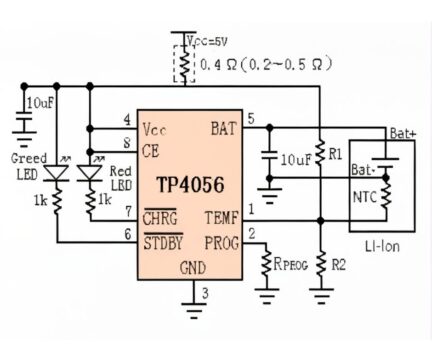
The TP4056 is an 8-pin chip, roughly 5×4 mm in size. Inside, it’s like a miniature lab:
CC/CV algorithm – the same one used by your iPhone, Tesla, or any other device with a lithium-ion battery. First comes constant current (quickly filling the battery), then constant voltage (slowly topping up to 100%). Classic.
- Built-in power transistor – meaning no external diode is needed to prevent reverse current. Everything is integrated. Engineers at Linear Technology would probably nod in approval.
4.2 V reference system – precision ±1.5%. Perfect for a lithium-ion cell. Slightly below 4.2 V – undercharged. Slightly above – risky. The TP4056 maintains this threshold like a Swiss watch.
Thermal regulation – if the chip heats up to around 145 °C (which can happen when charging a deeply discharged battery at high current from 5 V), it automatically reduces the current. No intervention required. This protects the chip, your battery, and potentially your home.
The coolest part – current adjustment.
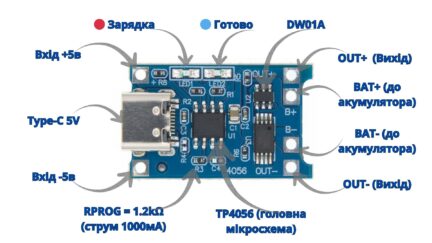
See the resistor on the board labeled R3 or RPROG? That’s the one that sets the battery’s charging current. The formula is simple:
Current (mA) = 1200 ÷ resistor value (kΩ)
- 1.2 kΩ → 1000 mA (1 A – fast, but heats up)
- 2 kΩ → 580 mA (medium, versatile)
- 5 kΩ → 250 mA (slow, but cool and safe)
One resistor – that’s it. All the configuration you need. Ingenious, isn’t it?
What does this small chip replace in the circuit:
| Power key | ✓ |
| Measuring resistor | ✓ |
| Comparators | ✓ |
| Blocking diode | ✓ |
| Thermal control | ✓ |
| Indication logic | ✓ |
20+ components, 5×5 cm board, complex circuitry, expensive.
one chip + three resistors, 28×17 mm board, works out of the box, pennies.
Where it lives: dissecting reality
And now the most interesting part – let’s see where our hero actually hides.
Power banks – especially budget models. Open up a cheap $3.60 power bank, and you’ll almost certainly find a small board with a TP4056. It charges the battery, while a separate boost converter outputs 5 V to the USB port.
Wireless earphones – yes, even those $7.20 Chinese TWS earbuds. The tiny battery is charged via the case, and inside the case sits our old friend, the TP4056.
Portable speakers, pocket flashlights, disposable vapes – the list goes on. In the low-cost segment, it’s essentially the standard.
DIY Arduino/ESP32 projects – this is a whole other religion. A TP4056 module with micro-USB or Type-C is the easiest way to add battery power to your project. Connect the battery, connect the board – it just works.
But there is an important nuance!
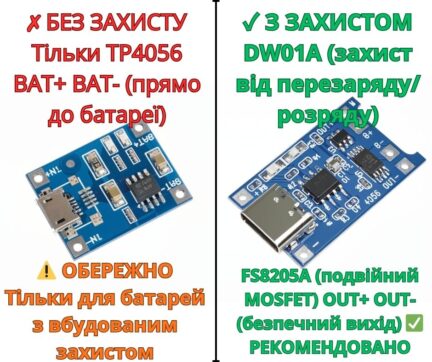
High-quality modules include not just the TP4056, but also additional protection components:
- DW01A – a chip that protects against overcharge, overdischarge, and short circuits
- FS8205A – a dual MOSFET that physically disconnects the battery if a problem occurs
If the board has markings like “OUT+” and “OUT−” (not just “BAT+” and “BAT−”), that’s a good sign. It means protection is present. Such modules are safer and will properly disconnect the battery if something goes wrong.
The dark side: when cheap = dangerous
But hold on – it’s not all perfect. Let’s talk about the issues.
Modules without protection – some cheap boards come without the DW01A or MOSFET. Just a bare TP4056. These are only suitable for charging batteries that already have built-in protection. Otherwise, it’s a game of Russian roulette.
Type-C without proper design – see a module with a Type-C connector? Great! But check whether it has two 5.1 kΩ resistors on the CC1 and CC2 lines. If not, the module simply won’t charge from a standard USB-C adapter. The manufacturer just swapped micro-USB for Type-C, ignoring the specification.
Charging under load – a classic trap. Connect both a TP4056 battery and your load (e.g., an ESP32). Plug in USB and expect it to work. Technically, it will. But the module can’t distinguish how much current goes to the battery versus the load. Result: improper charge termination, overheating, and faster battery aging.
For proper charging under load, you need an additional power-path circuit to separate the flows. Alternatively, use specialized chips like MCP73871 or BQ24195, which handle this natively.
Overheating – normal for a linear charger. If a battery is discharged to 3 V and the input is 5 V, the chip drops 2 V. At 1 A, that’s 2 W of heat. The TP4056 is tiny – physics is unforgiving, and it gets hot. Solutions: reduce the current (e.g., 2 kΩ instead of 1.2 kΩ) or add a small heatsink pad under the chip.
How to distinguish a high-quality module:
✓ Neat soldering
✓ Legible markings
✓ Type-C version has the correct CC resistors
✗ Too cheap (< $0.24) and no protection – proceed with caution
How much does it cost and why is it so cheap?
Today, a single TP4056 chip from major suppliers costs around $0.09 in bulk. Retail modules go for 10–30 UAH, depending on whether protection is included and the overall build quality.
For comparison: modern multifunctional chargers with power-path functionality from Texas Instruments or Analog Devices cost several dollars just for the chip. Here, you get a complete board with a connector for the price of a cup of coffee.
Why so cheap? First, it’s made in China – manufacturing processes are optimized to perfection. Second, the architecture of a linear charger is simple – it’s not a complex switching converter. Third, mass production – producing millions of units drives the cost down to a minimum.
And you know what? That’s a good thing. Democratization of technology is always positive. Now, any student can add a Li-ion charging solution to their project without taking out a loan.
Competitors and the future
Will the TP4056 last forever? Probably not. Technology keeps moving forward.
MCP73831 (Microchip) – another linear charger, up to 500 mA. Smaller, but less flexible in terms of current adjustment.
BQ2419x (Texas Instruments) – “heavy artillery” with I²C control, power-path support, and fast-charging capabilities. Designed for smartphones and high-end devices.
TP5100 (also by TOPPOWER) – a switching charger for 1S/2S batteries with currents up to 2 A. For cases where a linear charger is too inefficient.
But you know what? For a huge number of simple single-cell devices, the TP4056 will remain a reliable workhorse. In real-world applications, simplicity, predictability, and low cost often matter more than “fast charging in 30 minutes.”
Your flashlight doesn’t need Quick Charge. Your DIY temperature sensor couldn’t care less about USB PD. What they need is something simple, reliable, and inexpensive – and the TP4056 fits the bill.
Conclusion: heroes do not always wear capes
The TP4056 is more than just a chip. It’s a symbol of how technology can be simple, cheap, and reliable all at once.
It made Li-ion charging accessible to everyone – from a first-year student to small businesses. It enabled millions of people worldwide to build portable devices without fearing they’d burn out a battery or even their home. It proved that you don’t need to spend tens of dollars on a branded chip to get a dependable solution.
Millions of makers. Billions of devices. One tiny chip, the size of a fingernail, quietly doing its job for decades.
And as you read these lines, somewhere in the world, someone is connecting another battery to a tiny blue board with two LEDs – completely unaware that inside, a modest hero of the portable electronics era is at work: the TP4056, a $0.3 chip that changed the world.

