





© ROOT-NATION.com - Use of content is permitted with a backlink.
AMD has unveiled a new line of Ryzen PRO 9000 Series desktop processors, significantly strengthening its offer in the workstation and business solutions segment. The key feature of the announcement was the integration of AMD’s proprietary 3D V-Cache technology into the commercial sector.
This has resulted in the introduction of the world’s first chip for professional systems that utilizes increased cache capacity to significantly accelerate massive databases and complex computing tasks. The new series includes models with 6 to 16 cores, with some configurations featuring a thermal package of up to 170 watts. This range of power guarantees consistently high performance under heavy workloads, allowing OEM partners to create highly customized systems.

Ryzen PRO 9000 Series processors are an integral part of the AMD PRO ecosystem, which focuses on providing enterprise-grade security, advanced remote management tools, and long-term platform stability, which is critical for today’s IT infrastructures. The developers focused on bringing professional workstations to a new level of efficiency. In the media and entertainment industry, this is manifested in the ability to edit 4K or 8K video in real time, speed up encoding processes, and seamlessly compose graphics, especially when using Radeon PRO graphics cards. For architectural and engineering design, the new chips become a reliable tool for creating complex models, working with BIM systems, and real-time visualizations. In industrial design and manufacturing, Ryzen PRO 9000 Series accelerates 3D design in CAD systems, simulations, and mechanical modeling, which helps to iterate ideas faster and shorten the path to a finished project.
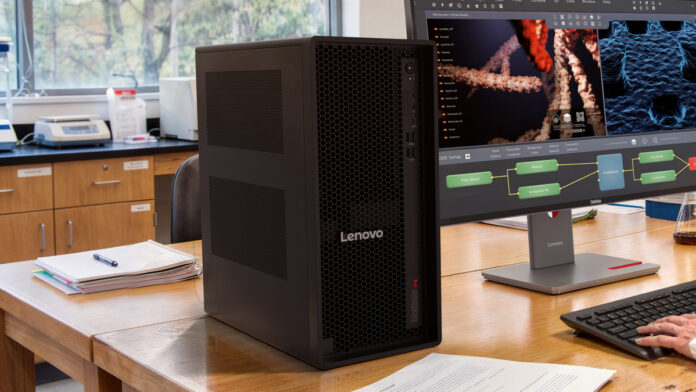
The first devices based on Ryzen PRO 9000 Series are scheduled for the second half of 2026. Lenovo is expected to be one of the first to demonstrate the capabilities of the new chips as part of its own ThinkStation P4 station at the NXTBLD industry event. The technical specifications of the X3D models are impressive: the flagship AMD Ryzen 9 PRO 9965X3D offers 16 cores and 32 threads with a frequency of up to 5.5 GHz and a total cache of 144 MB at a TDP of 170 W. The junior model in the X3D series, the Ryzen 7 PRO 9755X3D, features 8 cores, 16 threads, runs at up to 5.2 GHz and has 104 MB of cache with a 120W power limit.
The classic line without 3D cache also offers powerful solutions. The Ryzen 9 PRO 9965 model is identical in terms of the number of cores and frequencies to its X3D counterpart, but has 80 MB of total cache. The Ryzen 9 PRO 9955 and 9945 variants have 12 cores and 24 threads with a frequency of up to 5.4 GHz; the difference between them is TDP – 120 W versus energy-efficient 65 W, respectively, with the same 76 MB of cache. The mid-range segment includes the octa-core Ryzen 7 PRO 9755 and 9745 with up to 5.4 GHz and 40 MB of cache, where the older version consumes 120 W and the younger version only 65 W. The series is rounded out by six-core Ryzen 5 PRO 9655 and 9645 chips with 12 threads, a peak frequency of 5.4 GHz, 38 MB of cache, and a similar division by thermal package into 120 W and 65 W.
Read also:
- Lenovo unveils ThinkStation P4 with AMD Ryzen PRO 9000 Series for AI and 3D graphics
- The era of 208 MB of cache: The monster AMD Ryzen 9 9950X3D2 with dual V-Cache is on sale now