





© ROOT-NATION.com - Use of content is permitted with a backlink.

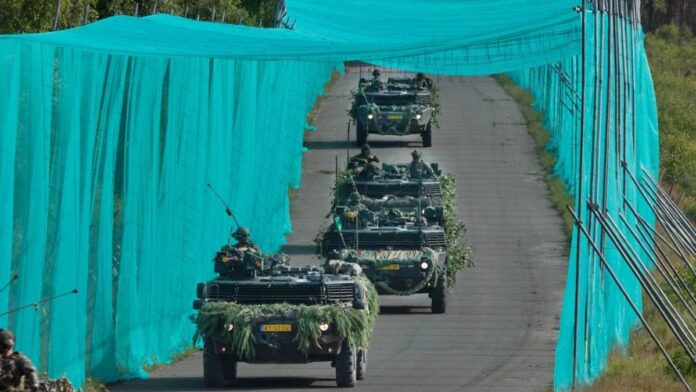
The Netherlands is conducting large-scale military exercises called “Fighter Lion,” during which it is practicing repelling an invasion based on a scenario resembling a russian attack. A distinctive feature of the maneuvers was the use of anti-drone tunnels – routes covered with nets – which were first employed by the Ukrainian military to protect equipment from attacks by FPV drones.
Read also: AERONAUT – everything that flies above the ground: aviation, UAVs and drones, missiles, and space
The Netherlands has thus become one of the first NATO armies to directly integrate Ukraine’s combat experience into its largest military exercises in the past 20 years. Approximately 7,000 Dutch service members are participating in Fighter Lion.

The exercises, which the Dutch Ministry of Defense describes as the largest for ground forces in 2026 and the most extensive in two decades, are taking place at training grounds near Bergen-Hone. The scenario is fictional but is clearly based on a russian invasion: an enemy state named Murinus invades NATO territory, advancing from the east toward western Europe after crossing the Oder River and moving toward the German regions of Bergen and Münster. The Dutch Army is tasked with halting the advance using the same defensive maneuvers that would be required in the event of a real large-scale conflict.
The 13th Light Brigade was tasked with halting the simulated enemy’s advance before it could consolidate its positions. Afterward, the 43rd Mechanized Brigade used heavy armored vehicles to complete the operation. The handoff of combat operations between the two brigades without a pause in hostilities is known as the “Forward Passage of Lines” maneuver, which requires extremely precise coordination and is being used for the first time during Fighter Lion. Whereas previously units practiced their phases sequentially, this year they are training to hand off the battle without a pause, just as it happens in real combat conditions.

The most distinctive feature of Fighter Lion is not the scale of the exercises, but their content. Throughout all maneuvers, troops operate under the constant threat of drones and electronic warfare systems. Just ten years ago, such scenarios were virtually nonexistent in NATO exercises, but now they define the Dutch Army’s modern combat operations planning. Units of drone operators from the new Tech Dev formation use reconnaissance and strike drones to play the role of the enemy. This allows ground forces to gain real-world experience in countering the threats that Ukrainian troops face every day.
Read also: Everything About the Chaklun Jet UAV Designed to Intercept the “Geran-3”
The anti-drone tunnels, which attracted particular attention during the exercises, were adapted from the Ukrainian battlefield. Since vehicles traveling on roads and dirt tracks are vulnerable to kamikaze drones, the Ukrainian military began covering the most critical routes with nets mounted on frames. Such structures limit the drones’ angle of attack and force them to approach from directions where countermeasures are more effective. Similar structures were built at the Bergen-Gone training ground to train soldiers to operate within them and ensure their defense.

Lieutenant General Jan Swillens, Commander of the Dutch Army, stated that the Dutch Army is one of NATO’s leaders in the use of drones. They are drawing on the experience of the war in Ukraine to understand the capabilities of drones and how to counter them. Armored vehicle crews trained using simulators, operating combat vehicles and tanks via screens rather than being physically inside the vehicles. This approach allows for large-scale training without damaging equipment or causing inconvenience to the civilian population.
The Fighter Lion scenario takes into account the multi-domain nature of modern warfare. Electronic warfare units conduct jamming operations, while soldiers learn to remain undetectable across the electromagnetic spectrum to avoid detection and engagement, and Bushmaster armored personnel carriers are used in conjunction with systems that analyze the electromagnetic environment around the vehicle.
The Fighter Lion scenario is based on a fictional geography that reflects NATO’s real-world defense challenges in Northern Europe. The crossing of the Oder River by troops from the fictional state of Murinus reflects real concerns about the possible use of this route by russian forces in the event of a war against the Alliance. The training ranges between Bergen and Münster are located precisely in the area that NATO’s defense plans identify as one of the key areas for large-scale conventional defense.
Read also:
- An Armored “Umbrella” Against Artillery: Ukraine Unveils a Unique Mobile Bunker in France
- Weapons in the war against drug cartels: Honduras to purchase Ukrainian drones