





© ROOT-NATION.com - Use of content is permitted with a backlink.
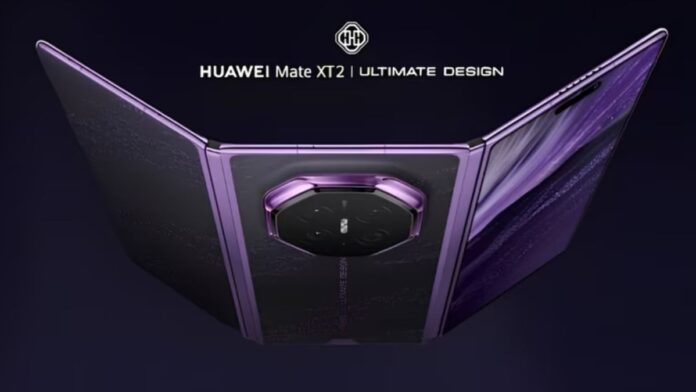
Huawei unveiled a new dual-hinge foldable smartphone two days before Apple is reportedly set to unveil its first foldable iPhone. The Mate XT 2 has already been unveiled in China and will hit the market in the coming days. When unfolded, the smartphone will feature a 10.2-inch display with 3K resolution and a battery above 6,000mAh. The manufacturer has incorporated a redesigned hinge into the smartphone, which is intended to minimize the crease – one of the main issues with foldable screens. The device also has an IP58 and IP59 rating for dust and water resistance.
Read also: Foldable Smartphone Reviews

The smartphone features a Lingdun privacy screen that uses a dual-pixel configuration, so double-tapping the outer display narrows the viewing angle. As a result, people nearby won’t be able to see the screen’s content. It will come with 16 GB of RAM and up to 2 TB of flash storage, and runs on HarmonyOS 7, which includes a split-screen option designed specifically for this type of display. The device is available in black, white, and purple, and its price will start at approximately $3,000.
Read also: Huawei Smartphone Reviews
The smartphone is powered by the Kirin 9050 Pro, built using Huawei’s newer in-house manufacturing process. This is a chip that the company was not expected to be able to produce after Washington cut off its access to leading semiconductor manufacturers. Xiaomi, incidentally, has also achieved something similar on its own. Its 18 Fold will run on its own Xring O3 with LPDDR6 memory.
It turns out that two Chinese manufacturers are releasing flagship foldable smartphones powered by chips they developed themselves. In addition, Xiaomi has already created its own 3-nm chip for autonomous driving, while Huawei continues to innovate despite sanctions. Export restrictions were intended to prevent exactly this. They have transformed the equipment trade and pushed Chinese developers to create their own chips using domestic manufacturing processes.
Read also: Report from the Xiaomi booth at #IFA2026: Human × Car × Home
Against this backdrop, Apple’s device is a first-generation product. According to reports on its expected specifications, it will feature a 7.8-inch internal screen and a 5.3-inch external display, will not have a telephoto lens, and will feature Touch ID in the power button instead of Face ID. These omissions are the price to pay for its slim profile, and that price will be steep. The foldable iPhone is expected to cost over $2,000.

Apple has taken this approach before – the company was late to the game when it came to large screens, 5G, and stylus support, but each time it entered the market with a superior implementation and turned a profit. However, the situation is different with foldable smartphones. This form factor has been around since 2019; the mechanical challenges have been well-studied, and companies that have been refining it for years have already accumulated manufacturing expertise that will be surprisingly difficult to surpass on the first try.
Huawei’s limitation lies not in engineering capabilities, but in distribution. Its smartphones ship without Google services, which prevents them from entering the European and American markets in significant volumes; thus, the Mate XT 2 competes with Apple only within China. And this is still a market of interest to both companies. It is in China that Apple’s market share has been under sustained pressure from local premium smartphones, and it is here that the foldable smartphone unveiled earlier will be aimed directly at its competitor.
Read also: Premium Fitness: Huawei Takes the Market by Storm with Its Updated Band 11 Fitness Trackers