





© ROOT-NATION.com - Use of content is permitted with a backlink.
Lately, something strange has been unfolding between Microsoft and OpenAI. Today, let’s try to unpack what exactly is going wrong in this relationship.
In tech history, there are moments when corporations – sometimes without realizing it – end up nurturing rivals powerful enough to challenge them. The most recent and clear-cut example is the evolving story of Microsoft and OpenAI. What was intended to be a strategic alliance aimed at securing dominance in the AI space has turned into a drama with an unpredictable script. Microsoft poured in $13–14 billion – and, in doing so, may have helped create a competitor of its own.
According to recent Bloomberg reports, this is shaping up to be a textbook tech paradox: an investor funds the rising star, only to be left in the background. Instead of Microsoft’s products being seen as the flagships of the AI revolution, it’s the OpenAI brand – and only OpenAI – that has become synonymous with artificial intelligence in the public eye. It’s a bit like imagining Sony funding the launch of the iPod, or a VHS company backing Betamax – except this time, it’s Microsoft playing the role of the sidelined sponsor.
In its quest to dominate the new digital era, the American tech giant built a throne – but placed someone else on it. While products like Copilot remain largely confined to the corporate niche, ChatGPT has already gone mainstream, interacting with millions, setting standards, and even shaping a new digital culture. This raises a fundamental question: who’s really in charge here – the investor, or the “experiment” it helped bring to life?
Read also: ChatGPT Destroys the Competition: Era of Super Apps Has Arrived
TABLE OF CONTENTS:
A successful father who is not the head of the family
The partnership between Microsoft and OpenAI is a textbook example of how a strategic bet on the future can lead to losing control over the present. When Satya Nadella invested the first billion in what was then a semi-philanthropic startup from San Francisco, it’s unlikely he imagined he was helping to create not just a powerful tool – but a potential monarch of the AI industry.
Microsoft does have something to boast about: over 70% of Fortune 500 companies are already using Copilot. But the more relevant question isn’t “what are CIOs buying?” – it’s “what do employees launch after their first cup of coffee?” And that answer doesn’t favor the company Bill Gates built. ChatGPT is the one getting the attention. It’s a bit like the IT director ordering Zunes for the entire office, only for everyone to show up the next day with iPods in their pockets.
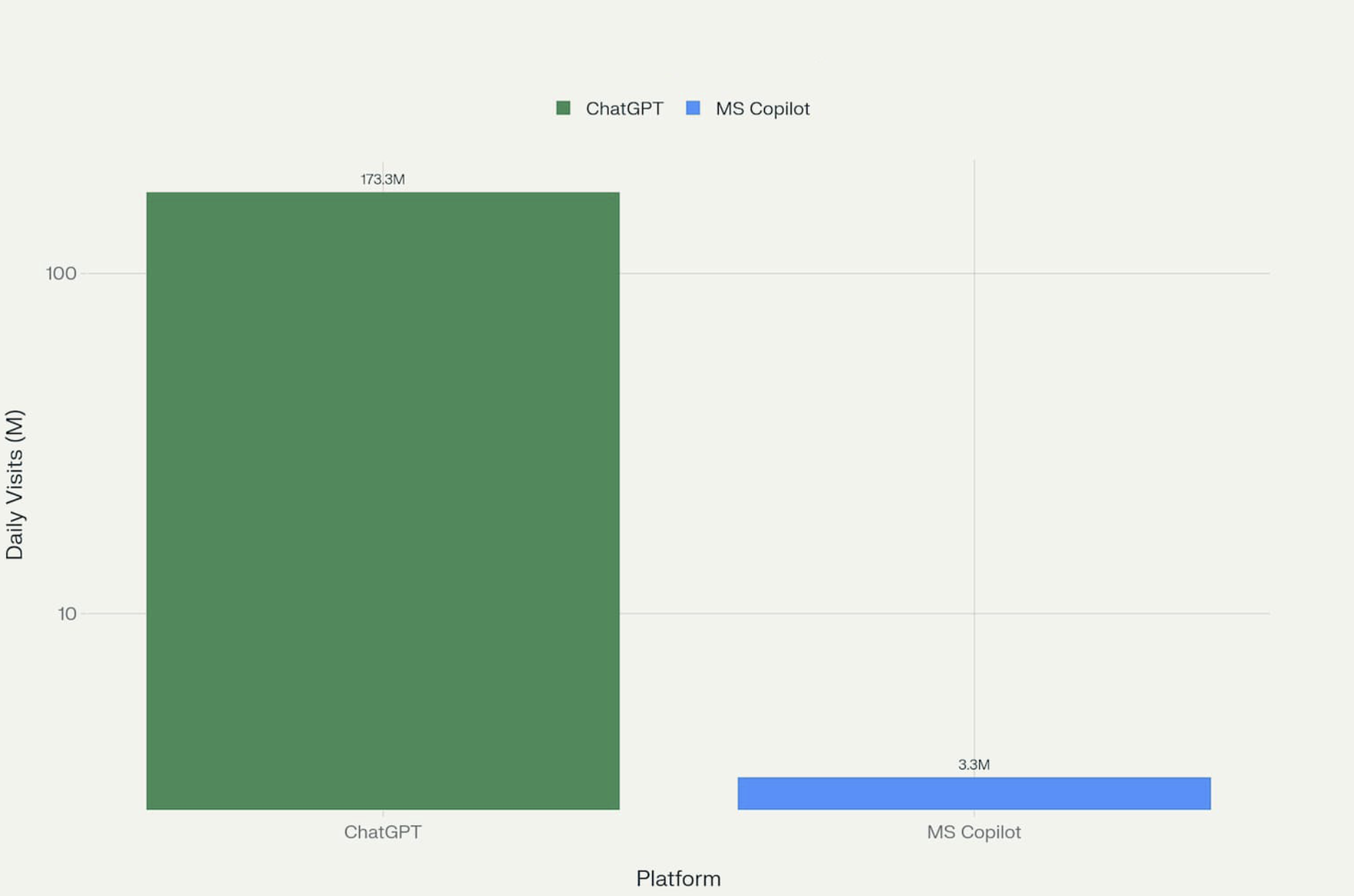
The irony is that Microsoft did everything right from a corporate strategy standpoint: it integrated Copilot into Office, Windows, and Teams, maintained a consistent UX across its ecosystem, and stayed aligned with enterprise needs. But users don’t think in terms of architectural modules – they vote with clicks. And more and more of those clicks are going to ChatGPT. It’s not just a tool anymore; it’s a cultural reference point. People don’t say, “I’ll ask the AI” – they say, “I’ll ask ChatGPT.” Even if they’re using Bard or Claude, the associative victory has already been won.
This phenomenon has deep psychological roots. The so-called halo effect – where a strong first impression overshadows everything that follows – can be decisive in marketing. In November 2022, OpenAI delivered exactly that kind of impression. And while Microsoft is still refining logic in Excel spreadsheets, ChatGPT has already become the “Google of the AI era.”
Microsoft can give Copilot away for free, embed it at the BIOS level, or bundle it with Azure – but that misses the core issue: in the collective mind of users, ChatGPT has evolved from a product into a generic name. That’s the pinnacle of marketing success. And ironically, it was Microsoft that paid for that transformation.
Read also: Gabe Newell’s Starfish Neuroscience Сhallenges Neuralink
Financial reality: who really makes money
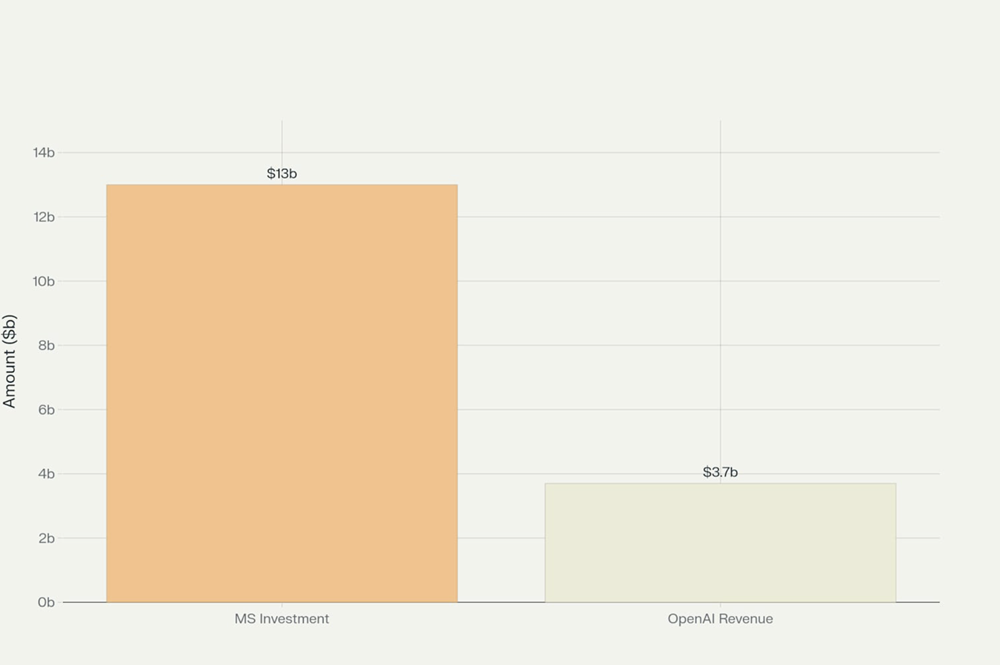
When we move from emotion to numbers, the paradox only deepens. In 2024, OpenAI generated $3.7 billion in revenue – a remarkable 131% year-over-year growth. But that figure pales in comparison to the nearly $13–14 billion Microsoft has already poured into this experimental alliance. Which raises a fair question: if this was an investment, where are the dividends?
The answer doesn’t lie in direct profits, but in indirect returns. Microsoft makes money in two main ways: First, through Azure – its cloud platform, which serves as the de facto engine behind all of OpenAI’s computations. Every ChatGPT query is quietly powered by a Microsoft data center humming in the background. Second, through the stock market. The AI hype surrounding OpenAI has helped boost Microsoft’s market capitalization and impress investors with growth that’s indirectly tied to the partnership. It’s the classic “sell shovels during a gold rush” model – there’s no need to dig for gold yourself if you can profit from equipping those who are.
Today, Microsoft proudly reports that its AI-related business generates over $13 billion in annual revenue. But a closer look reveals that much of this figure is built not on Microsoft’s own breakthrough technologies, but on repackaged offerings from OpenAI. Copilot, Bing Chat, and even portions of its enterprise services are all layered on top of an architecture that wasn’t developed in Redmond.
The result is a paradoxical picture: Microsoft owns the shovels, rents out the tools to the miners, and sometimes even draws the map – yet it’s others who strike gold, and it’s their names in the headlines. In the PR game, it’s not the one issuing the infrastructure bill who wins – it’s the one getting quoted.
Read also: Everything You Need to Know About Dolby Atmos FlexConnect Wireless Technology
Cutting off the branch you’re sitting on against technical amnesia
The tech world is full of cautionary tales where strategic short-sightedness and misplaced confidence in one’s dominance lead to missed historic opportunities. Sony is a near-textbook example. It had everything needed to create the iPod before Apple did – advanced technology, a strong brand, and a direct line to the music industry through Sony Music. But instead of leading a digital revolution, it became bogged down by legal constraints, internal disagreements, and corporate inertia. Apple, once known mainly for niche computers used by designers, didn’t just win – it rewrote the rules of the game.
The same thing happened with Betamax. It was the technically superior format – better image quality, less noise – but that didn’t matter. JVC’s VHS hit the sweet spot of consumer expectations: longer recording time, cheaper tapes, and more available content. In the end, it wasn’t quality that won – it was the ecosystem. Today, we’re seeing a déjà vu. Microsoft offers deeper integration, more powerful data centers, and a near-flawless vertical stack with Windows, Office, and Azure. But it’s OpenAI that figured out the most important part – how to turn a technology into a brand, and a brand into a user reflex.
Perhaps the most poignant example of corporate irony comes from 1997. At that time, Microsoft – then the undisputed tech giant – invested $150 million in Apple, which was on the brink of collapse. This gesture was seen as the magnanimity of a winner. Yet, a decade later, the “rescued” company introduced the iPhone, sparking an architectural revolution that transformed Microsoft from a trendsetter into a follower.
History doesn’t repeat itself exactly, but it rhymes. Today, Microsoft once again finds itself in the role of supplier – this time providing the oxygen for AI – while the real attention, user loyalty, and cultural phenomenon status go to its “partner.” Technologies evolve, but the paradoxes remain.
Read also: Seven Annoying Windows 11 Features – and How to Fix Them
The trap of strategic investment
Why has Microsoft found itself in the paradoxical position of being the main sponsor of its most prominent competitor? The answer lies in the nature of technology alliances, where strategy often clashes with market realities, and investment logic doesn’t guarantee brand success. Back in 2019, when Redmond signed its deal with what was then a relatively small OpenAI, AI was still a niche technology dominated by Google. The plan seemed straightforward: back a promising startup, secure exclusive access to its models, and leverage them to strengthen Microsoft’s platforms – Office, Azure, Windows. But somewhere along the way, things didn’t go according to plan.
OpenAI has evolved from being just a technology provider into an independent player competing for users’ minds and attention. Originally designed as the underlying engine for Microsoft Copilot, ChatGPT unexpectedly became a full-fledged interface for interacting with AI – complete with its own voice, image, and audience. It became the face of the technology, not just the backend. This is a classic example of a product that wasn’t meant to be the frontman suddenly taking center stage – much like the iPhone did in 2007 or Google in 2004, when setting the right standard once means an entire category ends up carrying your name.
Microsoft faces a classic dilemma: Should it hold back its partner, risking slowing down its own products? Or should it fuel OpenAI’s growth, allowing it to maintain the lead in the consumer space? Perhaps it can try to play both sides, hoping that dominance in infrastructure will offset the loss of brand association.
Нинішня ситуація дивовижно нагадує перехід від ери десктопів до мобільного світу.
Microsoft held on to Windows for too long, failing to see that mobile interfaces were redefining the very concept of the personal computer. Today, it is similarly focused on integrating AI into legacy products like Word, Excel, and Outlook, while users have already moved on to a new paradigm: fast, contextual, personalized conversations with ChatGPT.
The difference this time is that Microsoft isn’t just a bystander – it’s a major shareholder in this revolution. It’s like if Nokia had invested billions in Apple a year before the iPhone launch, only to helplessly watch its investment fund the collapse of its own business model.
Read also: Online Safety: How to Protect Your Data – Even When You Let Your Guard Down
Can Microsoft still change the game?
Redmond still holds several serious aces up its sleeve. The company controls the cloud infrastructure powering ChatGPT, has near-monopoly access to the corporate world through Office, Teams, and Windows, and commands financial resources that OpenAI can only dream of. All the tools are there. But the question isn’t about the tools.
Today, the brand is the product, and the product instantly becomes the brand. Microsoft finds itself in a situation once faced by Sony and Nokia: you can have better engineering, greater efficiency, and even a larger audience – but still lose in the cultural gravity field. In a world where “AI” means “ChatGPT” to millions, even the best integration of Copilot in Word and Outlook is seen as a side feature, not the main event.
Yes, Microsoft can compete on functionality, user experience, or price. But can it change the language people use to think about AI? Can it make everyday users mentally swap “ask ChatGPT” for “use Copilot”? History offers examples – Google displaced Yahoo, Facebook pushed out MySpace, Chrome overtook Internet Explorer. But each case required either a product breakthrough or a complete cultural shift, along with time and billions of dollars.
In this context, Microsoft has created its own “iPhone” and “Walkman.” The problem is that this time, the box doesn’t say Windows – and it’s uncertain if anyone even associates Copilot with Microsoft at all. This could be a brilliant long-term investment, a strategic bet on infrastructure, or a costly mistake repeating old errors – just in a new package.
At this point, Redmond has one significant source of satisfaction: at least it profits from the success of its biggest competitor. The “hosting the hype” model works. And that’s still more than what Sony could say while watching the iPod turn its music empire into a footnote in history.
Read also:
- When AI Nudges Toward Death: The Illusion of a Safe ChatGPT
- Microsoft, how many more interns will decide what Windows should be?

