





© ROOT-NATION.com - Use of content is permitted with a backlink.
A controversy has emerged online surrounding Notepad++ for macOS. What began as a technical disagreement has evolved into a broader conflict with reputational consequences. To understand the situation, it is useful to examine what happened, why tensions escalated, and what arguments are being made by both sides.
At first, I considered titling this article “How One Programmer from New York Frustrated the Entire Open-Source Community – and Why the Story Matters Beyond Software.” In the end, however, it seemed more appropriate to present the perspectives of both sides of the dispute.
Imagine using the same tool for twenty years. It is free, reliable, free of advertising, and consistently performs its task better than many alternatives. There is only one issue: it does not run on your computer, never has, and its creator has stated directly that it likely never will.

Then, one morning, you type the name of that tool into a search engine and find a website with the familiar logo, familiar branding, and a message that says: “Finally available for your system.” The initial reaction is excitement – but it does not last long.
That is essentially what happened this spring to thousands of Mac users around the world when they discovered what appeared to be a macOS version of Notepad++. What initially looked like a routine technical development quickly evolved into one of the more heated debates in the software community this year. At the center of the dispute is a broader question that extends beyond a single application: where does the right to build or adapt software end, and where does the obligation to seek permission begin?
Read also: John Ternus: The Engineer Apple Has Been Waiting For for Quarter Century
TABLE OF CONTENTS:
What is Notepad++ and what makes it so special?
For readers outside the software world, a simple explanation may help. Notepad++ is a text editor for Windows – but far more capable than a basic notepad application. It is effectively a multi-purpose tool for working with text and source code. The editor supports syntax highlighting for dozens of programming languages, line numbering, hundreds of plugins, and fast handling of even very large files. At the same time, it remains completely free: no advertising, no subscriptions, and no paid “premium” tier.
The software was created in 2003 by Vietnamese developer Don Ho. The project reportedly began out of practical frustration. At the time, Ho was working as a programmer and was dissatisfied with the performance of the text editor available in his workplace environment. After an alternative proposal was rejected, he began developing his own editor in his spare time and later released it as open-source software. That project eventually became Notepad++.

Since then, the software has reportedly been downloaded more than 28 million times from a single distribution platform alone – and that figure predates its migration to GitHub. Today, it is difficult to find a Windows developer who has never used it at least once. Notepad++ has become more than a utility; within the Windows development ecosystem, it is widely regarded as a longstanding standard tool.
This context explains why the absence of a macOS version remained a recurring point of discussion for years. Throughout its more than two decades of existence, Notepad++ has been developed exclusively for Windows. Don Ho considered the possibility of supporting macOS at one stage, but ultimately decided against it. As the project creator, that decision remained his prerogative.
For Mac users, the software largely remained unavailable outside of workarounds or emulation.
Read also: Windows 11 and “K2 Plan”: How Microsoft Is Trying to Fix What It Broke
Hero or violator? Enter Andrey Letov
In March 2025, New York–based developer Andrey Letov decided to address what he described as a “20-year gap” in software availability. That was the phrase he used on his website to characterize the absence of Notepad++ on macOS.

The stated goal was straightforward: to provide Apple users with functionality they had long wanted. Andrey Letov developed a native macOS port – a version designed to run directly on the platform rather than through compatibility layers or emulators. Under conventional development timelines, such a project could require a larger engineering team and a significantly longer development cycle. Letov stated that modern AI-assisted coding tools helped accelerate the process, allowing him to complete much of the work independently within a relatively short period.
The controversy did not center primarily on the technical achievement itself. It emerged from the way the project was presented and distributed.
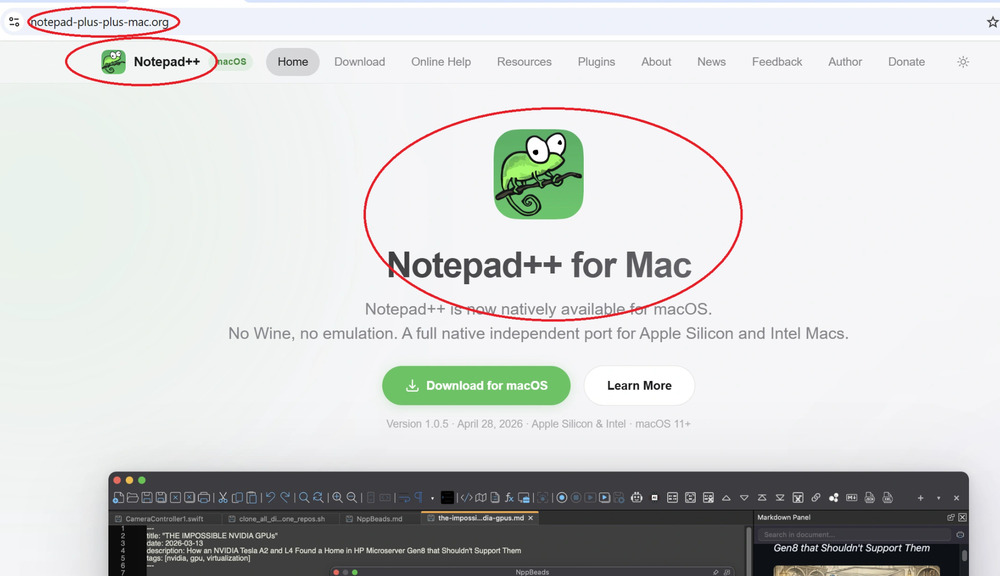
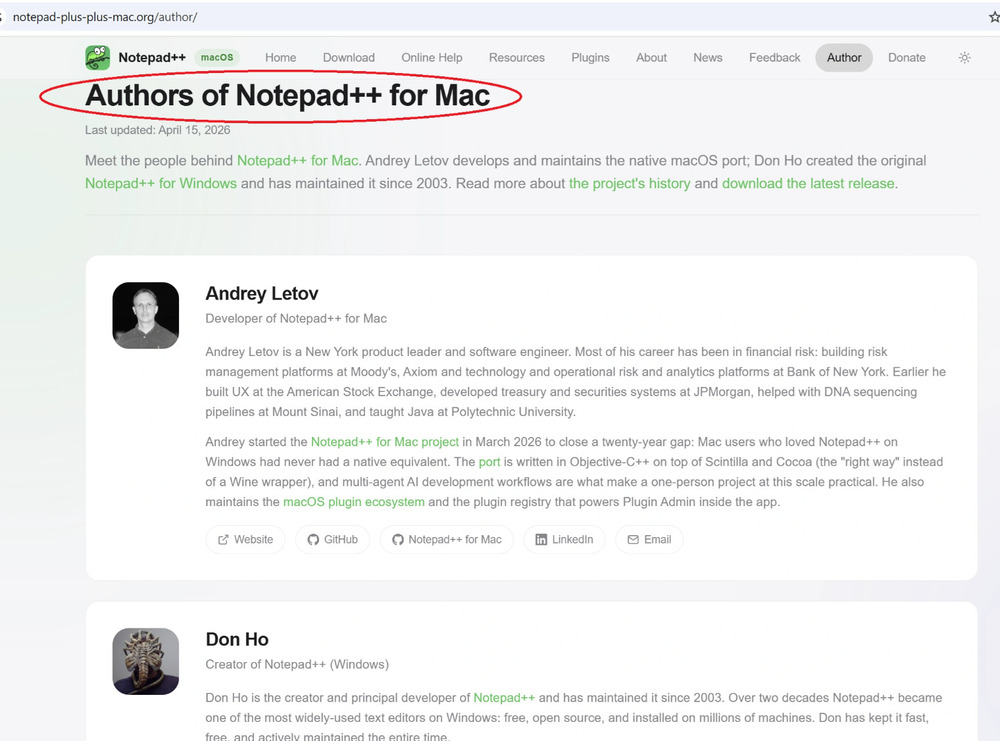
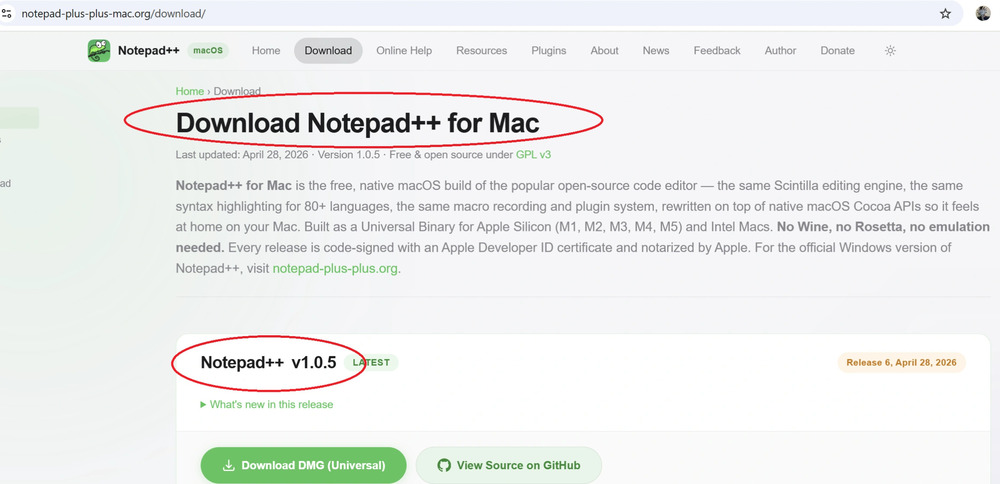
The project website opened with the headline: “Notepad++ is now available on macOS.” It prominently displayed the original chameleon logo long associated with the software, used the Notepad++ name throughout the site, and included a contributors section where Don Ho appeared alongside Andrey Letov, creating the impression that the original creator was connected to – or had endorsed – the project.
Technically, the site did contain indications that the port was unofficial. In practice, however, those distinctions were not immediately obvious. Most users searching for “Notepad++ Mac” were unlikely to examine the fine print closely, and many interpreted the project as an official macOS release.
Read also: Digital Detox in 2026: Why Going Offline Is Becoming the New Luxury
“No, no, and absolutely not” – Don Ho responds
The reaction from Don Ho was immediate and unambiguous. “This is unauthorized, unapproved, and in no way affiliated with the official Notepad++ project,” Ho wrote publicly. He also described the presentation of the project as misleading and disrespectful toward both the original software and its users.
In a private message to Andrey Letov – later published by Ho – he expanded on the concern in more detail. The core argument was straightforward: when users encounter the familiar logo, the established product name, and the name of the original creator together in one place, they have little reason to assume the software is unofficial. As a result, they download, install, and trust it as though it were an endorsed release.

Now consider the broader implication. If, at some point, this unofficial “Notepad++ for Mac” distribution were compromised – whether through malicious code, insecure updates, or even major software defects – many users would likely associate the failure with Notepad++ itself rather than with an independent third-party developer.
From Don Ho’s perspective, the issue was therefore not only about branding or attribution. It concerned responsibility and trust. A project built over more than two decades carries an established reputation, and unofficial software presented in a way that appears affiliated can directly affect that reputation if problems arise.
This concern was not hypothetical or irrational. In open-source ecosystems, unofficial distributions that appear indistinguishable from official ones can create genuine security and trust risks for users.
Read also: XChat by Elon Musk: End-to-End Encrypted Messaging Service Challenging WhatsApp and Telegram
“But I meant well!” – Letov responds
Andrey Letov did not remain silent. In public discussions on GitHub, he explained his position: his intention was to fill a long-standing gap for users, effectively extend access to Notepad++ on macOS, and “expand the reach” of the project. He stated that he did not intend to mislead users or misrepresent the software as an official release.
That distinction matters. In assessing such disputes, intent is relevant and should not be dismissed outright.

Don Ho responded more directly, arguing that only a small portion of users would carefully read the website or notice disclaimers. In his view, most people would simply download and use the software, assuming it to be an official release of Notepad++ without engaging with the fine print.
Andrey Letov requested additional time – on the order of several weeks – to rebrand the project and remove potential sources of confusion. Ho declined this request, stating that continued distribution under misleading branding could not be justified while waiting for changes to be implemented.
He subsequently submitted a trademark complaint to Cloudflare, the infrastructure provider hosting Letov’s website, citing trademark-related concerns.
Following this escalation, the situation was resolved relatively quickly.
Read also: Claude Mythos: Too Intelligent for Its Users?
Chameleon Replaced by Frog
Letov announced a complete rebranding of the product. The application has been renamed to Nextpad++ for Mac. The website has been moved to nextpad.org.
The Chameleon branding has been retired, and it has been replaced by a frog as the new visual identity.

Starting from version 1.0.6, there is no reference to Notepad++ in the product name or branding. The conflict has been formally resolved. However, one question remains and has not gone away: whether it is acceptable at all for someone to do this, even after a rebranding.
Read also: Quantum Networks as Alternative to Classical Internet: What to Expect
Open-Source License: Not What It Appears to Be
This is a good point to pause and clarify something that is often misunderstood.
Notepad++ is distributed under the GPL license. This means that anyone is allowed to take the source code, modify it, and build their own version of the software. That is exactly the purpose of open source. It is not considered theft – it is an intended feature of the licensing model.
However, the GPL governs rights to the code itself. It does not cover branding or trademarks.

The name “Notepad++” and the chameleon logo are trademarks. They belong to Don Ho. This introduces a different legal framework.
You are free to take the source code and build your own editor – that is allowed. But you cannot name it Notepad++. You also cannot use the original logo. And you cannot present the original author as being affiliated with your project without their consent.
GPL licensing and trademark law operate in separate legal domains. They do not overlap in that sense. This distinction is often overlooked or misunderstood, particularly in open-source communities where enthusiasm can sometimes outweigh careful reading of the legal details.
Read also: Childbirth in Space: Science Fiction or Biological Catastrophe?
Artificial Intelligence as a Catalyst
This story is difficult to understand without another important context: it likely would not have happened without artificial intelligence.
Letov openly stated that he used so-called “vibe coding” – an approach where tasks are described in natural language, and the AI generates the code. Instead of writing every line manually, the developer provides direction, then iterates by refining and correcting what the system produces.
This approach allowed a single developer to build, in a few months, something that would traditionally require a team and years of work. From a purely technical standpoint, that is a significant efficiency gain.
At the same time, there is a less straightforward side to this. AI has substantially lowered the barrier to entry in software development. It is now possible for people with limited formal programming experience to produce complex software systems. This includes cases where they may not be familiar with legal nuances such as copyright, trademark law, or established norms within open-source communities.
Technical capability has increased. Understanding of boundaries has not necessarily kept pace.
Read also: Trump vs. Claude AI: How the AI Debate Is Unfolding in the U.S.
What Is This Story Really About?
On the surface, this looks like a dispute between two developers over a name and a logo. But at a deeper level, it raises several broader questions.
On respect for authors. Don Ho made a conscious decision not to create a Mac version. That is his decision, and it requires no explanation. When someone does this ‘on his behalf’ and even attaches his name to the product – that is not helpful. It is a disregard for a person’s wishes.
On good intentions. Letov may well have genuinely wanted to do good. But good intentions do not negate the real consequences. Thousands of people could have downloaded the programme, sincerely believing it to be official. If something had gone wrong, the reputation of a completely different person would have suffered.

On new technologies and old responsibilities. Artificial intelligence has given Letov extraordinary technical power. But it has not given him an understanding of where his rights end and those of others begin. This is not an AI problem; it is a human problem. It’s just that now it manifests itself more quickly and more loudly.
On trust. Open source relies on trust between developers, and between creators and users. When that trust is broken, even with the best of intentions, it is difficult to restore.
Read also: Algorithm Without Fear or Doubt: Why AI Cannot Be Trusted with War
Who Won?
Formally, the outcome is in favor of Don Ho. The program was renamed, the logo was changed, and the original name was removed from the branding of Notepad++ derivatives.
However, there is another dimension to the result. Thousands of Mac users gained access to a native editor similar in functionality and design to Notepad++, albeit under a different name. Nextpad++ for Mac continues to exist, is actively developed, and appears to be functioning as intended.
The developer behind it continues work on the project despite the controversy. The technical outcome of that work remains intact, regardless of the dispute around naming and branding.

Don Ho has, in this case, reaffirmed that for more than twenty-two years he has retained full control over the direction of his creation. He is not willing to cede that authority to others, even when their actions are motivated by positive intent.
This story is not about clear-cut categories of “good” and “bad.” It reflects a broader tension in modern software development. As technology becomes more accessible, the ability to build and distribute software is no longer limited to large teams or experienced organizations. In this context, understanding boundaries is as important as the technical ability to cross them.
Read also:
- Balcony Solar System, Part 1: EcoFlow Stream Pro (Ultra) – A Residential Energy Independence Solution
- Balcony Solar Power System, Part 2: EcoFlow Stream Setup, Basic Configuration, Backup Power, and Scalability
- Balcony Solar Power System, Part 3: Choosing and Installing Solar Panels. Flexible vs Rigid Panels – Which Are More Efficient?
- Interview with founders of Ukrainian Global Drone Academy: How drone warfare culture and operator mindset are shaped

