





© ROOT-NATION.com - Use of content is permitted with a backlink.
Rather than focusing on reducing energy consumption and greenhouse gas emissions, Elon Musk is once again reaching for a technological extreme. His latest idea involves launching thousands of satellites into orbit to partially block solar radiation in an effort to cool the planet. The concept is technologically ambitious, but ethically questionable.
Read also: Trump vs. Microsoft: Conflict That Could Escalate into Scandal
TABLE OF CONTENTS:
Elon Musk’s ‘brilliant’ idea?
The concept falls within the trend of so-called geoengineering, increasingly supported by tech billionaires who believe any crisis can be “fixed” with a gadget. However, scientists warn that interfering with climate processes could trigger cascading effects – from disrupting weather cycles to altering the biosphere in ways humanity may no longer be able to control.
Despite the appeal of a “simple solution” to a global problem, Musk’s initiative raises numerous questions. Who would decide when and how to “shade” the Sun? And could this project become another attempt to postpone real action – transitioning to clean energy, reducing consumption, and changing the economic model?

Elon Musk appears to have a somewhat contradictory – almost polygamous – relationship with the climate crisis. At times, he expresses concern about global warming and the U.S. withdrawal from the Paris Agreement, while at other moments he supports politicians who deny both climate change and the agricultural sector’s role in emissions. In the latest act of this internal contradiction, he now proposes simply “covering” the Sun.
Read also: Diary of Grumpy Old Geek: Bot Diella Becomes a “Pregnant” Minister
Elon Musk Proposes Reducing Global Warming by Blocking the Sun
Elon Musk, CEO of SpaceX and owner of the X platform, has once again sparked debate – this time with the idea of “regulating” sunlight. In a series of posts, he outlined a vision for creating a massive constellation of satellites orbiting Earth to reduce the amount of solar radiation reaching the planet’s surface.

The proposed concept is based on Solar Radiation Management (SRM) technology – a branch of geoengineering that aims to artificially reflect or block a portion of solar radiation to slow global warming. This idea has been a subject of intense debate among scientists, environmentalists, and policymakers for years: some see it as a potentially lifesaving tool, while others view it as a planetary-scale risk.
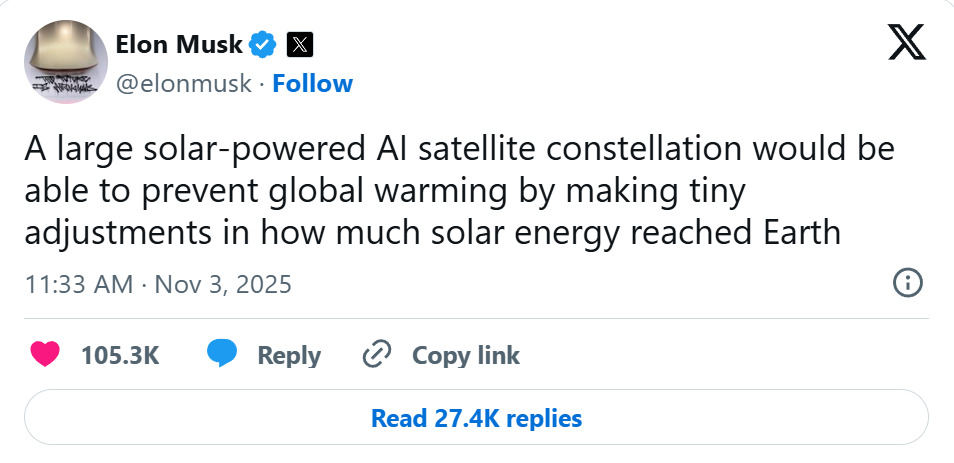
Musk envisions a large constellation of solar-powered satellites, controlled by artificial intelligence, capable of fine-tuning the amount of solar energy reaching Earth. In theory, this could help stabilize the planet’s temperature without requiring a radical overhaul of the global energy system.
In one post, Musk added, “Think in terms of a Type II Kardashev scale, and the path becomes obvious,” alluding to a level of civilizational development where humanity can harness the full energy of its star. This level of thinking highlights Musk’s ambition to view technology as a key solution to global challenges, but it also raises questions: is he attempting to replace complex climate responsibility policies with an engineering experiment?
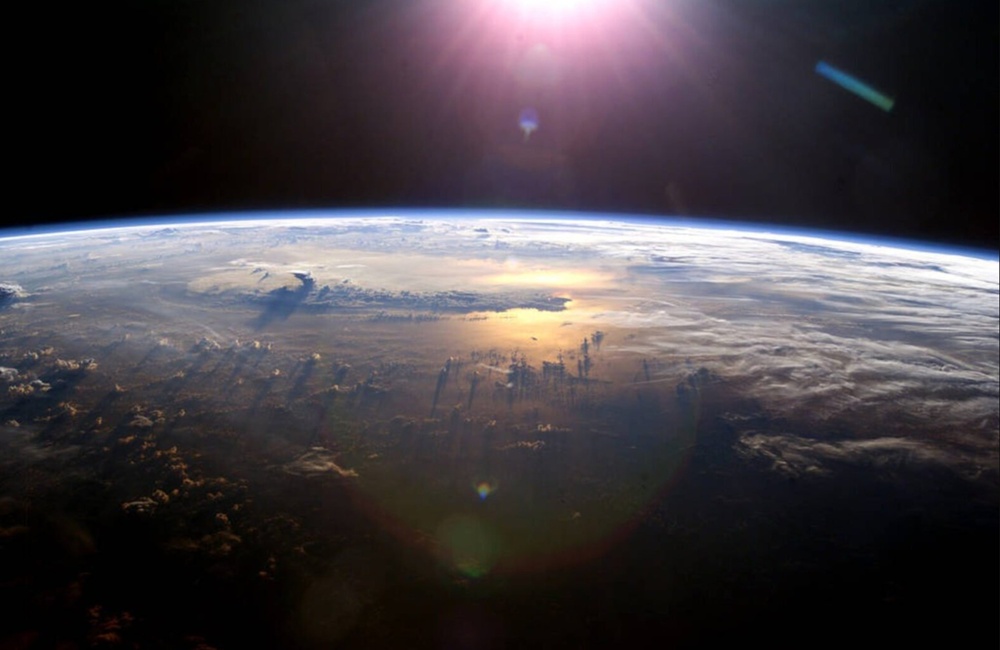
Musk believes that even minor adjustments to the solar flux could have a noticeable effect – both in preventing further warming and potentially triggering a new cooling period. “The Earth has been a snowball many times,” he noted, referring to prehistoric periods of extensive glaciation.
However, the scientific community warns that any interference with the climate system carries risks of unpredictable consequences, from altered atmospheric circulation to disrupted ecosystems. While Musk’s vision once again pushes the boundaries of conventional thinking, the question remains: is this a bold innovation or another technological illusion that distracts from addressing the root causes of the climate crisis?
Read also: Breakthrough Development: Scientists Create Artificial Muscles Activated by Ultrasound
Another whim of an eccentric billionaire?
Musk has yet to present any concrete plans for implementing this idea, and SpaceX has not officially confirmed work on SRM technology. Yet the very fact that the world’s richest person – owner of the largest satellite fleet, with over 8,000 active Starlink units – is publicly contemplating interference with the planet’s energy balance is concerning. When someone with such resources and influence talks about “shading the Sun,” it moves beyond mere futuristic speculation.

Musk’s vision goes even further. He speaks not only about blocking sunlight but also about using space as a new energy source. According to his estimates, up to 100 gigawatts of electricity could be transmitted from orbit annually – and eventually up to 100 terawatts from future energy plants on the Moon. This goes beyond mere geoengineering; it represents an attempt to usher humanity into a completely new era – an era of space-based energy expansionism.
Read also:
- Diary of a Grumpy Old Geek: The MacBook Pro 14 M5 Is Just a Copy-Paste
- Diary of a Grumpy Old Geek: Jony Ive and Gadgets

