





© ROOT-NATION.com - Use of content is permitted with a backlink.
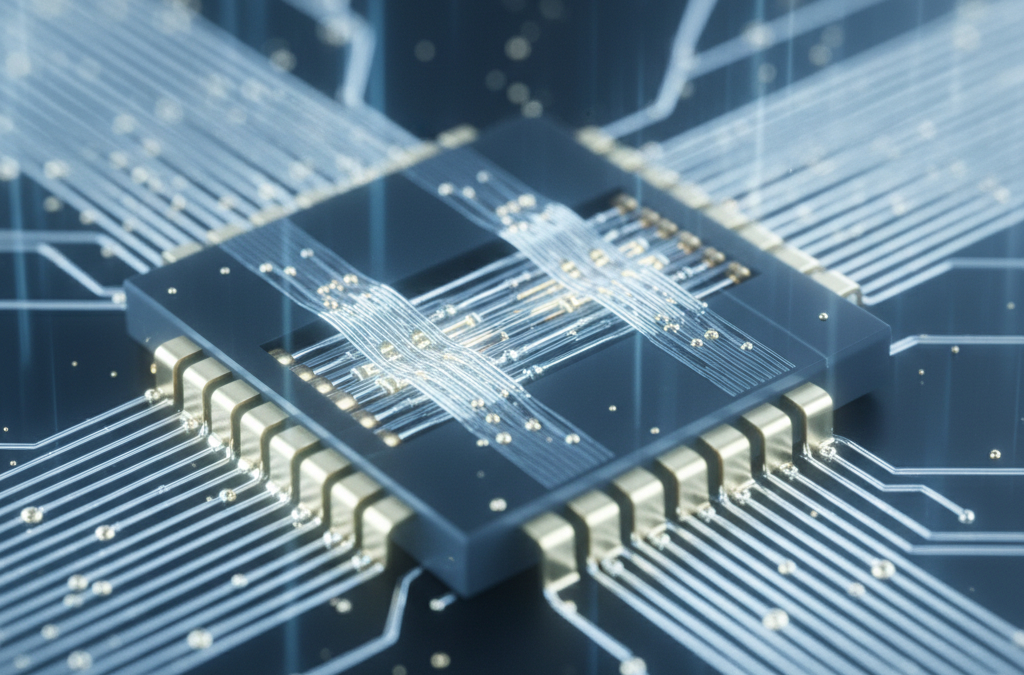
Researchers at KAIST have developed a highly energy-efficient microchannel collector for electronics cooling that enables chips to be cooled from within.
There is something almost philosophically ironic about the fact that the most advanced technology humanity has ever created ultimately runs up against one of the most fundamental challenges in physics: excess heat. Artificial intelligence systems capable of defeating chess champions, writing poetry, deciphering protein structures, and forecasting financial markets are not ultimately limited by a lack of data or shortcomings in their algorithms. Instead, they are constrained by a much simpler factor: the silicon chips at their core become too hot to operate efficiently.

This is where the Korea Advanced Institute of Science and Technology (KAIST) introduced a solution that appears both radical and elegantly simple. Rather than relying solely on external cooling methods, the researchers developed a way to cool chips from the inside, bringing thermal management directly into the device itself.
Read also: Everything About Project Helix: Xbox’s Last Big Bet or a Way Out of the Memory Crisis
TABLE OF CONTENTS:
When Physics Becomes the Enemy of Progress
To appreciate the scale of the challenge Korean engineers are trying to address, it is worth stepping back from the technological details and looking at the broader picture. Over the past five years, the AI race has effectively turned computing power into the new oil – one of the most valuable and sought-after resources of the digital era. Companies are spending billions of dollars building massive data centers and filling them with thousands of GPUs. NVIDIA, AMD, Intel, and their competitors continue to push new generations of chips to market, each offering ever greater computational density.
Yet higher density brings with it another characteristic that marketing departments tend not to emphasize: heat generation. A modern flagship AI chip can consume between 300 and 700 watts on its own. Multiply that by thousands of units inside a single data center, and the result is a facility whose thermal output resembles that of an industrial plant far more than a conventional computing center.

Overheating is not merely an inconvenience. It poses a fundamental threat to performance. As transistor temperatures approach critical limits, processors deliberately reduce their clock speeds in a process known as thermal throttling. If excessive heat persists, system stability deteriorates and hardware failures eventually become inevitable. In other words, chips that cost tens of thousands of dollars effectively shut themselves down to avoid permanent damage.
This is why, despite receiving little public attention, cooling accounts for between 30 and 40 percent of the electricity consumed by many large data centers. Roughly a third of their power budget is devoted not to computation, reasoning, or analysis, but simply to preventing the hardware from overheating.
Read also: Everything About NVIDIA RTX Spark: The Superchip Redefining Personal Computing
The Anatomy of Overheating: Why Conventional Methods Are Reaching Their Limits
For decades, the computer industry has relied on two primary approaches to managing heat. The first is air cooling, which uses large aluminum or copper heat sinks combined with fans that force air through their fins. The second is liquid cooling, in which metal cold plates containing internal channels circulate water or glycol-based fluids to absorb heat from the chip surface and carry it to an external heat exchanger.

Both approaches share a fundamental design limitation: they cool the surface of the chip, while the heat itself is generated inside it. Between the heat source and the cooling system lies a stack of materials – solder joints, thermal interface layers, the processor package, and additional interface materials. Each of these layers acts as a thermal barrier, making it more difficult to remove heat efficiently.
For consumer-grade processors, where heat fluxes typically range from 50 to 100 W/cm², these methods remain adequate. Modern AI accelerators, however, operate at heat densities that are an order of magnitude higher. In localized regions of the die – so-called hotspots – heat flux can reach several thousand watts per square centimeter. No external cooling system can efficiently manage such extreme concentrations of heat.
Read also: NVIDIA N1 and N1X: The Moment Windows Has Been Waiting for for Twenty Years
KAIST: Water Inside the Chip
The KAIST team’s response to this challenge involves rethinking the very architecture of cooling. Instead of continuing to refine external systems, the researchers asked a more fundamental question: what if the cooling fluid circulated directly inside the silicon die itself?
This concept – so-called microchannel cooling – is not entirely new. Similar ideas were already proposed by researchers as early as the 1980s. However, all previous implementations encountered the same fundamental obstacle: when water is forced through microscopically narrow channels over significant distances, hydraulic resistance increases dramatically. Overcoming this resistance requires substantial pumping power, which in turn reduces the overall energy efficiency and undermines the practical value of the approach.

KAIST addressed this limitation by adopting a principle well known from biological circulatory systems: instead of a single long channel, they implemented a branched network of shorter pathways. The cooling fluid is introduced through multiple inlet points simultaneously, distributed across short microchannels, and collected through several outlets. The resulting structure resembles a tree-like vascular system, where ordinary room-temperature water acts as the working coolant.
The geometry of these channels is remarkably small, with widths narrower than a human hair. Yet this microscopic scale is precisely where the key advantage emerges. As channel dimensions decrease, the relative surface area available for heat exchange increases, significantly improving thermal transfer efficiency between the fluid and the heated substrate.
Read also:Five AI Cities: Inside the Emergence AI Experiment – Order, Chaos, and Survival
Numbers That Speak for Themselves
The results of KAIST’s laboratory tests are not merely encouraging. By thermal engineering standards, they are close to extraordinary.
First, the system demonstrated the ability to dissipate more than 2000 W of thermal power per square centimeter of surface area. This is a value so high that even specialists in thermal management need to pause to properly contextualize it. For reference, the surface of the Sun emits approximately 6300 W/cm² – meaning the microchannel system would correspond, in purely numerical terms, to roughly one-third of that flux. While such a comparison has limited physical meaning in practice, it helps illustrate the scale: at this level of heat removal, even the most power-dense next-generation AI chips would no longer be constrained by the cooling system’s capacity.
Second, despite these extreme heat fluxes, the junction temperature – the critical internal temperature point within the chip – remained below 100°C. This is a crucial result, as it directly determines the stability and long-term reliability of semiconductor devices. Most modern processors specify maximum junction temperatures in the range of 100–125°C, meaning the KAIST system maintains a substantial thermal safety margin.
However, the most striking result is the third metric: the coefficient of performance (COP). The team achieved a value of 106,000. According to the researchers, this is roughly an order of magnitude higher than the previous world record in this field, set only a few years earlier.
In practical terms, this implies a fundamental shift in data center economics. A facility equipped with such a cooling system could redirect a large portion of the energy currently consumed by pumps, fans, and chillers directly toward computation. The overall efficiency of the infrastructure would move to an entirely new level.
Read also:Privacy as a Business Model: Proton Services and Efforts Toward a Surveillance-Free Internet
From the Lab to the Server: A Long Road Ahead
At this point, however, an important caveat is necessary – and, to their credit, the KAIST researchers acknowledge it openly. What has been demonstrated is a laboratory prototype built on a test silicon sample. The gap between “it works in the lab” and “it can be deployed in a production data center” is substantial, and in the semiconductor industry it is often measured in years or even decades.
First and foremost is the issue of hermetic sealing. Water and electronics are traditionally incompatible. A system of microchannels embedded within silicon must operate reliably for years of continuous use without any leakage. Even a single droplet of fluid reaching active electronic components could potentially damage not just one chip, but an entire server rack worth millions of dollars.

Second, there is the question of manufacturability at scale. Fabricating microchannels in silicon is an exceptionally complex process that requires cleanroom-grade facilities and nanometer-level precision. Whether this approach can be transferred to mass production without a prohibitive increase in cost remains an open question.
Third, system-level integration presents another major challenge. A real-world data center is not a single chip under laboratory conditions; it consists of thousands of servers organized into racks, connected through shared power delivery systems, networking infrastructure, fire suppression systems, and, critically, cooling loops. A microchannel system embedded within a chip must interface with this external infrastructure – piping, pumps, heat exchangers, and monitoring systems. Achieving this integration will require not only engineering solutions but also new standards, new protocols, and a fundamentally different design philosophy for data center architecture.

Finally, there is the question of long-term durability. Water circulating under pressure through narrow channels in silicon, year after year, gradually degrades materials through cavitation and corrosion-related mechanisms. How long such a system could survive under continuous industrial operation remains unknown.
Read also: What is ANEEL and why thorium could change nuclear energy
Broader Context: Cooling as a New Battleground in the AI Race
Despite all the caveats, the KAIST breakthrough is significant for reasons that extend well beyond its immediate technical contribution.
First, it clearly signals where the next fundamental bottleneck in artificial intelligence development lies. If thermal management has become so critical that leading research institutions are spending years developing internal microchannels within silicon itself, it suggests that conventional external cooling approaches are approaching their limits. The paradigm of “more GPUs” is increasingly colliding with a hard physical ceiling.

Second, it opens up a broader discussion about what the next generation of data centers will look like. It is entirely plausible that future AI servers will be designed as hybrid thermal systems: microchannel liquid cooling at the chip level, immersion cooling at the server level, and conventional heat exchangers at the facility level – effectively three layers of thermal management instead of one.
Third, and perhaps most importantly from a technological geopolitics perspective, cooling itself is becoming a competitive advantage. The company or country that first manages to industrialize and scale such approaches will be able to build significantly more efficient compute clusters under the same energy constraints. In a world where every watt of compute power has become a strategic resource, this is no less consequential than transistor density per square millimeter.
Read also: Computers in Space: Limitations as an Advantage
Instead of a Conclusion: A Race Where Cooling Matters More Than Algorithms
The KAIST study is further evidence that we are living in an era where the most striking technological breakthroughs are not necessarily happening where one might expect. Not in quantum computing laboratories, not in the algorithmic research divisions of major tech corporations, but in quieter academic institutes where thermal engineers gradually etch micro-scale channels into silicon wafers, micron by micron.
Artificial intelligence has learned to think. It has learned to learn. It has even learned, to some extent, to “create.” Yet it still has not learned how to avoid overheating – and it is this limitation, as it turns out, that has become one of the most urgent constraints of the digital 21st century.

Korean researchers are not promising a revolution tomorrow. What they are offering is a direction – and that direction, at this stage, appears more than sufficient. A chip cooled from within is not merely a technological novelty. It is an archetype of what hardware architecture in the age of artificial intelligence may look like: less spectacular than promotional narratives about neural networks, but far more fundamental to whether that era will materialize at all.
Read also:
- Ariane 6 and Amazon Leo: How a Record-Breaking Launch Is Reshaping the Space Race Balance
- SpaceXAI1: Elon Musk Takes Artificial Intelligence into Space
- DLSS 4.5: Why This Technology Changes the Approach to Path Tracing
- Weapons of Ukraine’s Victory: “Vyrivniuvach” Guided Glide Bomb

