





© ROOT-NATION.com - Use of content is permitted with a backlink.
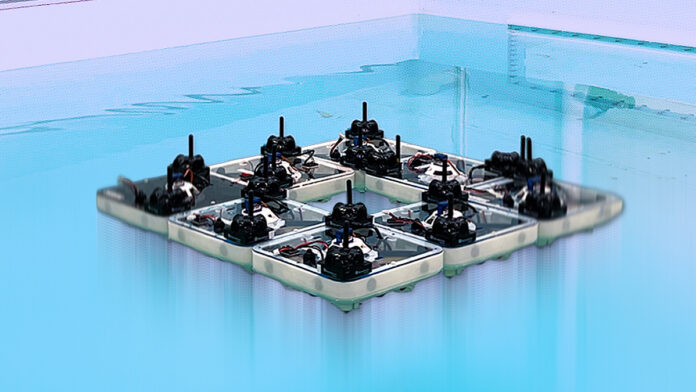
The urban shoreline is typically viewed as the boundary of land, but experts at MIT view bodies of water as dynamic, LEGO-like building sites. They have introduced FloatForm technology – a swarm of compact, square-shaped robotic boats capable of assembling into large structures, disassembling, and transforming without direct human intervention. The plate-sized robots (21 cm) have their own propellers, sensors, and magnetic latches. This paves the way for adaptive floating infrastructure: a mobile bridge after a disaster, a fair on a canal, or a temporary stage for a festival.
MIT professor and CSAIL director Daniela Rus notes that the project transforms the waterfront into a controllable urban extension, where autonomous vessels create bridges and platforms on demand. According to Wei Wang, a former MIT researcher and head of the Marine Robotics Lab at the University of Wisconsin–Madison, still water is becoming a programmable space. Alejandro González-García, a former researcher at MIT CSAIL and the Senseable City Lab, adds that floating bridges will help relieve urban traffic and improve city life by utilizing the water.

Read also: AERONAUT – everything that flies above the ground: aviation, UAVs and drones, rockets, and space
The study, published in *Nature Communications* on July 9, builds on the earlier Roboat project, developed by the laboratories of Daniela Rus and Carlo Ratti in collaboration with the Amsterdam Institute for Advanced Urban Solutions (AMS Institute). While Roboat tested full-scale vessels on Amsterdam’s canals to transport waste and passengers, FloatForm scales up the concept to tackle a more complex challenge – the self-organization of hundreds and thousands of robots.
The researchers borrowed the idea of self-decentralization from fire ants, which form living rafts during floods using simple local rules. Most existing robotic systems rely on a central computer, which slows down operations and creates the risk of a single point of failure. In FloatForm, a lightweight central planner merely sets the final positions to ensure grid accuracy, while the boats perform maneuvers, collision avoidance, and adaptation to obstacles autonomously by exchanging data with their neighbors. As a result, the entire swarm moves in unison, and the computational complexity does not increase as the number of boats grows.

During tests at MIT, a group of eight robots assembled from random positions into a specified shape, joined together to form a rigid vessel, disbanded, and regrouped within 4–8 minutes. In collective transport mode, each robot acts as an individual pusher. Simulations have demonstrated the system’s effectiveness for groups of up to 64 vehicles, and forming a single structure increases its stability against waves and currents.
The robots are connected via a hidden mechanism featuring a single servomotor and an origami-inspired structure. This structure contracts or expands, extending permanent magnets with alternating polarities to ensure a secure connection. Thanks to a 3D-printed gearbox, the coupling does not require constant power consumption, conserving battery power for propulsion and computing. Four mini-turbines enable movement in any direction, and the developers added stabilizing fins to counteract excessive rotational force.

In tests, the task success rate was 90% for four robots and 70% for eight. In the event of malfunctions, individual units autonomously returned to formation or freed themselves from jamming. The transition from a pool to open water bodies will require reinforcing the valves and replacing the ultrasonic sensors with GPS or cameras. The technology can be applied on offshore platforms, for environmental monitoring, and in any city with rivers or canals. Stephen Seron, an assistant professor at the University of Michigan, called this an important step in the development of distributed robotics on water.