





© ROOT-NATION.com - Use of content is permitted with a backlink.
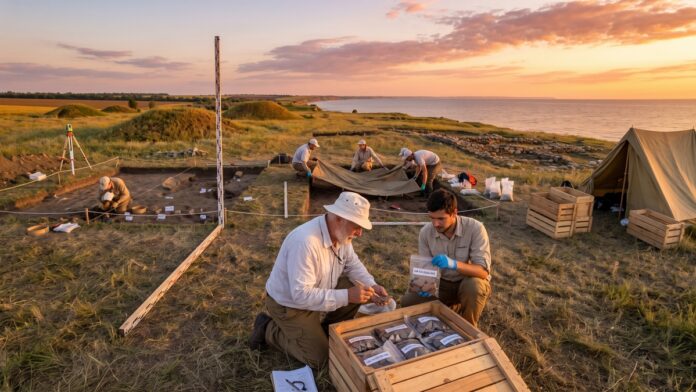
Based on research by academic archaeologists, a European report was compiled on the state of Ukrainian cultural heritage during the Russian-Ukrainian armed conflict and in the postwar period.
Read also: AERONAUT – everything that flies above the ground: aviation, UAVs and drones, rockets, and space
On August 11, 2026, the web platform of the Cultural Property Protection for All initiative, known as “Protection of Cultural Heritage for All” (code CA24119) and operating under the auspices of the European COST project (European Cooperation in Science and Technology), published a summary of the study.
The author of this report, titled “Illegal Archaeological Excavations, Damage Assessment, and Illicit Trade in Ukrainian Cultural Objects: Legal and Traceability Issues” (Illegal Archaeological Excavations, Damage Assessment, and Illicit Trade in Ukrainian Cultural Objects by Dr. Andris Kairiss), is Dr. Andris Kairiss (Andris Kairišs), an expert with the International Committee on the Management of Archaeological Heritage within the International Council on Monuments and Sites (ICOMOS).

This paper resulted from a short-term scientific visit (STSM). It took place at the Institute of Archaeology of the National Academy of Sciences of Ukraine in May of this year under the guidance of Evelina Kravchenko, Ph.D. in History, who serves as a senior research fellow in the Department of Early Iron Age Archaeology. The event was made possible by a joint COST grant initiative, in which Ukraine has held full participant status since 2022.
The abstract notes that Ukraine’s archaeological heritage is at extremely high risk due to its location primarily in open areas, agricultural lands, coastal zones, built-up areas, and regions affected by hostilities. Since the onset of Russian aggression in 2014, and especially following the start of the full-scale invasion on February 24, 2022, historical sites, museums, archives, and valuable collections have suffered catastrophic destruction, looting, unauthorized removal, and illicit trafficking.
The greatest danger threatens those cultural assets located in temporarily occupied territories and in areas near the front lines, where Ukrainian scholars and government officials have limited or no access whatsoever. The very fact of the occupation poses additional threats to the cultural heritage. The situation on the Crimean Peninsula is particularly critical, where movable artifacts and immovable heritage sites, in particular the ancient city of Chersonesos Taurica along with its agricultural district, are suffering from illegal interference by the occupying authorities. There, historical heritage is being exploited for ideological purposes, collections are being relocated, and Ukrainian oversight is being gradually displaced.
In his work, the researcher also analyzes the challenges associated with documenting cultural heritage sites, assessing the extent of losses resulting from military clashes and the occupation regime, as well as issues of legal guardianship. Particular attention is paid to intangible losses, which deal an irreparable blow to identity, national memory, and the continuity of the historical process.
The report contains an extensive list of urgent recommendations. First and foremost, it calls for the establishment of a unified mechanism for rapid communication between foreign law enforcement agencies, customs authorities, postal services, museum institutions, auction houses, and restitution agencies to facilitate the rapid exchange of information regarding seized or suspicious archaeological finds from Ukraine.
In addition, the report emphasizes the need to establish emergency expert response teams capable of immediately identifying seized items that may have been smuggled out of occupied Ukrainian territories. Another important step is to ensure free access to scientific databases, archaeological publications, museum catalogs, and visual information repositories for domestic law enforcement agencies, customs officials, prosecutors, and authorized specialists.
It is also proposed to adopt a detailed protocol for documenting and handling intercepted artifacts. Among the recommendations is the need to clearly define state ownership and chronological boundaries for archaeological treasures, as well as to distinguish between offenses against the monuments themselves and those against individual artifacts.

The importance of enhanced monitoring of postal shipments, customs inspections, and the online space for the illegal trafficking of Ukrainian antiquities is separately emphasized, alongside the impermissibility of legitimizing any items of dubious or unknown origin. Additionally, it is proposed to develop concise practical guidelines for military personnel, explosive ordnance disposal units, engineers, and civil-military cooperation teams regarding the handling of archaeological sites and chance finds. Equally important is the priority given to digitizing documentation, which will facilitate the identification and restitution of domestic cultural objects, as well as materials from occupied or frontline zones.
In the concluding section, Dr. Andris Kairiš shares his own vision for future strategic steps, emphasizing that archaeological assessment must be a mandatory and effective stage in the process of planning, construction, infrastructure development, and global postwar reconstruction must be the conduct of archaeological assessments.