





© ROOT-NATION.com - Use of content is permitted with a backlink.

The U.S. Marine Corps’ new AI-powered turret is capable of detecting and targeting people, even though it is being promoted as a means of countering drones. A human operator must personally confirm each shot, but the AI handles virtually all other steps in the decision-making process for opening fire.
The United States is integrating yet another system with autonomous capabilities into its arsenal. Although this AI platform was designed to take down drones, it appears capable of autonomously targeting ground targets, including people, even though the developer claims that the decision to fire remains with the operator.
Read also: AERONAUT – everything that flies above the ground: aviation, UAVs and drones, rockets, and space
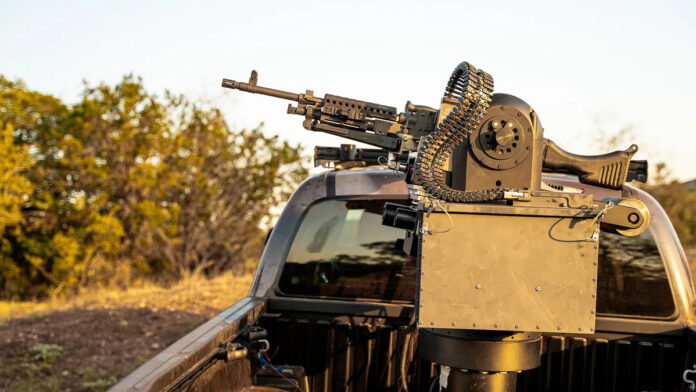
The Marine Corps has selected the Bullfrog M240 robotic turret from Allen Control Systems for integration into its L-MADIS air defense system. The initial contract for prototype development is valued at $6.2 million.

The Bullfrog’s design combines AI, computer vision, and high-precision robotic mechanisms with a 7.62-mm M240 machine gun. Weighing over 135 kg, the platform is capable of independently detecting, identifying, tracking, and engaging targets, after which it transmits the data to a human operator for approval of the attack.
The manufacturer emphasizes that the final decision is always made by a human, but nearly the entire kill chain is executed by software. As a result, the soldier’s control is reduced to a single decision, which often must be made under stressful conditions and relies primarily on what the AI algorithms have identified on the battlefield.
Allen Control Systems positions Bullfrog as a solution for destroying unmanned aerial vehicles, but footage released by the developers demonstrates how the system switches from aerial targets to ground targets. At the same time, the software has no apparent restrictions that would prevent the algorithms from identifying people as potential targets.

The version equipped with an M240 machine gun has a rate of fire of up to 850 rounds per minute, has a range of up to 800 meters, and is capable of taking down unmanned aerial vehicles of various classes.
Of particular interest to marines is the ability to mount the system on existing military platforms, which solves the problem of high costs – specifically, the need to use missiles costing hundreds of thousands of dollars to destroy inexpensive drones. According to ACS, the cost of neutralizing a single target can be as low as $10.

The U.S. Army and Navy are already deploying Bullfrog systems, while simultaneously developing versions compatible with the .50-caliber M2 machine gun, the M230 automatic cannon, and the M134 Minigun. The Marine Corps plans to mount this system on the L-MADIS – a mobile anti-drone platform based on two Polaris MRZR all-terrain vehicles.
Pentagon regulations require that autonomous and semi-autonomous weapons provide commanders and operators with the ability to exercise appropriate human oversight during the use of force. Bullfrog formally meets these criteria, as a human authorizes each shot; however, the final push of the button becomes meaningless when the selection, tracking, and recommendation of the target are carried out by AI. The Bullfrog system does not yet have the capability to independently make decisions about taking a human life. However, it clearly demonstrates just how close military AI has come to the threshold beyond which a machine makes fatal decisions.
Read also: Beam Instead of a Bullet: How Laser Weapons Are Rewriting the Rules of Modern Warfare
Can i mount one on my house