





© ROOT-NATION.com - Use of content is permitted with a backlink.
I’ll start this review of the Hypershell X PRO with a bit of background. It usually takes me less than three hours to obtain an exoskeleton and upgrade it for sprinting in S.T.A.L.K.E.R.: Call of Prypiat. Back in the day, I used to speedrun the game and could reach Prypiat in about two hours. From there, it was simply a matter of sprinting to the hatch, retrieving the toolkit, and making it back to Cardan. Two bottles of Kozaks vodka later, and the exoskeleton was fully upgraded for running.

TABLE OF CONTENTS:
Technical specifications
- Construction materials: aluminium alloy, stainless steel, carbon fibre-reinforced polymer
- Operating temperature: -20 – 60°C
- Smart modes: Stair descent, Downhill, Uphill, Stair ascent, Mountain terrain, Cycling, Running, Dirt track, Brisk walking, Walking
- Number of smart modes: 10
- Operating modes: Eco/Hyper/Fitness
- Maximum assisted speed: 20 km/h
- Range: up to 17.5 km with 2 batteries
- Physical exertion reduction: up to 30%
- Peak power: 800 W
- Weight: 2.0 kg (without battery)
- Smart control: iOS, Android
- Warranty period: 24 months from the manufacturer
Hypershell Pro X video review
What Is It?
I know that in Fallout 2 you can get Power Armor almost immediately if you’re willing to save-scum your way to Navarro. I know exactly where to throw a grenade to unlock the door leading to the Rubin exoskeleton, and that a set of APA armor in Fallout: New Vegas can be found in the Deathclaw Promontory across the Colorado River.
For the record, there are 36 Deathclaws there in total. A shotgun build is your best friend – although who am I kidding, you’ll probably spec into a sniper build anyway. With all that in mind, I understand that the Hypershell X PRO isn’t really a full-fledged exoskeleton. It’s closer to an aggressively mechanized version of a chair.

On the other hand, I couldn’t help feeling a bit like Lobanovskyi before a Dynamo Kyiv match against Barcelona. In a way, I’d been preparing for this my entire life, tracking down exoskeletons anywhere a game would let me – and often where it wouldn’t. Now I’d finally found one in the real world.
Because, technically speaking, the Hypershell X PRO really is an exoskeleton. It’s a wearable system designed to reduce the load on your legs by taking over part of the physical effort involved in demanding tasks. That can make it useful for rehabilitation after an injury, for older adults, and for professionals such as couriers, field operators, and many others.
Positioning and Price
The Hypershell X PRO is priced at around $1,200. That said, the lineup also includes both more affordable and more expensive models, which we’ll return to later in the review.
How It Works
At its core, the Hypershell exoskeleton has a surprisingly simple operating principle. Essentially, it consists of two powered linkages that use servo motors to lift your legs as soon as the system detects movement in your hips. That’s really the gist of it.
The rigid connection between the waist section and the supports mounted above the knees also makes it slightly easier to remain standing by transferring part of the load through the frame. However, that design comes with a few trade-offs, which I’ll cover later in the review.

This is where I’d like to make a point aimed specifically at gamers. Why? Because if you play games, you already know what an exoskeleton is. You don’t need the concept explained to you.
What you can do, however, is explain it to your parents or grandparents – or to friends and relatives going through rehabilitation after military service. Games have given many of us an intuitive understanding of what an exoskeleton is supposed to do. Devices like the Hypershell X PRO simply bring that concept into the real world.
Specifications
To be clear, the Hypershell X PRO is neither an exosuit nor powered armor. It doesn’t increase your lifting capacity on its own. Instead, its primary purpose is to reduce physical strain and improve endurance by assisting leg movement. The unit isn’t designed to be submerged in water, but it is rated IP54, meaning it can handle rain, splashes, and sweat without issue.

There’s no nuclear power cell here, unfortunately. Instead, the Hypershell X PRO uses a removable 72 Wh battery pack, rated at approximately 5,000 mAh with a maximum output voltage of 16.8 V. The system also incorporates a basic onboard AI that automatically selects the appropriate assistance mode based on your movement. That said, you can also switch between operating modes manually whenever you prefer.
Model Lineup
It’s also worth explaining the different versions, because the Hypershell X is available in four configurations: the Hypershell X GO, X PRO, X Carbon, and X ULTRA. The X GO is the entry-level model, designed primarily for recreational use. It features a 400 W motor, delivers up to 15 km of assisted travel on a full battery charge, and provides walking assistance at speeds of up to 12 km/h.

The Hypershell X PRO is the all-around model in the lineup. It features an 800 W motor, offers an assisted range of up to 17.5 km, and supports movement at speeds of up to 20 km/h. That makes it a better fit for users who expect to tackle more demanding terrain, such as hiking in the mountains, or who simply need a higher level of assistance during physically intensive activities.

The X Carbon delivers the same level of performance as the X PRO but upgrades both the materials and the construction, while reducing the overall weight by around 200 g. The aluminum alloy frame is replaced with carbon fiber, and the standard nylon fabric gives way to breathable Gore-Tex. At first glance, that might make it seem like the obvious choice for hiking and outdoor adventures. Personally, though, I’d recommend it for users who spend long hours wearing the exoskeleton on the job – such as warehouse workers or couriers. The carbon-fiber frame is more durable under sustained daily use, while the lighter weight becomes increasingly noticeable over the course of a full workday.
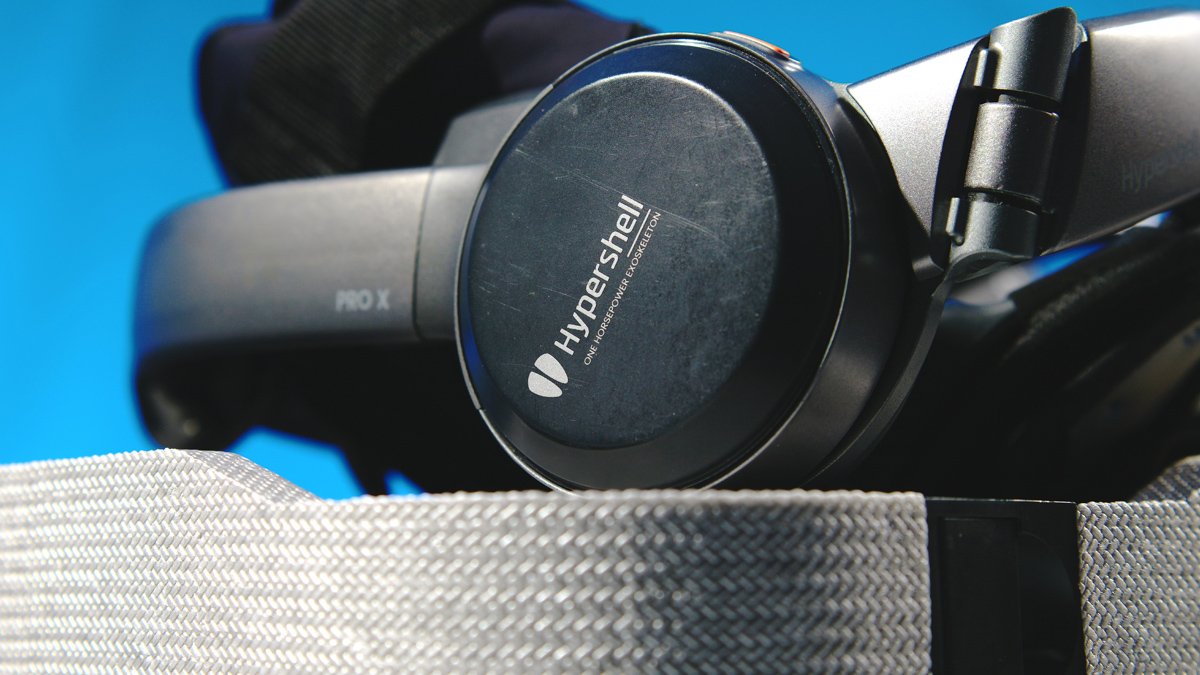
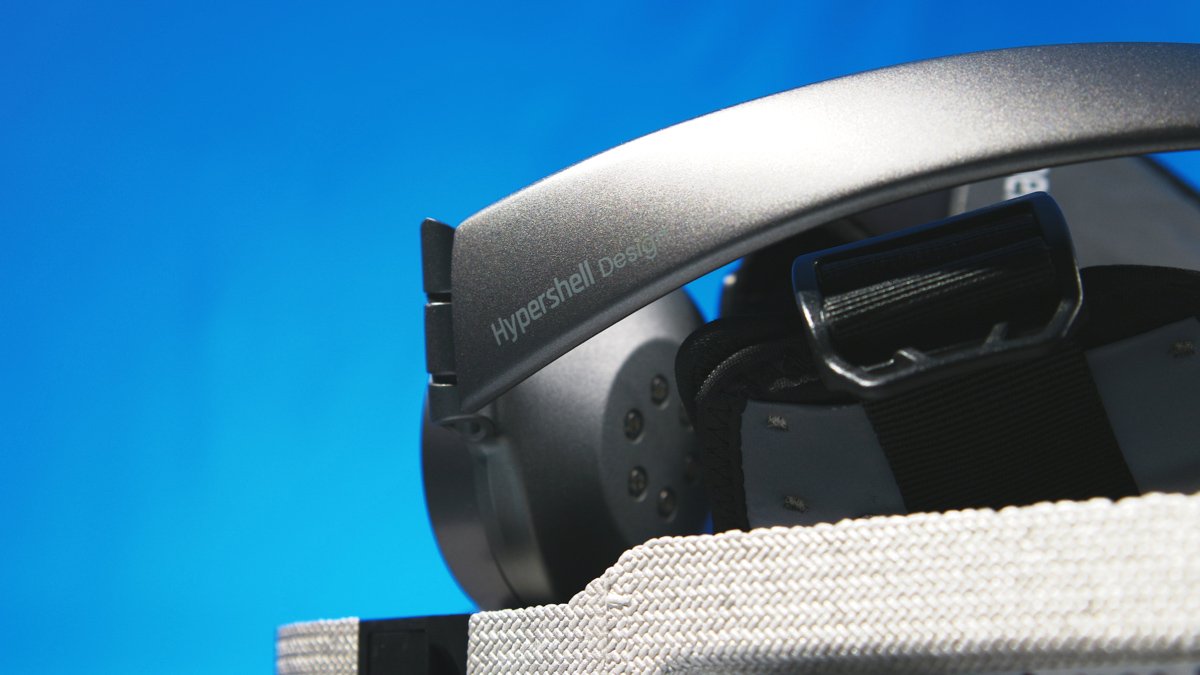
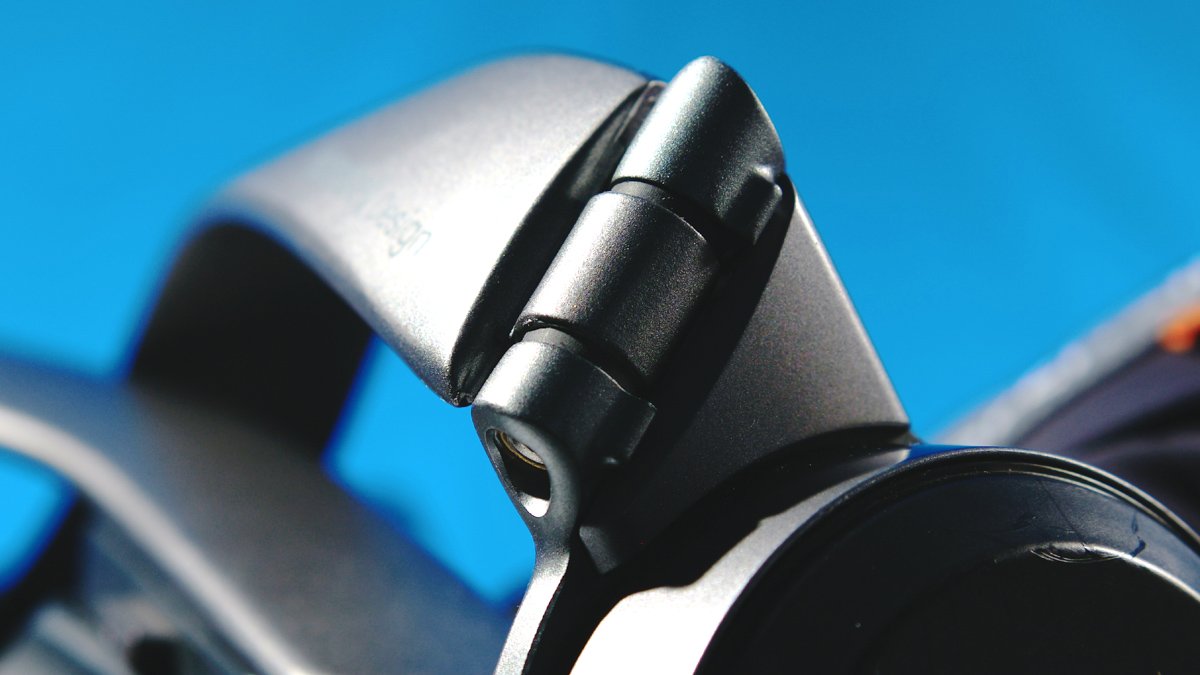
At the top of the range sits the Hypershell X ULTRA. It’s designed for maximum performance and more demanding environments, featuring dual 1,000 W motors, an assisted range of up to 30 km with two batteries installed, and support at speeds of up to 25 km/h.
Moving on to the positives, the Hypershell X PRO is quick to put on, although the straps and adjustments may take a little getting used to the first few times. Charging is another strong point: the battery supports input power of up to 65 W, reaching 75% charge in around 35 minutes and a full charge in approximately 88 minutes. The kit also includes two battery packs, making it easy to swap one for the other during extended use.

One limitation is that the batteries can’t be charged outside the exoskeleton itself. On the other hand, Hypershell offers some genuinely useful accessories, including the Hypershell Charging Hub, which can charge up to four battery packs at the same time. That’s clearly aimed at commercial users running multiple batteries – courier services are an obvious example – but it’s good to see that the ecosystem already includes a practical solution, and one that isn’t prohibitively expensive.

Here’s a free product idea: the Hypershell X Carbon BX. Take the existing X Carbon, bundle it with three battery packs and the charging dock right in the box, and you’ve got a package that’s immediately ready for professional, all-day use.
Software and Controls
The companion app is called Hypershell+, and it’s more than just a setup utility. In addition to providing step-by-step guidance on using the exoskeleton, it also lets you create and fine-tune custom assistance profiles, allowing the system’s power delivery to be tailored to your preferences and intended use.

Not that extensive customization is strictly necessary – the three preset assistance modes already do an excellent job in their intended roles. On top of that, the Hypershell X PRO lets you fine-tune each preset directly from the controls, adjusting the assistance level in 25% increments. That level of flexibility is likely to be more than enough for most users.




Build Quality
I do have one criticism when it comes to the build quality. The battery fits so tightly in its compartment – and is so difficult to remove – that I almost need an exoskeleton for my arms just to take it out consistently. There’s no hidden trick or unusual release mechanism involved, either. It simply slides on rails and locks into place with a latch. The retention is reassuring from a security standpoint, but in day-to-day use it feels unnecessarily stiff.

And no, I don’t think the ingress protection rating is a convincing explanation for this. Proper water resistance comes from features such as rubber seals, protected connectors, and sealed interfaces – not from making the battery excessively difficult to remove. As it stands, every time I take the battery out, it feels like I’m about to break the exoskeleton. In my case, the issue was easy to improve by applying a small amount of Ballistol lubricant to the battery rails, after which removal became much smoother.
Using the Hypershell X PRO
My experience with the Hypershell X PRO came with a few caveats. The first is that the rigid side linkages get in the way of your trouser pockets. They don’t block access completely, but they do make reaching into them less convenient. Oddly enough, that can also work in the exoskeleton’s favor. If your pockets have a habit of letting things fall out, the side supports effectively keep them pressed closed. It’s difficult to lose something accidentally when the exoskeleton is holding the pocket against your leg.

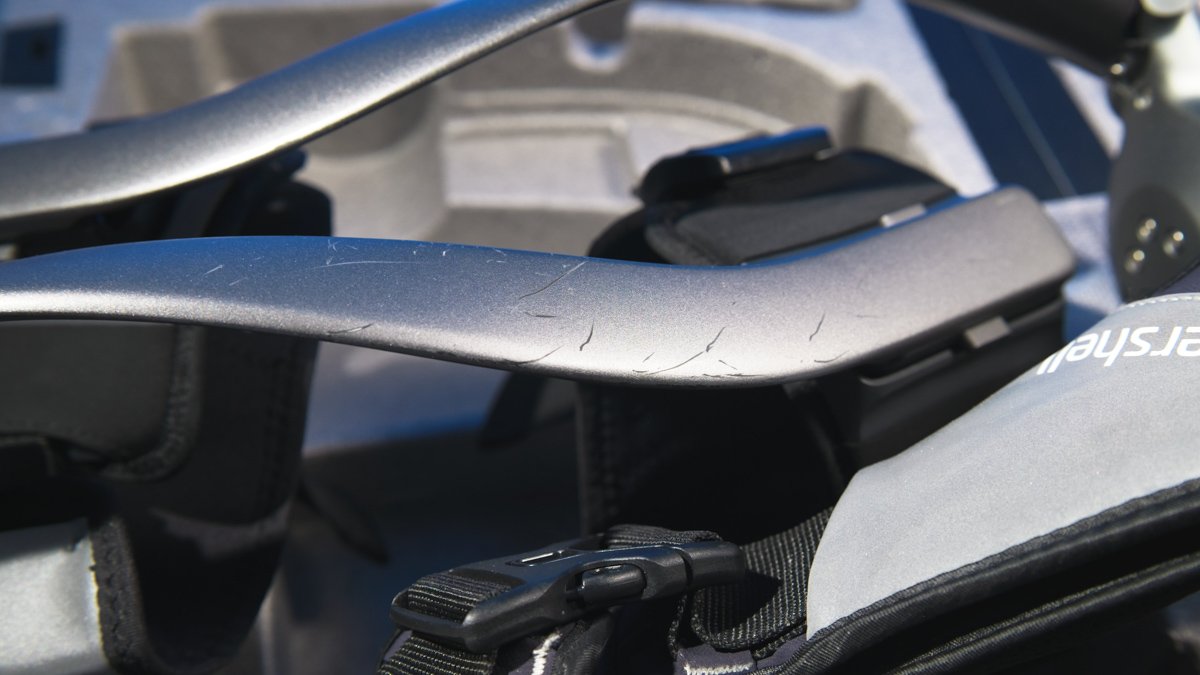
Surface wear on the side linkages is also inevitable. Until you get used to wearing the exoskeleton, it tends to take the impact when brushing against door frames, furniture, or sharp corners. On the bright side, that’s the exoskeleton absorbing the hit instead of your legs. Another point worth mentioning is that the servo motors generate both heat and noise during operation. Neither is excessive – the motors never became uncomfortably hot, and the sound isn’t particularly loud – but they are certainly not silent, especially when the assistance level is set to maximum.

One thing the Hypershell X PRO doesn’t protect you from – in fact, it can make it more noticeable – is heat buildup. The contact pads are made from synthetic materials. They’re reasonably breathable, but they aren’t Gore-Tex, as that upgrade is reserved for the X Carbon. As a result, the areas compressed by the straps inevitably become warmer during extended use. It’s not a design flaw so much as a consequence of wearing a close-fitting support system, but it’s something to keep in mind, particularly in hot weather or during physically demanding work.
Final Thoughts
In the end, this is the conclusion I’d leave you with: if you have the opportunity, try the Hypershell X PRO at least once. This isn’t another incremental gadget feature like an under-display selfie camera or wireless charging on a smartwatch. It’s a technology with the potential to reduce physical strain, support recovery, and make everyday life noticeably easier for the people who need it most. That, ultimately, is the strongest recommendation I can give.


Dobra stvar samo što je skupa, većini potencijalnim kupcima nedostižno. Od 800$ do 1800$.