





© ROOT-NATION.com - Use of content is permitted with a backlink.
Today, we’re taking a closer look at the idea of superintelligence – a hypothetical form of artificial intelligence that surpasses the human mind in every domain, including science, creativity, strategic thinking, and self-learning.
Let’s start with a simple truth: “superintelligence” isn’t a breakthrough. It’s a buzzword – a marketing slogan born in the age of hype. A sleek label that has more in common with stock market language than with any real transformation of everyday digital life. It’s part investor pitch, part media spectacle, and a dose of Silicon Valley mythology for those still hoping for a tech messiah.
Mark Zuckerberg talks about building the “AI team of the future.” Sam Altman announces a new era of medical superintelligence. Ilya Sutskever takes it even further – launching a company called Safe Superintelligence Inc., as if this is already a fully established industry, like manufacturing frozen dumplings. One claims a breakthrough is just 24 months away; another implies it’s already happened – we just haven’t noticed yet. The hype machine is running at full speed.
But in day-to-day reality, there’s nothing even close to superintelligence. Your microwave still doesn’t know it’s heating up soup, and your voice assistant can’t reliably tell the difference between “turn off the lights” and “turn on the lights.” What we do have are vague definitions, shifting timelines that change faster than Elon Musk’s posts on Twitter, and “revolutionary” products that are really just the latest iterations of old ideas in fresh packaging.

The superintelligence narrative is, first and foremost, a product of the expectations market. And expectations are a convenient tool – especially when there’s little to show in the present. While some teams are busy simulating consciousness on GPU clusters, the real world is still waiting for something more basic, like reliable autocorrect in a messaging app.
Read also: How to Reduce RAM Usage in Windows 11
TABLE OF CONTENTS:
What do Big Tech executives think is a superintelligence?
The concept of superintelligence isn’t new. It’s been circulating in futurist circles for decades. But only recently has it become a full-fledged marketing hook – aimed at venture capital firms, startups, and eternally optimistic technophiles. The term “superintelligence” is now conveniently framed as the next step beyond AGI – the same hypothetical artificial intelligence that doesn’t just match human capabilities but exceeds them across the board.
Superintelligence comes with bold promises:
Total superiority across all domains – science, art, strategy, and complex problem-solving. No competition. No constraints.
Self-accelerating development – a system that doesn’t just learn, but learns how to improve its own learning, faster and more efficiently than any human could imagine.
The goal is stripped of ethics – there’s no built-in concern for “human happiness” or “justice” in its code. Only efficiency, optimization, and outcomes. And if humanity gets in the way, that becomes a matter of priorities – not morality.

It sounds like science fiction on steroids – which is exactly why it attracts money. Investors see it as something between a gold rush and a new planetary messiah. The teams are in place, the funds are set up, and the technical papers are written. But instead of real superintelligence, what we currently have are sophisticated copy machines: systems that can generate elegant sentences without understanding them; that play chess without grasping the concept of winning; that optimize metrics without knowing why.
The irony? This entire wave of hype isn’t proof of superintelligence – it’s a reflection of carefully orchestrated human wishful thinking.
So yes – superintelligence as a concept is a powerful driver of investment. But in practical terms, it remains what it has always been: an intellectual phantom, onto which we can project ambitions, anxieties, and hopes. And that’s exactly why it sells so well.
Read also: ChatGPT Destroys the Competition: Era of Super Apps Has Arrived
Hype instead of hard engineering
The growing hype around superintelligence is starting to look more and more like a classic bubble – inflated, loud, and polished to a shine. The promises are sweeping: medical breakthroughs, Nobel Prizes on the horizon, machine-driven insights in every domain. In presentations and manifestos, it all reads like the dawn of a new era. But peel back the glossy layer, and underneath, it’s still the usual suspects at work: large language models that, while now more capable of producing fluent answers, are ultimately still generating text, images, or bits of code. Bold, sometimes impressive – but it’s not thinking. And it’s certainly not “superintelligence.”
In contrast, take the electronics industry. Here, things are far more grounded – there are no vague promises about “conscious” models or “divine” optimization. Instead, users expect tangible results: real products that work, deliver, and improve measurable performance:
- intelligent assistance systems that really help
- powerful batteries that don’t give up after half an hour of streaming
- processors that can withstand the load without throttling or overheating.
That is, innovations that have form, function and result – not just a press release.
This is where companies face the hard realities. Despite the bold claims, several significant challenges remain unresolved:
- Cost of computation and energy consumption. Superintelligence demands massive numbers of processing cores, huge data centers, and megawatts of electricity. It’s expensive and far from environmentally friendly.
Edge integration. Talking about highly intelligent systems is one thing; making them run effectively on real devices – like smartphones or industrial sensors – is quite another challenge.
Security and privacy. Trusting that a superintelligent system will safeguard our data is about as naïve as expecting a mega-corporation to abandon advertising for the greater good of humanity.
In summary, superintelligence is not a technological breakthrough. It’s primarily a cultural narrative – appealing, exaggerated, and heavily funded. At best, it serves as a tool for research and inspiration. At worst, it’s another castle in the air that will dissipate when the demand for something truly functional arises.
Read also: Online Safety: How to Protect Your Data – Even When You Let Your Guard Down
Information and market bubble
We’ve seen this before – in the 1990s during the dot-com bubble. There were flashy headlines, massive investments, and companies with zero profits but sky-high valuations. Today, we’re witnessing a sequel: the AI boom. Just add “AI” to a company’s name, and its stock price can soar as if it’s not technology but alchemy. The formula is simple: add AI to your pitch, multiply your valuation by two. And, so far, it works.
Analysts are increasingly saying that the market capitalization of many tech giants today reflects not their current products, but the collective belief in future superintelligence. The financial market isn’t about what exists – it’s about what people want to believe in. To be honest, it feels like a classic manipulation scheme: loud announcements, hyped-up news, shareholders in a frenzy… until the bubble bursts and investors are left holding the bag – with significant losses in their portfolios.

The reality is quite different. We don’t live in a world where smart agents buy coffee, read minds, or cure cancer. Instead, AI still struggles with everyday tasks. Smartphones freeze, TVs misinterpret commands, and voice assistants confuse “set an alarm” with “play music.” Bugs, glitches, and awkward failures are still the norm. Against this backdrop, the narrative about a future “superintelligent civilization” feels inflated.
It’s true that foundational AI models have made significant advances – they outperform humans on benchmarks and impress with their vast knowledge, ability to generalize, and process language, images, and code. This represents a major leap forward. But there’s a difference between performing well on benchmarks and possessing awareness, understanding, or true autonomy. That’s where the science fiction, favored by marketers, begins.
Nicholas Bostrom once described superintelligence as a system that surpasses humans in every domain – and is uncontrollable once it emerges. But let’s be honest: if the concept of AGI itself still sparks philosophical debate, then talking about superintelligence arriving by 2025 is more an act of faith than sober assessment.
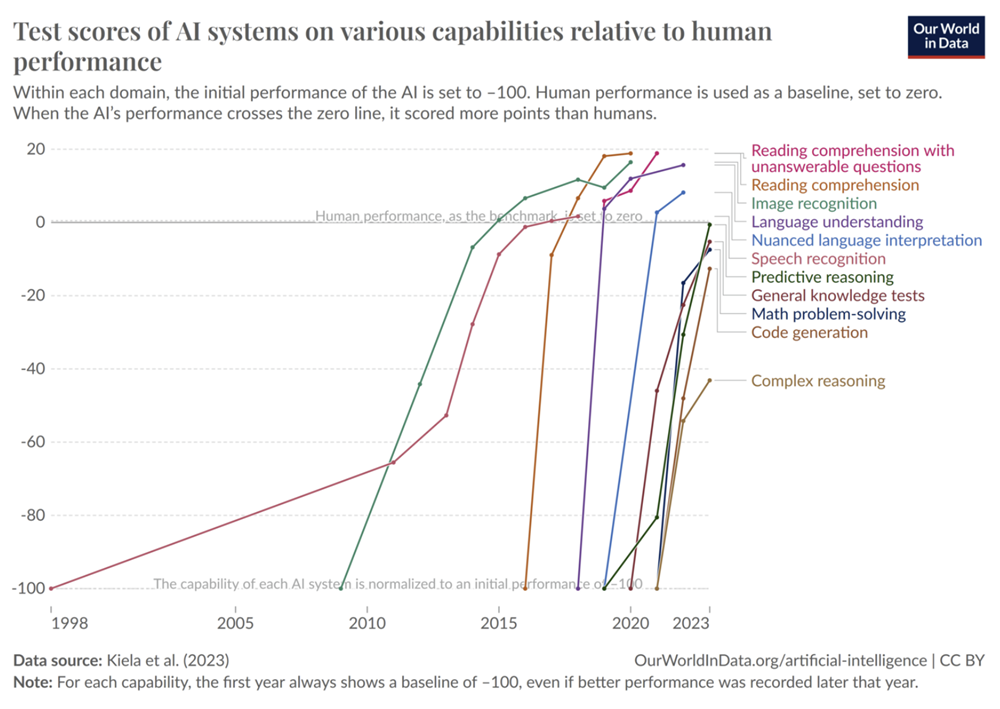
The paradox of our time is that genuine AI achievements have become the foundation for excessive hype. Executives at major companies regularly project improvements in model performance onto the idea of a “world intelligence,” making it easier to justify funding rounds, launch new investment funds, or announce high-profile collaborations. The result isn’t superintelligence – it’s super-expectations. And these inflated expectations are driving much of the noise in today’s market.
Read also: Network-Centric Warfare: How Warfare Is Evolving in the 21st Century
Why do we still believe in fairy tales?
The psychology of the crowd remains unchanged. FOMO – the fear of missing out – drives the market more than cool-headed analysis. In a post-Nokia world, where a giant fell under the pressure of the iPhone, every CEO wants to appear as a prophet: someone who sees further, acts faster, and changes the game. And if investors eagerly pour money into any company flashing the word “AI,” why not play along? Foreign funds stoke the hype, managers invite everyone to the “future,” and presentations take on a messianic tone. This is no longer just about technology – it’s become a new digital religion, centered on faith in algorithmic salvation.

In this gold rush, the narrative of superintelligence has become an investment wrapper: invest now or miss out. Buy today, because tomorrow might be too late. Although we’re talking about a hypothetical technology that doesn’t yet exist, stock markets behave as if it has already chosen its new gods. This marketing parade of absurdity turns hypotheses into stocks, hyperbole into products, and ideology into strategic plans.
If superintelligence ever does emerge, it will first and foremost be a legal and economic construct. Its landscape will be shaped by patents, IPOs, memorandums, and techno-ethical debates at Davos – not by firmware updates for your TV or new smartphone features. Its value will be measured not in lives saved, but in venture capital raised and pages of whitepapers published.
Instead of idolizing the term “superintelligence” as a digital Holy Grail, perhaps it’s time to come back down to earth. Look at how AI actually works today: recognizing speech, structuring texts, optimizing logistics, analyzing images. This is the real revolution – not superhuman, not magical, but concrete, technological, and practical. Not SAI, not AGI, but AI – intelligent, effective, and moderately useful.
Everything else, for now, is little more than a leap into investors’ coffers wrapped in futuristic rhetoric.
Read also:
- Strange Relationship Between Microsoft and OpenAI
- When AI Nudges Toward Death: The Illusion of a Safe ChatGPT
- ERNIE Bot: What’s Behind China’s AI Success

